
Bedding Packaging and Container Planning for Importers: Carton Size, Pack Configuration and Shipping Efficiency
For bedding importers, packaging is not a finishing detail. It affects retail presentation, carton quantity, warehouse handling, container utilisation, freight cost and the condition in which the product reaches the buyer.
Two bedding products with similar factory prices can produce different landed costs simply because one uses more packaging volume. Across thousands of units, that difference can materially affect margin.
Costita's current bedding range includes envelope fold packing, Homcot bags and PVC zipper bags with insert cards and stiffeners. Master carton configurations also change according to product size and set structure.
Why Packaging Should Be Decided Before the Purchase Order
A retail buyer may need bedding that can move directly from the import warehouse to a store shelf. An ecommerce seller may care more about compact packs and parcel dimensions. A distributor may prefer simpler packaging that reduces unnecessary cubic volume.
Retail Presentation
Packaging controls how the bedding appears to the end buyer and where product information, labels and barcodes are presented.
Shipping Density
Pack size affects sets per carton, carton CBM and how many sellable units can move within the available container space.
Warehouse Handling
Carton dimensions and weight affect storage, palletisation, picking and physical handling after the shipment arrives.
What Costita's Current Bedding Packaging Shows
Envelope Fold with Homcot Bag
Several cotton bedding collections use an envelope fold with a Homcot bag. Current product data includes master cartons around 112 × 50 × 80 cm and 120 × 60 × 90 cm depending on the range.
Homcot Bag for Larger Sets
Comforter and multi piece bedding sets need more physical volume, so their retail and master packing requirements differ from standard bedsheet sets.
PVC Zipper Bag
Selected bedsheet ranges use PVC zipper bags with insert cards and stiffeners. Current Queen and King configurations include cartons around 112 × 82 × 51 cm with 40 sets per carton.
Buyer Takeaway
A standard bedsheet set, Double set and comforter set should not be planned using one generic carton assumption. Packaging and loading calculations need to be completed at SKU level.
Carton CBM Is the Starting Point for Container Planning
Cubic volume allows buyers to compare how efficiently different products use shipping space. For master cartons measured in centimetres, the calculation is straightforward.
Carton CBM = Length × Width × Height ÷ 1,000,000
Use final packed carton dimensions rather than estimated sample dimensions when calculating freight.
At 40 sets per 0.468 CBM, the theoretical density is approximately 85 sets per CBM. If another product carries 60 sets in the same carton volume, the theoretical density rises to roughly 128 sets per CBM.
These figures are useful for comparison, but they are not final container capacities. Real loading depends on carton orientation, container dimensions, stacking and unusable spaces.
Do Not Treat Every Cubic Metre as Usable
A standard 20 foot general purpose container has an internal capacity of approximately 33.2 cubic metres in one Hapag Lloyd specification, with internal dimensions of roughly 5.9 m × 2.352 m × 2.395 m. Review the container specification.
That physical volume does not mean every cubic metre can be filled perfectly with bedding cartons. Door clearance, carton orientation, stacking strength and gaps between cartons affect the final load.

Pack Configuration Changes Freight Economics
A compact bedsheet set and a bulky comforter set may both belong to the bedding category, but they do not create the same logistics cost.
| Program | Typical Pack Character | Freight Effect |
|---|---|---|
| Standard bedsheet set | Compact folded product with relatively high sets per carton. | Usually better shipping density per sellable unit. |
| Premium bedding set | More structured retail presentation and additional packaging material. | Can increase cubic volume if presentation is not controlled. |
| Comforter set | Higher physical volume with additional components. | Lower units per CBM and potentially higher freight allocation per set. |
The Better Cost Comparison
Compare factory price, packaging cost and freight allocation per set. Factory price alone does not show the full commercial difference between two bedding programs.
Plan the Pack Before You Price the Shipment
A premium looking pack that consumes unnecessary container space can quietly reduce margin on every imported unit. Share the sales channel, pack requirement and expected order volume before finalising packaging.
Retail Packaging and Export Packaging Solve Different Problems
Retail packaging presents the product to the customer. The master carton protects multiple packs through transport and warehouse handling. Both should be approved together.
Retail Pack
The retail pack may carry size, fibre information, set contents, barcode, washing information, buyer labels and product presentation. Additional components improve presentation but can also add volume and weight.
Master Carton
The outer carton controls transport protection, sets per carton, gross weight, shipping marks and warehouse handling. It should remain efficient even when the retail pack becomes more structured.
Packaging Format Should Follow the Bedding Type
| Product Type | Packaging Priority | Shipping Concern |
|---|---|---|
| Standard bedsheet set | Compact presentation and easy identification. | Maximise practical sets per carton. |
| Premium cotton set | Balance presentation with product protection. | Avoid adding unnecessary retail pack volume. |
| Embroidered bedding | Protect the decorative finish. | Avoid abrasion and excessive compression. |
| Comforter set | Keep bulky components secure. | Container space becomes a major landed cost factor. |
| Multi piece set | Keep all components together and identifiable. | Verify every component before sealing the retail pack. |
| Ecommerce bedding | Compact, durable packaging. | Parcel dimensions and handling efficiency matter. |
Carton Weight Matters Alongside Carton Volume
Volume is only half the logistics calculation. A carton must remain practical to move, stack and handle throughout the supply chain.
Current Costita logistics specifications include master carton weights around 35 kg, 40 kg and 50 kg depending on product and pack configuration.
Sets per Carton
Higher quantities can improve density, but only while the carton remains structurally and operationally practical.
Carton CBM
Cubic volume shows how much container space is consumed by each carton.
Gross Weight
Cartons still need to be lifted, moved, stacked and stored without creating unnecessary handling problems.
Carton Strength Should Match the Route
Bedding cartons may move through the factory, origin warehouse, container, port, destination warehouse, distributor and retailer before the product reaches the end customer.
Carton strength should therefore reflect product weight, stacking requirements and expected handling conditions. When a new packaging format is introduced, a packing trial can help identify compression or handling problems before bulk production.
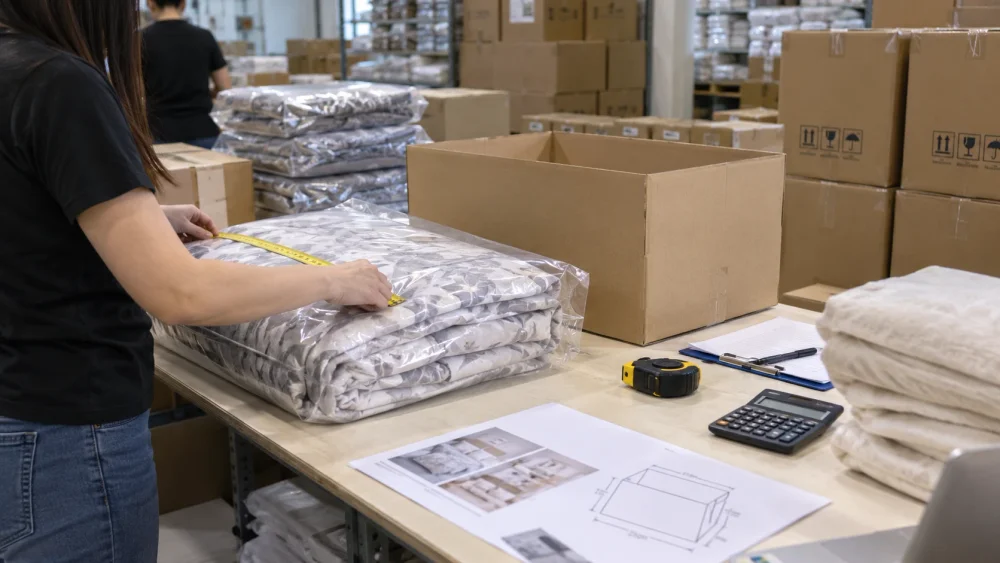
Mixed SKU Containers Need Better Planning
Many bedding buyers do not import one SKU per container. A single order may include Queen, King and Super King bedsheets, printed collections, premium sets and comforters.
Because each carton can have a different cubic footprint, buyers should calculate total CBM by SKU before confirming the final order mix.
| SKU | Carton Dimensions | Sets per Carton | Cartons | Total CBM |
|---|---|---|---|---|
| Queen Set | Final packed dimensions | Buyer confirmed | Order quantity ÷ sets per carton | Carton CBM × cartons |
| King Set | Final packed dimensions | Buyer confirmed | Order quantity ÷ sets per carton | Carton CBM × cartons |
| Comforter Set | Final packed dimensions | Buyer confirmed | Order quantity ÷ sets per carton | Carton CBM × cartons |
Why This Matters
Adding a bulky bedding line can reduce the number of compact bedsheet sets that fit into the same container. That is easier to optimise before production than after finished goods are already packed.
MOQ and Packaging Planning Should Be Connected
Costita's current bedding data includes different MOQ structures across product groups. Several cotton lines currently show overall MOQs around 1,000 sets, while other bedsheet collections list overall quantities around 4,000 to 5,000 sets.
Packaging materials also have their own economics. Multiple insert cards, colours or pack variants across small quantities can increase production complexity.
Container Capacity Should Be Verified, Not Copied
Estimated container quantities are useful during early planning, but buyers should confirm final capacity once packaging is fixed.
Final Carton Size
Use production packed dimensions rather than preliminary estimates.
Final Carton Weight
Confirm gross weight after the complete retail pack and carton contents are fixed.
Actual Loading Pattern
Verify how cartons fit physically inside the selected container before relying on a unit capacity estimate.
Packaging Efficiency Matters Even When Freight Rates Change
Freight rates move up and down, but pack density remains part of the product's logistics structure. A more efficient package requires less cubic space to move the same number of sellable units.
For LCL shipments, chargeable volume can directly affect freight. For FCL shipments, unused container space means the buyer is paying for capacity that produces no revenue.
Why India Works Well for Bedding Export Programs
India already operates at meaningful scale in international bed linen trade. In 2024, India exported approximately US$485.94 million of non printed cotton bed linen under HS 630231, representing about 46.4 million kilograms. View the trade data.
India also exported approximately US$107.44 million of printed cotton bed linen under HS 630221 in 2024. Review the printed bed linen data.
Established Textile Supply
India has sourcing capability across fabric, stitching, finishing and finished bedding production.
Export Preparation
Experienced suppliers work with cartons, shipping marks, documentation and international buyer requirements.
Repeat Programs
The ecosystem can support repeat bedding supply where product, packing and logistics specifications are clearly controlled.
What Importers Should Include in a Packaging RFQ
| Packaging Field | What the Buyer Should Define |
|---|---|
| Retail pack | Bag, fold, box or other agreed presentation format. |
| Insert card | Size, artwork and material requirement. |
| Stiffener | Confirm whether structural support is required. |
| Labels | Product information, position and applicable buyer requirements. |
| Barcode | Barcode format and placement. |
| Set contents | Exact components included in each retail pack. |
| Master carton | Carton construction, dimensions and sets per carton. |
| Carton weight | Target maximum gross weight. |
| Shipping marks | SKU, buyer reference, destination and carton numbering. |
| Container plan | Estimated cartons, SKU mix and loading requirement. |

White Label Packaging: What Costita Can Support
Costita's bedding offer is focused on white label supply rather than private label manufacturing.
Buyers should share retail presentation, barcode, label, insert card, carton marking and destination packing requirements before order confirmation so the requested format can be checked against the selected product and MOQ.
Commercial Point
Not every packaging request will suit every bedding line or order quantity. Packaging should be evaluated together with the selected SKU, MOQ, carton configuration and shipping plan.
Common Packaging Mistakes Importers Should Avoid
Choosing the Retail Pack Before Calculating Freight
A premium presentation can create unnecessary cubic volume. Approve the retail appearance together with its shipping impact.
Using One Carton Standard for Every Product
Standard bedsheets, embroidered sets and comforters have different volume and protection requirements. The carton should follow the product.
Ignoring Sets per Carton
Small improvements in pack density can become commercially meaningful when multiplied across thousands of units.
Treating Estimated Capacity as Guaranteed
Use final packed dimensions and a real loading plan before confirming how many units will fit into the container.
Frequently Asked Questions
How do I calculate CBM for bedding cartons?
Multiply the carton length, width and height in centimetres, then divide by 1,000,000. For example, a carton measuring 112 × 82 × 51 cm occupies approximately 0.468 CBM. Use final master carton dimensions rather than sample pack estimates when planning freight.
How many bedding sets fit in a 20 foot container?
There is no universal number. The result depends on retail pack dimensions, master carton size, sets per carton, carton orientation and the actual loading pattern. Costita recommends confirming capacity using a final carton level loading plan.
Which packaging is better for wholesale bedding?
The correct format depends on the sales channel. Distributors may prefer compact packaging, while retail buyers may require zipper bags, insert cards or more structured presentation. The strongest choice balances presentation, protection and shipping efficiency.
Should importers maximise the number of sets per carton?
Not automatically. Higher density can improve cubic efficiency, but carton weight, stacking strength and handling must remain practical. The goal is an efficient pack, not simply the highest possible quantity.
Does retail packaging affect landed cost?
Yes. Retail packaging changes material cost, pack weight, carton dimensions and container utilisation. Small increases in individual pack volume can become significant across a large order.
What packaging information should I request from a bedding supplier?
Request the retail pack specification, master carton dimensions, sets per carton, gross carton weight, shipping marks and estimated loading plan. For mixed SKU orders, collect the information separately for every SKU.
Does Costita offer custom private label bedding packaging?
Costita's bedding program is focused on white label supply rather than private label manufacturing. Packaging and export preparation should be discussed according to the selected product, order quantity and available packaging options.
Final Buyer Takeaway
Packaging is part of bedding procurement because it affects product protection, retail readiness, warehousing, freight and landed cost.
The most useful numbers are straightforward: retail pack size, master carton dimensions, sets per carton, gross carton weight, total CBM and the final container loading plan.
The Procurement Rule
The best packaging is not automatically the smallest pack or the most premium pack. It is the format that protects the bedding, fits the sales channel and moves the required number of units efficiently.
Plan the Carton Before You Book the Freight
Costita helps bedding buyers review product configuration, packaging requirements, quantities and export preparation before bulk orders are finalised.