Bhagwa Pomegranate Import Guide: Grade, Size, Colour, Shelf Life, Packaging, Season and Sourcing from India
Bhagwa pomegranates are sourced for supermarket retail, wholesale distribution, hospitality supply and private-label fruit programmes. However, descriptions such as “premium,” “export quality” or “A-grade” do not provide enough information for a reliable bulk purchase.
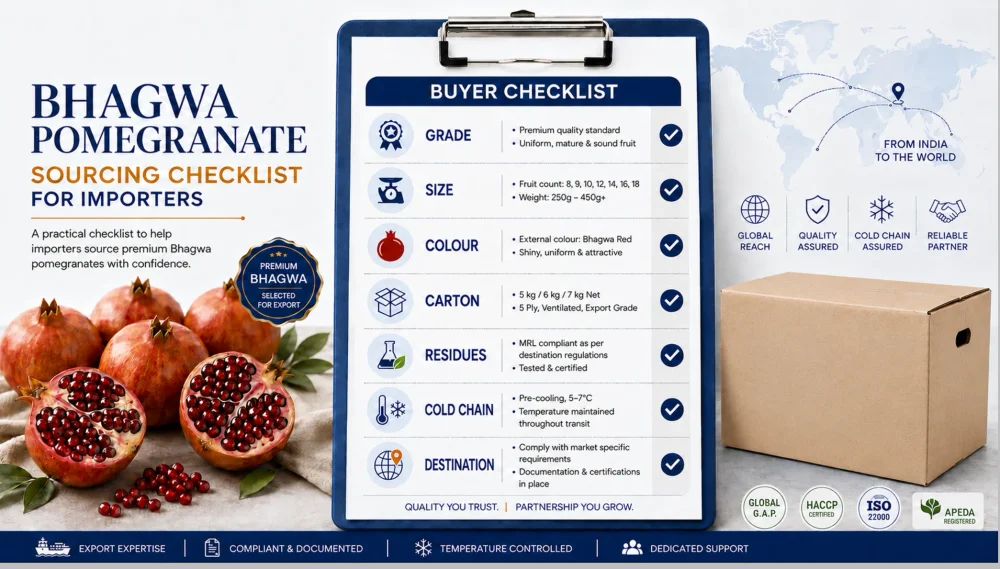
Importers should define the variety, commercial grade, individual fruit-weight range, colour tolerance, permitted defects, carton specification, residue-testing programme and required arrival condition before confirming an order. Buyers can review Costita’s Bhagwa pomegranate sourcing page and confirm the final specification through quotation.
What Should Buyers Confirm Before Importing Bhagwa Pomegranates?
Purchase Bhagwa pomegranates against a defined grade, individual weight range, colour reference, defect tolerance, carton format and destination compliance plan. Before shipment, confirm the supply lot, packhouse, residue controls, pre-cooling process, transport conditions and phytosanitary requirements.
Quick Navigation
Explore Fruits and VegetablesBuild the RFQ Around Measurable Product Specifications
The specification should allow the buyer, supplier, packhouse and inspection team to evaluate the same shipment against the same requirements. General descriptions should be converted into measurable weight ranges, defect limits, carton requirements and documented controls.
Reference photographs can support colour and external appearance requirements, but they should not replace written tolerances or a defined inspection process.
Use One Approved Specification
The same specification should control the quotation, sample approval, pre-shipment inspection and claims review.
| Specification Field | What the Buyer Should Define | Evidence or Verification |
|---|---|---|
| Variety and origin | Bhagwa, India, producing region and identified supply lot | Grower, exporter and packhouse records |
| Grade | Codex Extra, Class I, Class II or buyer-defined standard | Written defect and tolerance limits |
| Fruit size | Minimum and maximum individual weight in grams | Off-size percentage and carton count |
| Colour and rind | Approved red-colour range and permitted surface variation | Reference images and inspection sample |
| Internal quality | Agreed maturity, aril colour and eating-quality checks | Defined cut-fruit sampling method |
| Packaging | Net weight, fruit count, carton dimensions and ventilation | Approved carton and loading plan |
| Residue control | Destination-specific MRL programme and laboratory report | Sampling record and test scope |
| Cold chain | Pre-cooling, pulp temperature, transport setting and data logger | Temperature and loading records |
| Commercial terms | MOQ, preparation window, Incoterm and quotation validity | Final written quotation |
Extra, Class I and Class II Pomegranates
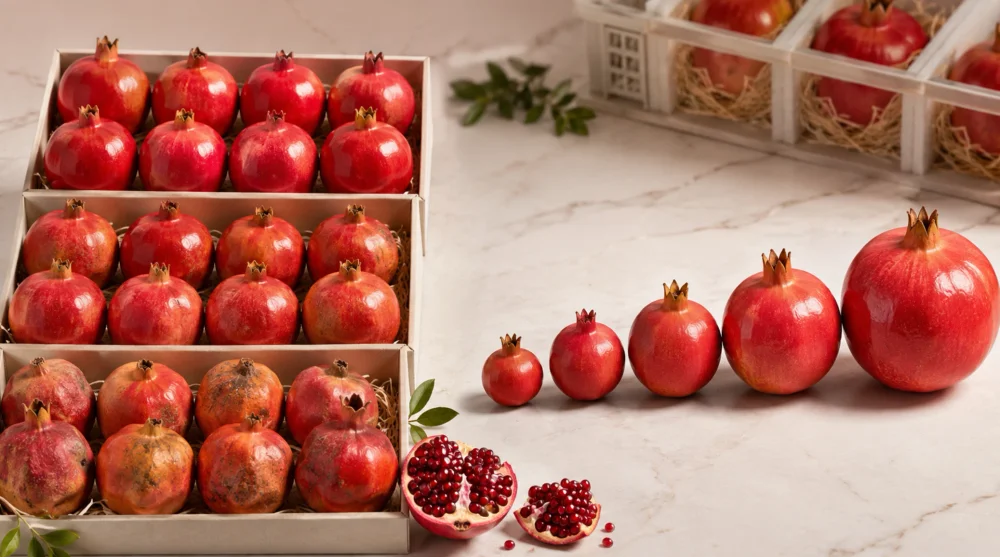
Codex recognises three commercial quality classes. Fruit in every class must be whole, sound, clean, sufficiently mature and capable of withstanding transport. The main difference is the level of external defects and presentation variation permitted.
Superior presentation
Permits only very slight superficial defects and is suited to highly visible retail presentation.
Suitable for premium supermarkets, gifting and tightly controlled fruit displays.
Balanced commercial choice
Allows slight defects that do not materially affect the arils, overall condition or keeping quality.
Suitable for supermarkets, import distribution and repeat wholesale programmes.
Wider visual tolerance
Meets minimum quality requirements while allowing more visible variation in shape, colour or rind.
Suitable for price-focused wholesale or approved processing programmes.
Codex Individual Weight Guide
State the actual individual fruit-weight range in every quotation and purchase order.
Costita’s live product page displays 150–200 g, 180–200 g and 200 g+ options. Because the first two ranges overlap, confirm the precise minimum weight, maximum weight and permitted off-size percentage in the quotation.
Colour, Maturity and Natural Crop Variation
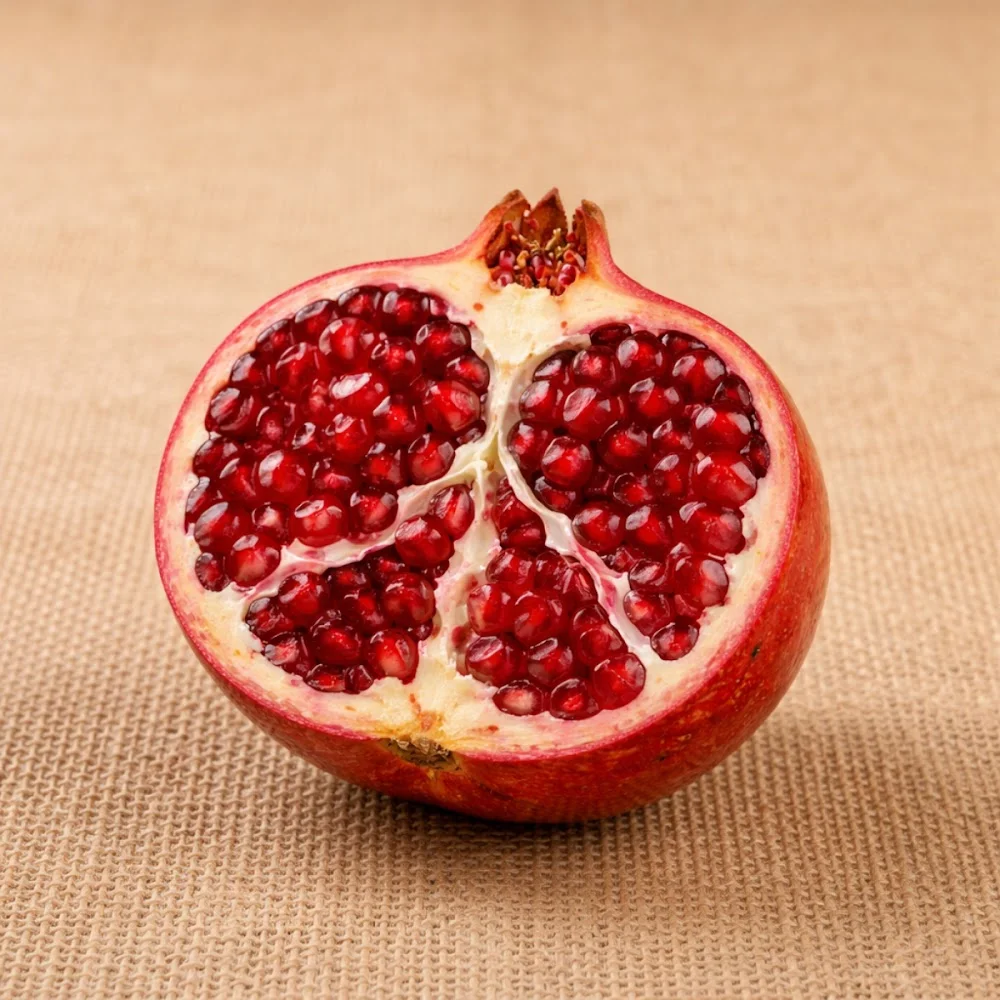
Bhagwa is commonly selected for its red presentation, but external redness alone does not prove maturity or internal condition. Colour can vary with sunlight, fruit position, growing region, weather and harvest timing.
Buyers should approve realistic colour references and distinguish acceptable natural variation from defects that affect appearance, saleability or shelf life. Internal maturity and aril quality should be inspected separately.
Acceptable Natural Variation
Approve a practical red-colour range.
Define permitted superficial differences.
Set tolerances appropriate to the grade.
Confirm acceptable dryness and damage.
Defects Requiring Clear Limits
Can increase decay and rejection risk.
May affect appearance and fruit condition.
Requires strict inspection tolerance.
Can reduce saleability at arrival.
Match the Product Specification to the Sales Channel
The highest visual grade is not automatically the strongest commercial choice. Buyers should compare the grade premium with the expected selling price, customer requirements, rejection risk and intended use.
Retail-Display Bhagwa Programme
Suitable for supermarkets, premium fruit retailers and private-label produce brands.
Extra or tightly controlled Class I
Narrow individual weight range
Strong colour and low visible-defect tolerance
Retail label, barcode and traceable lot
This requirement usually needs more selective grading and may reduce the quantity that qualifies from each crop lot. Confirm availability and quotation impact before planning retail promotions.
Wholesale and Food-Service Programme
Suitable for produce distributors, wholesale markets, hotels, restaurants and catering suppliers.
Class I or defined commercial grade
Practical range for the sales channel
Sound internal condition and arrival quality
Efficient count and repeatable carton format
This requirement can prioritise eating quality, saleable arrival condition and procurement value rather than requiring nearly identical external appearance across every fruit.
Plan Supply Around India’s Pomegranate Crop Cycles
APEDA identifies three indicative production cycles. These periods support procurement across several parts of the year, but they do not guarantee the same grade, colour, fruit size, volume or price in every harvest.
Ambe Bahar
Early-year flowering cycle
Mrig Bahar
Mid-year flowering cycle
Hasta Bahar
Late-year flowering cycle
Work Backwards from the Required Arrival Date
Allow time for crop allocation, sorting yield, residue testing, packhouse scheduling, carton preparation, phytosanitary procedures, treatment requirements and freight booking.
Shelf Life Depends on the Complete Cold Chain
Bhagwa pomegranates may have useful storage potential, but variety alone does not determine the condition at arrival. Harvest maturity, fruit condition, cooling speed, humidity, packaging, transport airflow and temperature stability all influence moisture loss, shrivelling, decay and saleable life.
APEDA provides a general storage reference of approximately 5°C and 90–95% relative humidity for up to two months. This should be treated as technical guidance, not a guaranteed commercial shelf life for every crop, route or shipment.
General APEDA reference for controlled storage.
Humidity management helps limit moisture loss.
Actual saleable life remains shipment-specific.
Control Quality from Harvest to Arrival
Each stage should produce records that can be reviewed during inspection, document approval and any later claims assessment.
Harvest Condition
Confirm maturity, harvest date and initial fruit condition.
Packhouse Handling
Record receiving, grading, packing and lot identification.
Pre-Cooling
Confirm cooling time and fruit pulp temperature before loading.
Controlled Transit
Approve temperature, ventilation, airflow and logger placement.
Arrival Inspection
Define inspection timing, sample size and acceptance criteria.
Documents Buyers Should Request
Packaging Must Match the Fruit Size and Shipment Route
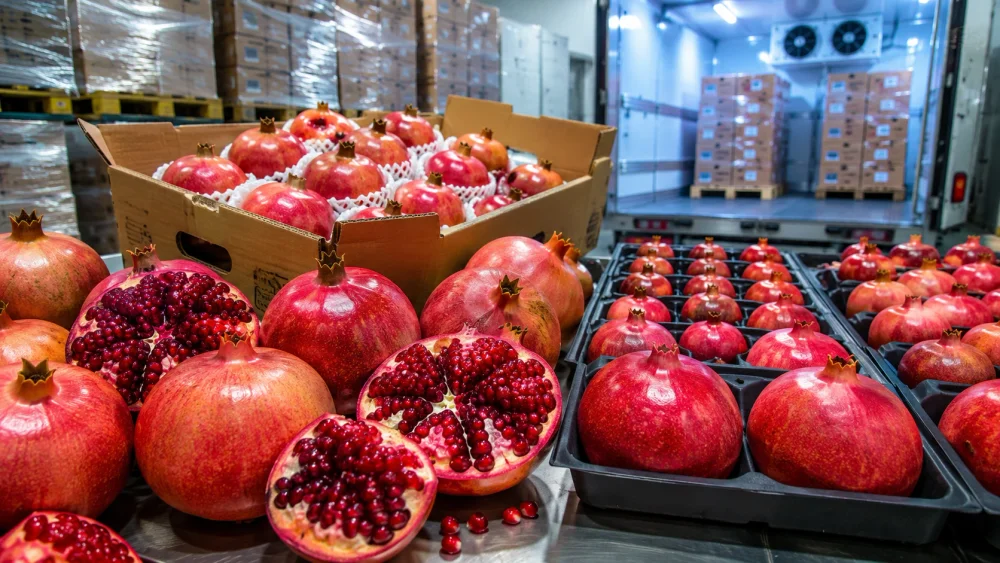
Export packaging should protect the fruit, support ventilation, resist stacking pressure and preserve the agreed presentation during handling and transit. Carton design should be approved together with the fruit weight, count, internal protection and loading method.
Costita’s live Bhagwa pomegranate page lists a five-ply corrugated carton, 2 kg net weight and nine to ten fruits. These are supplier-provided specifications and should be confirmed for the selected fruit-weight range.
Current Listed Carton
Confirm all specifications through the final quotation and approved packing sample.
Nine to ten fruits in a 2 kg carton indicate an average fruit weight of approximately 200–222 g before tolerances. The count may need to change for other fruit-weight ranges.
Approve the Complete Carton Specification
Dimensions
Record internal and external carton dimensions.
Board Strength
Confirm board grade, flute and compression requirement.
Ventilation
Match ventilation openings to the cold-chain plan.
Internal Protection
Approve trays, sleeves, paper, dividers or liners.
Loading Method
Confirm pallet or floor loading and maximum stack height.
Required Marks
Include variety, grade, size, origin, lot and net weight.
Private Labelling and Custom Packaging
Custom cartons, stickers and retail labels may be possible depending on order quantity, artwork, language, barcode requirements and preparation time.
Confirm the printing MOQ, artwork approval process, additional cost and production schedule through quotation.
Freight Planning Requires Verified Carton Data
Do not approve container loading from a carton-count claim alone. The freight plan needs verified dimensions, gross weight, stacking strength, airflow clearance, palletisation and reefer payload limits.
Container loading varies by carton specification, loading method, carrier and destination.
Confirm MOQ, Price and Preparation Time Through Quotation
Fresh-fruit commercial terms change with the crop, grade, individual fruit weight, carton format, residue-testing requirement, destination protocol and freight schedule. Website information should be used as an enquiry reference rather than a permanent commercial commitment.
Displayed Total MOQ
Confirm the commercial minimum for the required grade, size and carton.
MOQ per Variation
MOQ by weight range, grade or packaging option is not clearly published.
Final Unit Price
Confirm price unit, packing inclusion, Incoterm, validity and taxes.
Preparation Window
Allow for crop allocation, testing, inspection, packing and freight booking.
The final written quotation should control the variety, grade, fruit-weight range, packaging, order quantity, Incoterm, inspection scope, payment terms and shipment schedule.
Why Buyers Source Bhagwa Pomegranates from India
India combines established pomegranate-growing regions, multiple crop windows, specialist packhouse infrastructure, residue-testing systems and experience serving regional and long-distance markets.
These advantages support international procurement, but buyers must still verify the specific orchard, crop lot, exporter, packhouse, grade availability and destination pathway used for their order.
India’s pomegranate exports in FY 2023–24.
Official value reported for FY 2023–24.
Gulf, South Asian, European and U.S. destinations are represented.
For April 2024 to January 2025, the official source reported USD 59.76 million in export value and 21% growth. This is a partial-period indicator and should not be compared as a complete financial-year total.
View Official ReleaseRelevant Indian Capabilities
Established production regions
Maharashtra, Karnataka, Gujarat and Andhra Pradesh are identified among major producing states.
Multiple crop windows
Ambe, Mrig and Hasta cycles support sourcing during several periods.
Packhouse and traceability systems
Recognised facilities and APEDA systems support lot-level controls.
Packaging and label flexibility
Sorting, carton and marking options may be adapted to buyer requirements.
Limitations Buyers Must Manage
Seasonal variation
Size, colour and volume vary between crop periods.
Residue risk
Destination MRL compliance requires a documented programme.
Packhouse availability
Approved facilities may have scheduling constraints.
Market-access changes
Import permits, treatments and declarations can change.
Cold-chain disruption
Delays and temperature instability can affect arrival condition.
Online listing differences
The available crop may differ from displayed size or lead-time information.
Classification Note
Fresh pomegranates are commonly reported under Indian ITC-HS 08109010. The international six-digit heading is broader and can include other fresh fruits. Confirm the current destination tariff code and nomenclature version with the importer or customs broker before filing.
Confirm Destination-Market Requirements Before Packing
Import conditions differ by destination, origin, treatment pathway, intended use and arrival port. Requirements should be checked before orchard allocation and packaging approval, not after the fruit has been packed.
Final admissibility, tariff classification, documentation and compliance should be confirmed with the importer, customs broker and relevant authority.
| Destination | Principal Checks | Procurement Implication | Official Reference |
|---|---|---|---|
| UAE | Phytosanitary certificate, commercial documents, origin evidence, entry inspection and applicable residue documentation | Confirm the importer’s release process and current residue requirements before packing. | UAE MOCCAE |
| Saudi Arabia | Registered importer, phytosanitary certificate, SFDA food-clearance documentation and customs procedures | Align the document set and clearance responsibility before freight booking. | Saudi SFDA |
| European Union | Phytosanitary certification, EU pesticide MRLs, traceability, packhouse controls and official checks | Use a documented farm, laboratory and packhouse control programme. | European Commission |
| United Kingdom | Current plant-health status, phytosanitary requirements, pesticide limits and importer procedures | Check current Great Britain requirements separately from EU rules. | GOV.UK |
| United States | Commodity admissibility, permit, treatment, facility, packaging and port conditions in APHIS ACIR | Do not ship until the exact India-to-U.S. pathway is confirmed. | USDA APHIS |
| Australia | BICON import permit, approved pathway, phytosanitary certification, treatment and secure packing conditions | Prepare against the current BICON case, not an earlier shipment example. | Australian BICON |
| Other Markets | Country-specific permit, phytosanitary, residue, treatment, labelling and customs requirements | Validate each destination independently with the importer and authority. | Relevant national authority |
Gulf Markets
Confirm importer registration, phytosanitary documents, residue requirements and clearance responsibility before dispatch.
EU and United Kingdom
Use destination-specific plant-health, pesticide, traceability and importer requirements. Do not assume that EU and UK rules are identical.
United States and Australia
Both markets use pathway-specific conditions that can include permits, treatment, approved facilities and prescribed packaging controls.
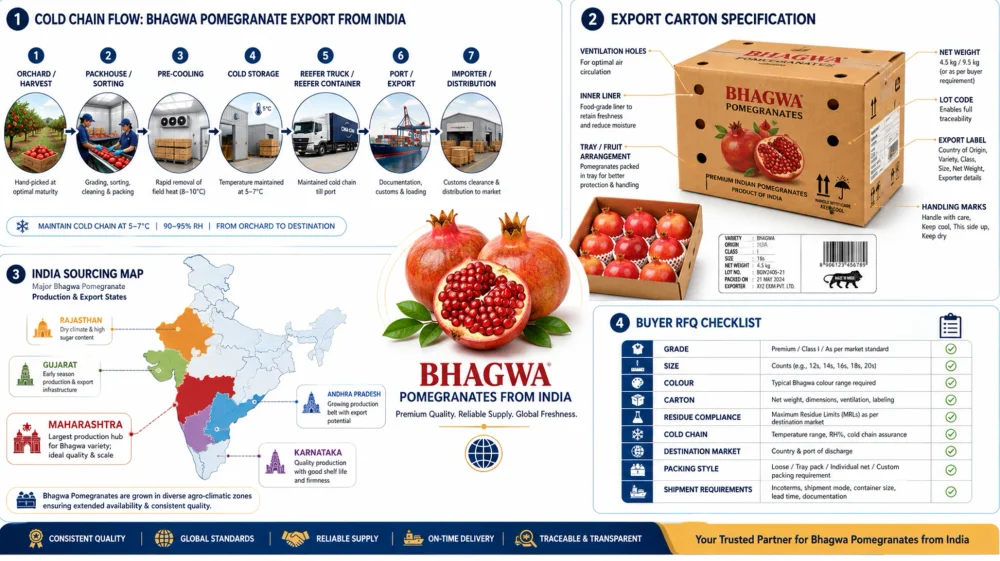
Buyer Checklist Before Confirming a Bhagwa Pomegranate Order
Complete these checks before approving the crop lot, packaging or shipment. The same requirements should appear in the quotation, purchase order, inspection instruction and claims procedure.
Product and Quality
Compliance and Shipment
Do not approve loading until product specifications, inspection criteria, compliance documents and commercial responsibilities are recorded in writing.
How Costita Supports Bhagwa Pomegranate Sourcing
Costita’s sourcing process is designed to align the buyer, supplier, inspection team and logistics partners around one approved requirement. For fresh produce, the process should cover the crop lot, exporter, packhouse, residue programme, packaging and destination pathway.
These controls can reduce sourcing uncertainty, but they do not replace importer due diligence, regulatory approval or shipment-specific contractual terms.
Review the Requirement
Confirm the destination, sales channel, grade, fruit size, carton and arrival expectations.
Verify the Supply
Check crop availability, supplier information, packhouse arrangements and required documentation.
Inspect Before Shipment
Review grade, weight, appearance, packaging, markings and relevant shipment records.
Coordinate Dispatch
Align freight, export documents, temperature controls and destination responsibilities.
Inspection, cargo-insurance support, remedies and delivery terms remain subject to the final quotation, policy conditions, shipment records and circumstances of the issue. No sourcing process can remove every agricultural, regulatory or logistics risk.
Frequently Asked Questions
These answers address the main commercial questions buyers raise when comparing Bhagwa pomegranate suppliers, specifications and import routes.
Which Bhagwa pomegranate grade is suitable for supermarket imports? +
Extra or tightly specified Class I fruit is generally more suitable for visually demanding retail programmes. The decision should reflect permitted rind defects, colour coverage, fruit weight, target selling price and rejection risk. Costita recommends measurable acceptance limits instead of ordering only “A-grade.”
What fruit size should an importer request? +
State an actual individual fruit-weight range in grams. Terms such as medium, large or letter codes may be interpreted differently. The quotation should also define the permitted off-size percentage and expected fruit count in each carton.
What is the shelf life of Bhagwa pomegranates? +
APEDA provides a technical storage reference of up to two months at approximately 5°C and 90–95% relative humidity. Actual saleable life varies with maturity, initial condition, pre-cooling, packaging, temperature stability, transit time and handling after arrival.
When is Bhagwa pomegranate available from India? +
India’s Ambe, Mrig and Hasta crop cycles create several indicative harvest periods. Availability of a particular grade, weight, colour and quantity remains crop-dependent. Buyers should plan from the required arrival month and confirm the selected supply lot.
What is Costita’s MOQ for Bhagwa pomegranates? +
Costita’s live product page displays a total MOQ of 16,000 pieces. MOQ by grade, weight range or packaging option is not clearly published. Confirm the available crop, final commercial minimum and quotation validity before planning the shipment.
Can Costita arrange private-label pomegranate cartons? +
Custom cartons or stickers may be possible depending on quantity, artwork, printing setup, language and preparation time. Confirm the printing MOQ, additional cost, barcode requirements and artwork approval schedule through the final quotation.
Which documents are usually required for a pomegranate shipment? +
Common documents can include the commercial invoice, packing list, transport document, certificate of origin and phytosanitary certificate. Depending on the destination, buyers may also require an import permit, residue report, treatment certificate, preclearance record or additional declaration.
Request a Bhagwa Pomegranate Quotation
Send the destination country, required arrival month, grade, individual fruit-weight range, colour expectation, carton requirement, quantity, residue-testing needs, private-label details and preferred Incoterm.
This guide separates Costita’s public website information from official agricultural, trade and regulatory research. Product-page specifications are treated as quotation-dependent commercial information. Final product classification, admissibility and compliance should be confirmed with the importer, customs broker and relevant authority.