blog test
Bulk areca palm leaf plates are bought as food-contact products, not as decorative disposable items. Restaurants, catering groups and distributors must compare the material source, mould accuracy, food performance, defect limits, export packing, destination rules and landed cost before approving a supplier.
This guide is written for importers, hospitality procurement teams, wholesale distributors and private-label brands sourcing from India. It explains how to qualify the market, define the product, approve samples, control production and plan freight without relying on vague claims such as natural, green or export quality.
Start with market access, not plate size
The commercial case for alternative tableware is strengthening in several markets, but plastic-reduction policy and food-contact approval are separate questions. Dubai’s final restriction phase for specified single-use plastic items took effect on 1 January 2026 and includes plastic plates, cups, lids, cutlery and tableware.
That policy creates a sourcing opportunity, but it does not automatically approve every plant-based product. The importer still needs to confirm the exact material, testing requirements, labelling, product registration and local conformity route with the destination authority.
United Arab Emirates
Hospitality demand is supported by Dubai’s 2026 single-use plastic restrictions. Buyers should still obtain material declarations, test evidence, batch details and a local importer review before shipment.
Verify current requirements through Dubai Municipality’s official guidance.
United Kingdom
Plant-based construction does not remove food-contact responsibility. The buyer must assess natural contaminants, migration, traceability, intended food conditions and the evidence behind environmental claims.
Review the Food Standards Agency research before setting a compliance specification.
United States
FDA states that dinnerware made from the sheath of Areca catechu leaves may not lawfully be offered for sale without an applicable premarket authorisation.
Read the FDA letter to importers and distributors.
Know exactly what is being purchased
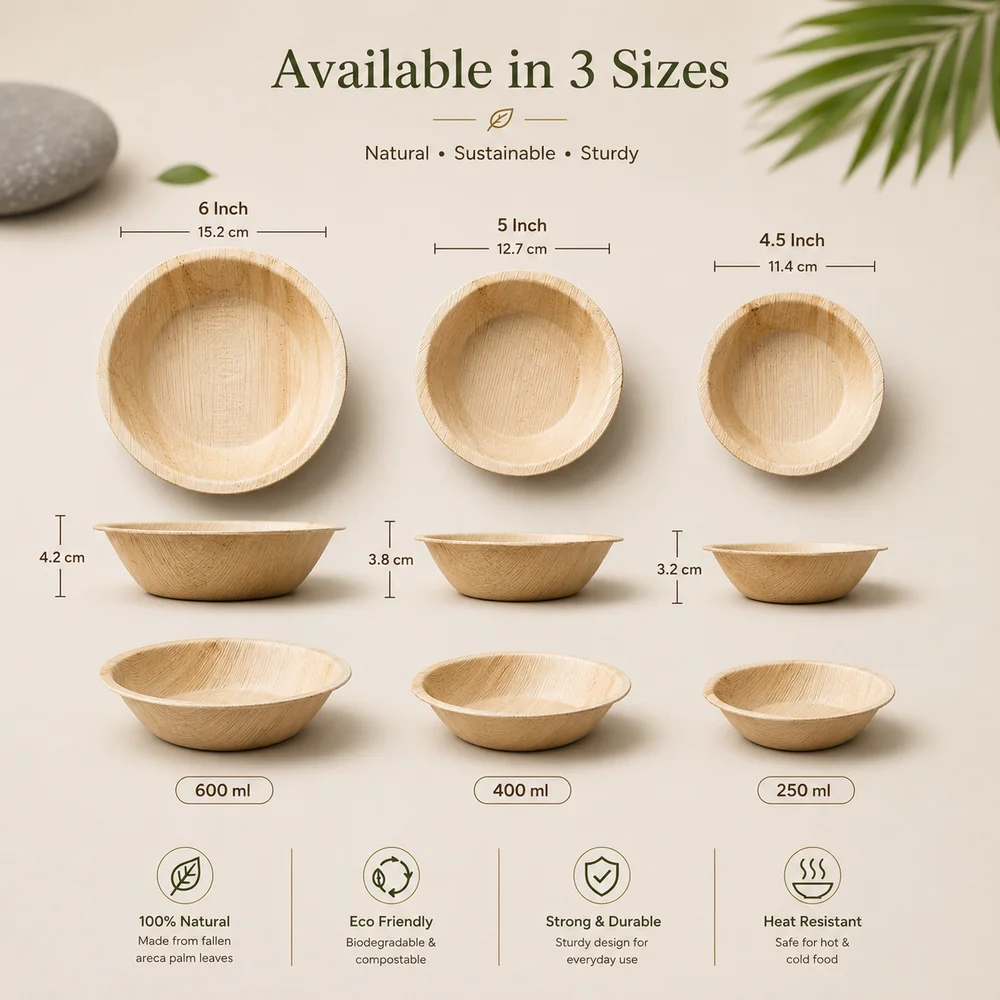
Areca tableware is normally formed from the dry sheath attached to the leaf of the Areca catechu palm. The commercial product may be round, square, rectangular, compartmented, shallow or deep, but shape alone does not define performance.
A buyer needs to know whether the factory adds coatings, binders, inks, surface treatments or adhesives. “No chemicals” should only appear in a purchase order or product claim when the supplier has declared the full construction and the evidence supports that statement.
Technical identity panel
Minimum facts required before sampling
Why buyers build areca programmes in India
India combines a large arecanut-growing base with established micro, small and export-oriented tableware manufacturing. Official second advance estimates for 2025–26 place the national arecanut area at about 1.106 million hectares and production at about 1.529 million tonnes.
The area estimate is about 6.3% above 2024–25, while estimated production is about 2.5% higher. Karnataka accounts for roughly 74% of the 2025–26 production estimate, making supplier location, sheath procurement distance and seasonal storage controls commercially important.
These crop figures indicate the depth of the agricultural ecosystem. They do not measure finished plate output, export volume or compliant manufacturing capacity. A buyer must still qualify the individual factory.
Second advance estimate from the Directorate of Arecanut and Spices Development.
National arecanut production estimate, not finished plate production.
Calculated from the official state and national production estimates.
India’s arecanut area expanded while production recovered from the 2022–23 decline
Indexed to 2021–22 = 100. Actual area and production figures are shown below each series.
0.849M ha
1.666M t
0.938M ha
1.369M t
0.949M ha
1.411M t
1.040M ha
1.491M t
1.106M ha
1.529M t
Top sourcing-state signal
State production share does not prove finished-goods capacity. It helps buyers investigate raw-material proximity and seasonal supply exposure.
Source: Directorate of Arecanut and Spices Development, May 2026.
How export-grade plates move from sheath to carton
Government manufacturing references describe the raw material as fallen dry sheaths collected from arecanut farms. Commercial factories then sort, clean, condition, press and trim the material before packing.
The exact controls matter more than the general process description. A supplier should be able to show how incoming material is rejected, how moisture is managed, how moulds are cleaned and how each production lot is identified.
Sheath collection
Naturally shed material is collected, kept away from soil contamination and moved to the processing unit.
Incoming sorting
Wet, damaged, mould-affected, insect-damaged or heavily stained sheaths are removed before production.
Cleaning
Surface soil and debris are removed using a controlled washing method and defined water-quality standard.
Moisture conditioning
Material is dried or conditioned to a repeatable range before pressing, reducing warpage and storage risk.
Heat forming
The sheath is placed between shaped moulds and formed using controlled temperature, pressure and cycle time.
Finishing and packing
Edges are trimmed, units are inspected, counted, sealed in inner packs and loaded into identified export cartons.
Process reference: Ministry of Micro, Small and Medium Enterprises project profile.
Source the right market, not just the right plate
Send your destination, required sizes, monthly volume and packing format. Costita will structure a product shortlist, sample route and export quotation around your buying conditions.