Areca Palm Leaf Plates vs Bagasse Plates: Which Is Better for Restaurants?
Restaurants are changing how they buy disposable tableware. Earlier, the decision was simple: choose the cheapest plate that could hold food. Today, restaurant owners, caterers, event companies and packaging distributors are looking at material, food performance, sustainability claims, customer presentation, regulatory pressure, price, storage, packing and bulk availability.
That is why two materials are becoming important in foodservice procurement: areca palm leaf tableware and bagasse tableware. Both are positioned as eco-friendly alternatives to traditional plastic disposables. Both are used by restaurants, caterers, events and food packaging distributors. But they are not the same product. They solve different problems.
Areca palm leaf plates are usually stronger for premium presentation, catering, dine-in events and natural table service. Bagasse plates and containers are usually stronger for high-volume takeaway, delivery, standard food packaging and cost-sensitive operations. For importers and restaurant suppliers, the better question is not “which one is better?” The better question is where each material should be used and how both can work together in a profitable foodservice catalogue.
Areca is stronger for presentation. Bagasse is stronger for volume.
If a restaurant wants a premium natural plate for dine-in, catering, buffet service or events, areca palm leaf plates are usually the stronger choice. If a restaurant wants a cost-efficient container for takeaway, delivery, packing, stacking and high-volume service, bagasse is usually the stronger choice.
If an importer wants to build a serious eco-friendly disposables portfolio, the strongest model is often areca plus bagasse, not one against the other. Areca helps the buyer upgrade presentation. Bagasse helps the buyer manage volume. Together, they help distributors serve more restaurant use cases.
Why Restaurants Are Comparing Areca and Bagasse
The demand for non-plastic foodservice tableware is no longer driven only by sustainability messaging. Single-use plastic restrictions, customer expectations and brand reputation are pushing foodservice buyers to review what they use in dine-in service, takeaway, delivery, catering and events.
In England, official single-use plastic guidance restricts several plastic items, including plates, bowls and trays in certain use cases. It also treats biodegradable, compostable and recycled plastic as plastic when an item is wholly or partly made from plastic, including plastic coating or lining. This is why restaurants and distributors need material clarity before they make bulk sourcing decisions.
They still need disposable plates, bowls and containers. But they now need materials that are easier to explain, easier to position and more suitable for modern foodservice expectations. That is where areca and bagasse enter the conversation.
Restaurant Buyer Decision Map
The real comparison is not material alone. It is service style, visibility, packing and repeat order volume.
Areca vs Bagasse Decision
Premium Catering
Takeaway Volume
Buffet Service
QSR
Foodservice Distributors
Cloud Kitchens
Eco Retail Packs
Events
Buyer-Level Comparison
Areca vs Bagasse: Which Material Fits Which Restaurant Need?
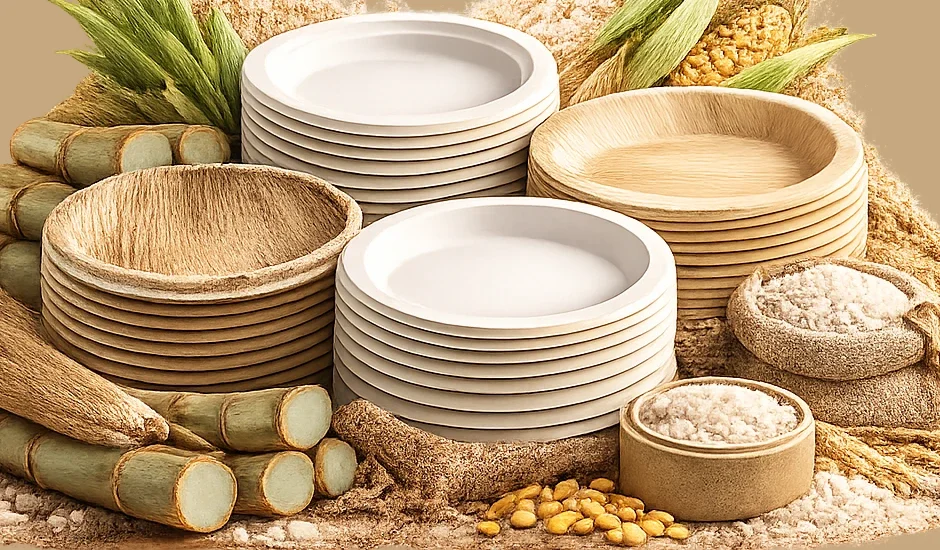
Areca palm leaf plates are made from naturally fallen palm leaf sheaths that are cleaned, heat-pressed and shaped into plates, bowls and trays. Their strongest value is customer-facing presentation, natural texture and premium table appeal.
Bagasse tableware is made from sugarcane fibre left after juice extraction. Its strongest value is operational utility, moulded shape consistency, stacking efficiency and high-volume food packaging use.
A restaurant buyer should not evaluate both materials only through sustainability claims. The better evaluation is based on service style, food format, storage needs, carton planning, customer visibility and bulk procurement economics.
| Feature | Areca Palm Leaf Plates | Bagasse Plates & Containers |
|---|---|---|
| Material Source | Naturally fallen palm leaf sheaths that are cleaned, dried and pressed into shape. | Sugarcane fibre left after juice extraction and moulded into foodservice formats. |
| Best Use Case | Premium plating, catering, buffet service, weddings, events and visible dine-in service. | Takeaway, delivery, meal bowls, containers, standard plates and high-volume operations. |
| Presentation | Natural wood-grain look with a premium, organic and differentiated table feel. | Clean, plain, functional and uniform for operational food packaging. |
| Strength | Strong rigidity for hot, heavy and oily food when the pressing quality is consistent. | Good rigidity in moulded plates, bowls and containers, especially for standardised use. |
| Importer Advantage | Higher perceived value and better differentiation. | Higher volume potential and wider operational use. |
When Areca Works Better
Restaurants Should Choose Areca When the Tableware Is Visible to the Customer
Areca palm leaf plates are best when the plate becomes part of the dining experience. This is why areca performs strongly in weddings, outdoor catering, buffet service, resort dining, food festivals, eco-conscious restaurants and customer-facing hospitality events.
The natural texture gives every plate a premium look, which helps restaurants and caterers move away from the cheap-disposable impression. For suppliers, this creates a stronger selling story because areca is not only an eco-friendly plate; it is a serving upgrade.
Areca is especially useful when food is served directly to the customer and presentation matters as much as convenience. It helps buyers create a natural, plastic-free and premium table setting without moving to reusable tableware.
Areca Buying Signals
- 1 A restaurant should choose areca when it wants a premium natural tableware look for dine-in service, catering, buffet counters, weddings and outdoor events.
- 2 A caterer should choose areca when the plate must hold hot, oily or heavy food while still looking better than ordinary disposable plates.
- 3 A distributor should choose areca when it wants a higher-value SKU that can be positioned around presentation, natural texture and customer-facing service.
- 4 An importer should choose areca when it wants a differentiated product range that can support stronger margin positioning than commodity disposables.
When Bagasse Works Better
Restaurants Should Choose Bagasse When Volume, Packing and Consistency Matter More
Bagasse is often the better choice when the restaurant needs volume, packing efficiency and consistent foodservice utility. A cloud kitchen sending hundreds of meals per day may not need natural texture on every plate. It may need stackable bowls, takeaway boxes, containers with lids and predictable carton packing.
Bagasse works well because it can be moulded into consistent shapes for plate, bowl, clamshell and container systems. This makes it useful for delivery-focused restaurants, QSR chains, canteens, cloud kitchens, takeaway counters and foodservice distributors that manage repeat bulk orders.
For importers, bagasse is a strong volume product. It may not always create the same premium visual appeal as areca, but it can move faster across takeaway, delivery, meal packing and operational food packaging channels.
Bagasse Buying Signals
- 1 A restaurant should choose bagasse when it needs high-volume takeaway packaging, meal bowls, container systems and delivery-friendly food formats.
- 2 A cloud kitchen should choose bagasse when stackability, storage efficiency, portion control and repeat carton planning matter more than natural presentation.
- 3 A QSR or canteen buyer should choose bagasse when it needs uniform shapes, consistent packing and cost-efficient eco-friendly disposables.
- 4 A distributor should choose bagasse when it wants a scalable food packaging range that can serve takeaway, delivery and high-frequency restaurant demand.
Use-Case Comparison
The Real Difference Is Presentation vs Volume
The biggest difference between areca and bagasse is not only material. It is buyer psychology. Areca sells through presentation. Bagasse sells through utility. A wedding caterer may choose areca because it looks natural and premium on the buffet table. A takeaway restaurant may choose bagasse because it needs stackable containers that can handle daily order volume.
This difference matters for importers. If you sell areca only as “eco-friendly,” you reduce its value. Areca should be positioned as a premium serving upgrade. If you sell bagasse only as “cheap,” you reduce its value. Bagasse should be positioned as a practical, scalable food packaging solution.
| Foodservice Use Case | Better Option | Reason |
|---|---|---|
| Premium restaurant plating | Areca | The plate is visible and the natural finish improves table appeal. |
| Wedding catering | Areca | Presentation matters because the serving format is customer-facing. |
| Takeaway meals | Bagasse | Containers, lids and bowls need stacking and operational consistency. |
| Cloud kitchens | Bagasse | Daily dispatch, warehouse storage and carton planning are critical. |
| Corporate catering | Areca + Bagasse | Serving and packed-meal formats may both be required. |
| Foodservice distribution | Areca + Bagasse | A mixed catalogue gives distributors wider customer coverage. |
Which Material Is Easier for Importers to Plan?
From an import planning perspective, bagasse usually has an advantage in standardization and packing density because moulded products are more uniform. This helps with stacking, carton planning, warehouse storage and container optimization for high-volume distributors.
Areca products can also be nested and packed efficiently, but natural material variation must be managed more carefully. Since every palm sheath has its own texture and structure, importers should pay closer attention to finish, thickness, edge trimming, shape consistency, moisture control and carton strength.
This does not make areca weaker as an import product. It means areca should be sourced with stronger quality control, while bagasse should be checked for lid fit, rim strength, coating or lining status, stacking stability and food-contact documentation.
Importer Portfolio Strategy
The Strongest Model Is a Mixed Areca and Bagasse Portfolio
For restaurant suppliers and eco-packaging wholesalers, the strongest opportunity is not choosing one material and ignoring the other. The stronger model is a mixed portfolio that uses areca for premium customer-facing service and bagasse for operational food packaging volume.
Areca palm leaf plates can serve premium restaurants, wedding caterers, buffet companies, hospitality buyers and eco retail packs. Bagasse plates, bowls and containers can serve takeaway operators, QSR chains, cloud kitchens, canteens and delivery-focused food businesses.
This makes the importer more useful to restaurant buyers. Instead of selling one product, the importer can solve multiple foodservice needs through one sustainable tableware category architecture.
Mixed Catalogue Map
A stronger distributor catalogue connects presentation-led demand with volume-led demand.
Eco-Friendly Disposables Portfolio
Areca Round Plates
Areca Square Plates
Areca Bowls
Compartment Plates
Bagasse Bowls
Takeaway Containers
Bagasse Plates
Eco Cutlery
Kraft Accessories
Restaurant Decision Framework
How Restaurants Should Decide Between Areca and Bagasse
Restaurants should choose based on food format, service style and buyer expectation. If the product is used in front of customers, areca usually creates stronger value. If the product is used for takeaway, delivery and packing, bagasse usually creates stronger operational efficiency.
A premium restaurant may use areca plates for outdoor events and bagasse bowls for takeaway portions. A catering company may use areca compartment plates for buffet service and bagasse containers for packed meals. A distributor may sell areca to event suppliers and bagasse to takeaway operators.
The right decision is not emotional. It is operational. The buyer should map where the customer sees the tableware, how the food is handled, how the product is packed, and how frequently the SKU must be reordered.
How Costita Supports Bulk Sourcing
From Material Comparison to Export-Ready Procurement
Costita helps global buyers source eco-friendly disposables from India with better procurement clarity. For areca and bagasse tableware, this means support across product shortlisting, material comparison, sample planning, MOQ discussion, supplier coordination and export packing review.
This is especially useful for importers, restaurant suppliers and distributors that want to build a mixed product range instead of testing one SKU without a category plan. The right sourcing process reduces confusion before sample ordering and makes bulk procurement easier to scale.
Costita can help buyers compare areca palm leaf plates, bagasse plates, bagasse bowls and takeaway containers, and complementary foodservice accessories so the final order matches the buyer’s market, service style and commercial target.
Final Verdict
Areca Builds Perceived Value. Bagasse Builds Volume.
Areca palm leaf plates are better when the restaurant needs premium presentation, stronger natural appeal and customer-facing tableware. Bagasse plates and containers are better when the restaurant needs high-volume takeaway packaging, delivery containers, stacking efficiency and cost control.
For importers, the best answer is often both. Areca helps suppliers win premium catering, hospitality and event demand. Bagasse helps suppliers serve volume-driven takeaway, delivery and QSR demand. Together, they create a stronger eco-friendly disposables portfolio for restaurants, caterers, wholesalers and foodservice distributors. Buyers can also review Costita’s UK single-use plastic restrictions guide and bulk areca sourcing guide before planning imports.
Build a stronger sustainable tableware range from India.
Compare areca palm leaf plates and bagasse disposables with clearer specifications, sample planning, mixed-SKU sourcing and export coordination before your next bulk order.
Frequently Asked Questions
FAQ: Areca Palm Leaf Plates vs Bagasse Plates
Are areca palm leaf plates better than bagasse plates?
Areca palm leaf plates are better for premium presentation, catering, events and visible foodservice. Bagasse plates are better for high-volume takeaway, delivery and cost-efficient food packaging. The better option depends on the restaurant’s use case.
Is bagasse cheaper than areca?
In many sourcing situations, bagasse is usually more cost-efficient for high-volume food packaging. Areca often carries a higher perceived value because of its natural texture and premium presentation. Importers can use areca for higher-margin foodservice segments and bagasse for volume-driven buyers.
Which is better for restaurants: areca or bagasse?
Restaurants should use areca for dine-in, buffet, wedding, outdoor event and premium catering service. They should use bagasse for takeaway boxes, delivery bowls, lids and high-volume meal packaging.
Can importers source areca and bagasse together?
Yes. A mixed areca and bagasse portfolio is often stronger for importers because it covers more buyer use cases. Areca supports presentation-led demand, while bagasse supports volume-led takeaway and delivery demand.
What should buyers check before ordering areca or bagasse in bulk?
Buyers should check material quality, product size, strength, moisture resistance, food-contact documentation, carton packing, MOQ, lid fit, container load planning and supplier consistency. Costita can support buyers with product comparison, sample planning and supplier coordination.