Private Label Socks Manufacturing in India: A Sourcing Guide for Importers, Retailers and Brands
Buying private label socks is not the same as purchasing a standard wholesale product.
An importer may need a specific cotton blend, ankle or crew length, cushioning level, size range, knitted logo, retail pack, barcode system and carton configuration. A sports brand may focus on moisture management and cushioning, while a school uniform distributor may care more about wash durability, colour consistency and repeat supply.
That is why the first question should not be:
What is your lowest price?
The better question is:
Can the supplier manufacture this exact sock consistently at the required quantity, quality and landed cost?
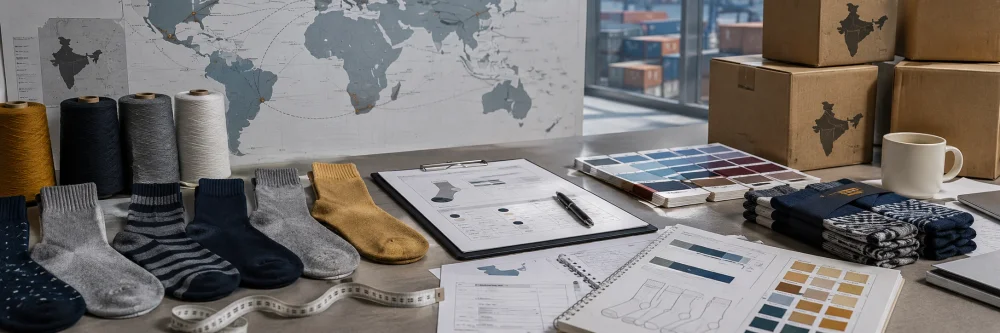
A strong private label programme therefore connects product specification, sampling, commercial terms, quality control, packaging and export planning before bulk production begins.
India as a Sock Sourcing Market
India already has an established hosiery export base.
In 2024, India exported approximately US$149 million under HS 6115, the broader customs category covering knitted socks and hosiery. India ranked seventeenth globally in exports under this category. (oec.world)
The country's wider textile manufacturing ecosystem is significantly larger. India's Ministry of Textiles reported textile and apparel exports, including handicrafts, of approximately ₹3,25,339 crore during FY 2025 to 2026, with exports reaching more than 100 markets. (pib.gov.in)
For sock buyers, the importance of this textile base goes beyond export value. It supports access to yarn sourcing, knitting, dyeing, finishing, packaging, testing and export logistics within a mature textile manufacturing environment.
India therefore deserves consideration for programmes involving:
- Everyday cotton socks.
- School and uniform socks.
- Sports socks.
- Work socks.
- Crew and ankle socks.
- Riding and boot socks.
- Custom logo socks.
- Retail private label collections.
The buyer still needs to qualify the individual factory. A strong manufacturing country does not automatically make every supplier suitable.
Why UK Buyers Should Review India Again in 2026
The sourcing equation for UK importers changed in July 2026.
The India UK trade agreement entered into force on 15 July 2026. The agreement changes tariff treatment across a large range of Indian goods entering the UK. Buyers should now review India alongside existing sourcing origins using the current tariff schedule rather than relying on historical duty assumptions. (trade-tariff.service.gov.uk)
Preferential treatment is not automatic simply because a product is shipped from India.
Importers should confirm:
- The correct commodity code.
- The applicable tariff.
- Rules of origin.
- Origin documentation.
- Whether the specific sock construction qualifies.
- The requirements applicable on the actual shipment date.
This can materially affect landed cost and should be checked before a large annual sourcing programme is awarded.
What Buyers Should Specify Before Requesting a Quote
A useful sock RFQ should give the manufacturer enough information to calculate both production feasibility and price.
At minimum, buyers should define:
| Requirement | What the buyer should specify |
|---|---|
| Sock type | Ankle, crew, sports, school, work or other style |
| Material | Required fibre composition or performance direction |
| Construction | Full terry, half terry, cushioned or non terry |
| Size | Market size range plus finished measurements |
| Colour | Approved colour reference |
| Branding | Knitted logo, embroidery or packaging branding |
| Quantity | Quantity by style, colour and size |
| Packaging | Single pair, multipack, sleeve, hanger card or box |
| Destination | Country where the product will be imported and sold |
| Quality | Measurement, shrinkage, workmanship and testing expectations |
| Shipping | Required Incoterm and destination |
A request such as:
“Quote 10,000 pairs of premium cotton socks”
leaves too much open to interpretation.
Two suppliers can answer that request with very different products while both technically meeting the description.
Choosing the Right Sock Construction
The product should be developed around its intended use.
Everyday and retail socks
Everyday socks normally need a balance of comfort, durability, fit and price. Cotton rich blends are common, but the final composition should reflect wash performance and expected product life.
School socks
School programmes normally require stronger control over colour consistency, reinforcement, elastic recovery and repeated washing.
For retailers selling the same core school range every year, repeatability can be more valuable than frequent design changes.
Sports socks
Sports products may require specific cushioning zones, arch support, mesh areas, moisture management and reinforced heel and toe sections.
Instead of asking for an “extra cushioned sports sock,” buyers should define where cushioning is required.
Work socks
Work socks generally place greater emphasis on durability, cushioning, reinforcement and comfort inside work footwear or boots.
Riding and boot socks
Longer constructions require attention to shaft length, calf stretch, cuff pressure and areas exposed to friction inside boots.
The correct construction should always be linked to how the end customer will actually use the product.
Cotton, Polyester, Nylon and Elastane: What Each Fibre Does
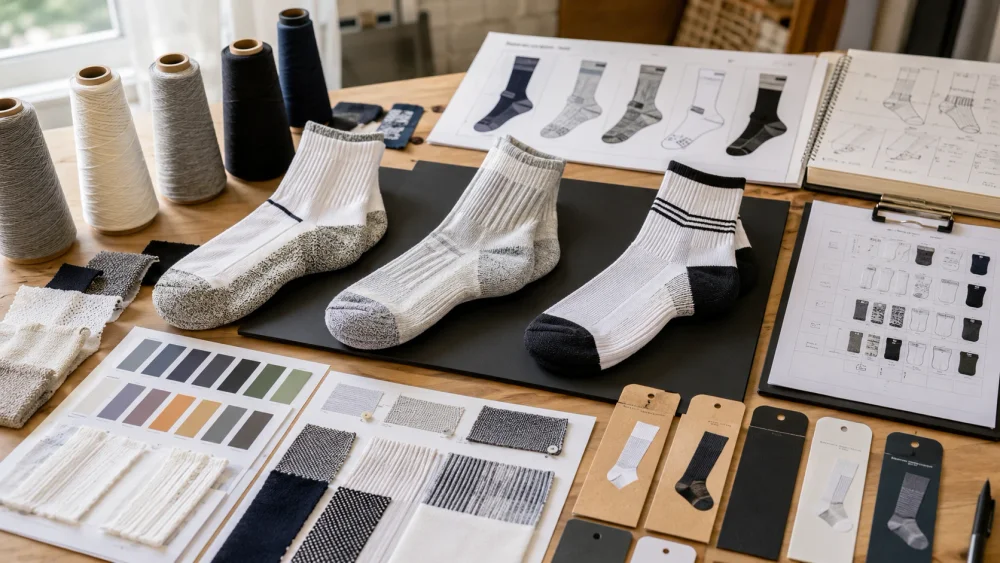
Material composition influences comfort, durability, recovery, drying performance and cost.
Cotton
Cotton is widely used in casual, school and everyday sock programmes because buyers and consumers are familiar with its softness and natural fibre positioning.
However, cotton percentage alone does not determine quality. Yarn preparation, knit construction, finishing and overall product weight also affect the final result.
Polyester
Polyester may be blended with cotton to improve durability, drying characteristics, shape retention and commercial cost control.
A polyester blend should therefore be evaluated by function rather than automatically treated as a lower quality option.
Nylon
Nylon can add strength and abrasion resistance, which makes it relevant for performance and higher wear applications.
Elastane
Elastane supports stretch and recovery. Even when used at a low percentage, it can significantly influence how well the sock remains in position.
One Costita full terry ankle sock currently uses a cotton rich construction with polyester and elastane, illustrating how different fibres can be combined to deliver comfort, durability and stretch rather than relying on a single fibre.
For private label programmes, the correct blend should be selected according to end use, target price, climate, wash expectations and retail positioning.
Full Terry, Half Terry or Non Terry?
Terry construction has a noticeable effect on thickness, cushioning, warmth, product weight and material consumption.
Full terry provides looped cushioning across a larger area of the sock and works well for comfort, work, sports and boot applications.
Half terry places additional cushioning only in selected areas and can provide a balance between comfort and lighter construction.
Non terry creates a thinner sock and can suit casual, dress or warm climate applications.
The buyer should specify the construction rather than asking only for a “thick” or “premium” sock.
Thickness is not a specification.
Construction is.
Sizing Should Be Measurable
Retail size labels such as UK 6 to 9 or EU 39 to 43 are useful for customers but are not enough for production control.
The technical specification should normally define measurements such as:
- Foot length.
- Leg length.
- Cuff width.
- Overall height.
- Heel position.
- Relaxed width.
- Relevant stretch measurements.
The measurement method and permitted tolerance should also be agreed.
This becomes particularly important when an order contains several sizes.
A single approved sample should not automatically be assumed to validate the complete size range.
Logo and Private Label Branding Options
Private label branding can be added directly to the sock or through retail packaging.
Knitted logo
The logo becomes part of the knitted structure.
This creates an integrated finish, but very detailed artwork may need to be simplified so it reproduces correctly within the knit.
Embroidery
Embroidery can create a more prominent brand detail but may add local thickness and cost.
The sample should be tested while worn, not only inspected when flat.
Retail packaging
Hanger cards, sleeves, belly bands, boxes and multipacks can carry stronger branding without making the sock itself visually complex.
Many programmes combine a smaller product logo with stronger branded packaging.
Buyers should approve logo size, position, colour and artwork before production begins.
Sample Approval Before Bulk Production
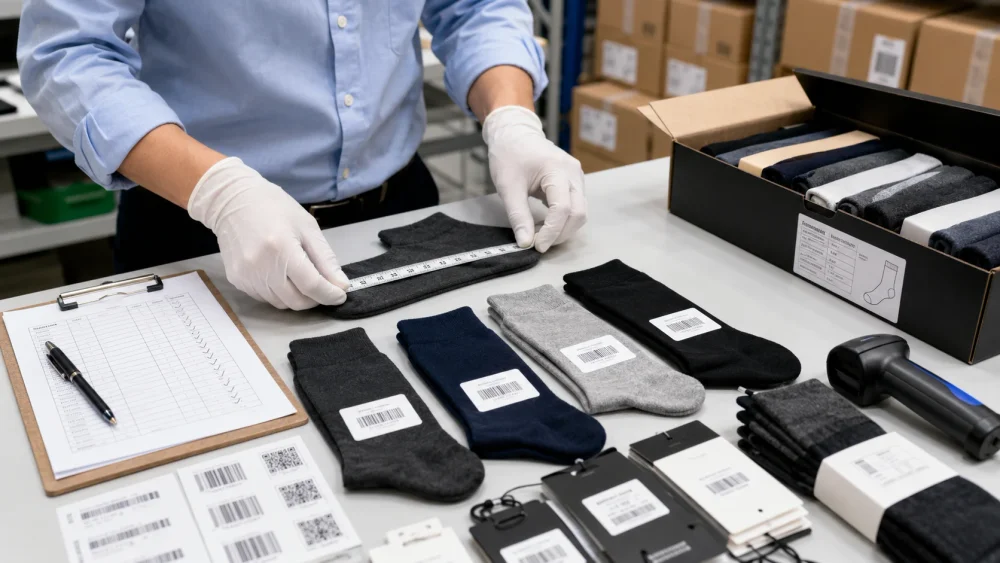
Sample approval is one of the most important stages in private label sock sourcing.
Photos can confirm appearance.
They cannot fully confirm fit, stretch, cushioning, seam comfort or wash behaviour.
The development process should normally confirm:
- Material composition.
- Sock dimensions.
- Colour.
- Construction.
- Terry or cushioning.
- Heel and toe shape.
- Logo appearance.
- Fit.
- Packaging.
- Wash behaviour where relevant.
The final approved sample should then become the reference for bulk production and inspection.
For repeat orders, the buyer should also keep a written specification containing measurements, colours, artwork, material details and approved tolerances.
That prevents the product from gradually changing across production batches.
PRIVATE LABEL SOCK SOURCING
Build the Specification Before You Negotiate the Price
Source custom socks from India with clearer product specifications, private label branding, sampling, supplier coordination and export planning built around your target market.
Understanding MOQ Properly
Buyers often ask:
What is the MOQ?
That question needs more detail.
A factory may have separate minimum quantities for:
- Total order quantity.
- Individual style.
- Colour.
- Size.
- Logo design.
- Yarn colour.
- Custom packaging.
For example, an MOQ of 3,000 pairs may apply to each colour rather than the entire order.
A three colour collection could therefore require 9,000 pairs.
Buyers should ask:
What is the minimum quantity at each level of my product range?
MOQ can be influenced by yarn purchasing, dyeing quantities, machine setup, packaging print runs and production efficiency.
Brands testing the market may sometimes reduce complexity by starting with fewer colours, a standard construction or simpler packaging.
Quality Inspection: What Should Be Checked?
Sock inspection should be connected directly to the approved specification.
A practical pre shipment inspection can review:
| Inspection Area | Buyer Check |
|---|---|
| Quantity | Correct pairs by size, colour and SKU |
| Measurements | Finished dimensions within agreed tolerance |
| Pair matching | Both socks match in size, shade and construction |
| Workmanship | No holes, knitting faults, stains or loose finishing |
| Colour | Consistency against approved reference |
| Logo | Correct placement, colour and orientation |
| Heel and toe | Correct shape, position and reinforcement |
| Elasticity | Fit and recovery consistent with approved sample |
| Packaging | Correct product, artwork, labels and barcode |
| Cartons | Correct quantity, markings and export condition |
Quality control should begin before final inspection.
Pre production checks help confirm materials and instructions, while production checks can identify issues before the full quantity has been completed.
Costita's Buyer Protection process currently describes supplier verification, production monitoring and physical inspection before shipment as part of its sourcing approach.
Wash Performance and Shrinkage
A sock can fit correctly before washing and differently after repeated laundering.
Where dimensional stability matters, buyers should agree:
- Washing method.
- Number of cycles.
- Measurements taken before washing.
- Measurements taken after washing.
- Permitted dimensional change.
- Colour or appearance expectations.
Terms such as “low shrinkage” are too vague for quality control.
A measurable tolerance gives both buyer and supplier a clear acceptance standard.
Compliance and Textile Labelling
Import regulations should be considered before retail packaging goes to print.
For the UK market, official textile labelling guidance requires textile products to show fibre content and provides rules where products contain different textile components. (gov.uk)
Private label buyers should therefore confirm the correct fibre description and percentages before bulk packaging production.
Depending on destination, the final label and product file may also need to address matters such as:
- Size.
- Country of origin.
- Importer or responsible business information.
- Product identification.
- Barcode requirements.
- Care information.
- Traceability requirements.
- Relevant chemical or product safety requirements.
These requirements vary by market.
The destination should therefore be disclosed when the RFQ is created rather than after production finishes.
Packaging and Carton Planning Affect Landed Cost
Retail packaging is part of the product, but export packing also affects commercial performance.
Before shipment, buyers should know:
- Number of pairs per retail pack.
- Number of packs per carton.
- Carton dimensions.
- Net weight.
- Gross weight.
- Total carton quantity.
- Total shipment volume.
Poor carton utilisation can increase freight cost even when the factory price is competitive.
This is particularly relevant when comparing suppliers.
A lower price per pair does not automatically produce a lower landed cost.
Factory Price Versus Landed Cost
The commercial comparison should include more than manufacturing price.
Depending on the transaction, landed cost can include:
Product cost + branding + retail packaging + testing + inspection + inland freight + export handling + international freight + insurance + customs duty + import taxes + destination handling + final delivery
The buyer should therefore compare suppliers on a common basis.
If one supplier quotes FOB and another quotes EXW, the numbers should not be compared directly without adjusting the additional costs.
For UK buyers, current preferential tariff treatment under the India UK agreement should also be checked using the final commodity classification and applicable origin rules rather than assuming every Indian product automatically receives the same benefit. (gov.uk)
Why International Buyers Source Socks From India
India offers several advantages for suitable private label programmes.
Strong textile manufacturing ecosystem
India's textile and apparel export base reached approximately ₹3,25,339 crore in FY 2025 to 2026, reflecting a substantial manufacturing and export supply chain. (pib.gov.in)
Existing hosiery export activity
India exported approximately US$149 million under the broader HS 6115 knitted hosiery category during 2024. (oec.world)
Multiple product constructions
Buyers can source cotton rich everyday socks as well as school, sports, work, terry and custom branded programmes.
Private label flexibility
Product construction, colours, logos, pack configurations and retail branding can be developed for specific programmes when the order size and factory capability support the requirement.
Improved UK trade environment
The India UK trade agreement entered into force on 15 July 2026, making current tariff and origin treatment particularly relevant for UK procurement teams evaluating Indian sourcing. (trade-tariff.service.gov.uk)
India should still be compared with other sourcing origins on total landed cost, production capability, MOQ, lead time and quality performance.
Country advantage should support supplier qualification, not replace it.

How Costita Can Support a Private Label Sock Programme
A structured sourcing process can reduce uncertainty between the buyer's requirement and factory production.
A typical Costita programme can follow this sequence:
Stage 01: Requirement Review
Product type, destination, sizes, material, colours, branding, quantity and commercial priorities are reviewed.
Stage 02: Supplier and Quote
Relevant manufacturing capability and quotation terms are compared against the actual specification.
Stage 03: Sample Approval
Material, fit, dimensions, logo, colour and packaging are approved before bulk production.
Stage 04: Production and Quality Control
Production progresses against the approved specification with agreed inspection checkpoints.
Stage 05: Export Coordination
Packing, documentation, freight and shipment planning follow the agreed delivery scope.
This approach is more useful than sending the same basic enquiry to multiple factories and comparing only the quoted price.
SOURCE WITH MORE CONTROL
Move From Supplier Search to Shipment Ready Production
Develop private label socks with specification control, sample approval, quality checks, retail packaging and export coordination aligned with your destination market.
Buyer Checklist Before Confirming an Order
Before issuing the final purchase order, confirm that:
- Sock construction and fibre composition are approved.
- Size chart and measurement tolerances are documented.
- Colours and logo artwork are confirmed.
- Terry and cushioning requirements are clearly defined.
- The final sample has been approved.
- MOQ is understood by style, colour and size.
- Packaging artwork and barcode information are correct.
- Quality inspection requirements are agreed.
- Carton configuration has been confirmed.
- Incoterm and shipping destination are written into the commercial agreement.
- Customs classification and destination requirements have been reviewed.
- Preferential origin requirements have been checked where applicable.
When these elements are controlled before production, price comparison becomes far more meaningful.
Frequently Asked Questions
Frequently Asked Questions
What is the MOQ for private label socks from India?
MOQ depends on the sock construction, yarn, colours, sizes, branding and packaging. Buyers should confirm whether the minimum applies to the whole order or separately to each colour, design or size. Costita reviews the actual programme before confirming supplier MOQ rather than applying one number to every sock product.
Can I request samples before placing a bulk order?
Yes. Costita recommends sample approval for custom and private label programmes. Buyers should review material, fit, measurements, construction, colour, logo and packaging before confirming bulk production.
Which material is best for private label socks?
There is no single best material. Cotton rich blends can work well for everyday and school products, while polyester or nylon may support durability and performance requirements. Elastane helps provide stretch and recovery. The material should be chosen according to the actual end use.
Can socks be manufactured with my logo and packaging?
Yes, depending on the programme. Branding can include knitted logos, embroidery and custom retail packaging. Artwork, dimensions, colours and placement should be approved during sampling before bulk production.
What quality checks should importers request?
Important checks include dimensions, pair matching, colour consistency, knitting quality, heel and toe construction, logo placement, elastic recovery, packaging accuracy and carton condition. Additional wash or performance testing may be required depending on the product.
Can Costita support UK and European sock buyers?
Costita supports international sourcing and export coordination. Destination requirements should be provided from the beginning because labelling, customs, documentation and product compliance can differ between markets. UK buyers should also review the current India UK trade agreement when calculating landed cost.
What information should I send for an accurate quote?
Send the sock type, destination country, material preference, size range, colours, logo requirement, cushioning or terry construction, packaging format, order quantity and required delivery date. The more clearly the product is specified, the more useful the supplier quotation will be.