Socks Quality Inspection Checklist for Bulk Importers: A Practical Buyer Guide
Sock Inspection Should Answer One Question
For a bulk buyer, quality inspection has one job:
Does the finished order match what was approved?
That sounds simple, but a sock can look acceptable while still failing on size, pair matching, elastic recovery, shade, fibre composition, logo placement, packaging or carton assortment.
These problems become expensive when they appear across thousands of pairs.
A retail buyer may receive the correct sock under the wrong size label. A private label brand may find logos positioned differently across production. A school sock may fit correctly before washing but lose dimensions after repeated laundering.
The inspection therefore needs to check the product as the buyer will actually receive and sell it.
The strongest approach is to define the standard before production, approve a reference sample, inspect against measurable criteria and release the shipment only after the order meets those requirements.
Why Bulk Buyers Need a Repeatable Inspection Process
International hosiery trade is large enough that even small quality failures can affect significant quantities.
In 2024, imports under HS 611592, which covers cotton knitted hosiery and related products, reached approximately US$1.59 billion in the European Union, US$708.7 million in the United States and US$354.1 million in the United Kingdom. This classification includes more than socks alone, so it should be treated as a hosiery market indicator rather than a socks only figure. (wits.worldbank.org)
India also operates within a substantial textile export ecosystem. Textile and apparel exports including handicrafts reached ₹3,25,339 crore in 2025 to 2026, with export growth recorded across more than 100 destinations. (pib.gov.in)
For buyers sourcing at scale, this makes consistent inspection more important, not less.
Manufacturing capacity creates supply opportunity. Quality control determines whether that supply remains commercially usable.
Start With the Approved Product Specification
Inspection becomes difficult when the purchase order uses words such as premium, high quality, soft or durable without defining what they mean.
Before bulk production begins, the buyer should have a clear reference covering:
- Fibre composition and approved yarn direction.
- Sock style, size range and finished measurements.
- Construction such as full terry, half terry or non terry.
- Heel, toe, cuff and reinforcement requirements.
- Approved colours and shade references.
- Logo size, position and artwork.
- Retail packaging, barcode and label details.
- Quantity by style, colour and size.
- Carton quantity and carton markings.
- Any agreed wash, colour or performance requirements.
The approved physical sample should be linked to this specification.
Without that reference, inspection becomes subjective.
The Core Socks Quality Inspection Checklist
A buyer does not need an inspection report with dozens of pages unless the product requires it.
The following checks cover most of the commercial risks in a standard bulk sock order.
| Inspection area | What the buyer should verify |
|---|---|
| Quantity | Total pairs and quantities by size, colour, SKU and pack configuration match the purchase order |
| Size | Foot length, leg length, cuff width and other controlled measurements remain within agreed tolerances |
| Pair matching | Both socks match in size, shade, construction, logo position and orientation |
| Workmanship | No holes, dropped stitches, stains, broken yarn, excessive loose threads or obvious finishing defects |
| Construction | Terry coverage, reinforcement, heel, toe and cuff match the approved sample |
| Colour | Production shade remains consistent with the approved reference and across the production lot |
| Branding | Logo dimensions, colour, orientation and position match the approved artwork |
| Performance | Wash behaviour, dimensional stability and elastic recovery meet agreed requirements where testing applies |
| Packaging | Size, barcode, fibre information, pack quantity and artwork are correct |
| Cartons | Carton quantity, markings, SKU segregation and physical condition match the shipping plan |
This checklist should then be adjusted according to the product.
A basic promotional sock may need fewer controls than a private label sports or school programme.
AQL Sampling Without Overcomplicating It
Bulk buyers normally do not inspect every pair.
Many inspections use statistical sampling to examine part of the production lot and make a decision about the overall shipment.
The current international standard ISO 2859 1:2026 defines acceptance sampling plans indexed by Acceptance Quality Limit for inspection by attributes. It replaced the previous edition and provides a structured approach to sample based lot inspection. (iso.org)
For the buyer, the practical point is simple.
Do not choose an AQL level because another brand uses it.
The sampling plan and acceptance limits should reflect the product, order value, supplier history and commercial risk.
A large retail programme with strict brand requirements may need tighter controls than a basic commodity order.
Define Critical, Major and Minor Defects Before Production
Inspection becomes easier when both buyer and supplier already know what constitutes a serious failure.
Critical defects
These normally involve safety, legal or severe compliance risks.
Examples can include contamination, dangerous foreign materials or serious regulatory failures.
Major defects
These can make the product unsuitable for normal sale or materially different from the approved specification.
Examples include wrong sizing, holes, major colour differences, missing branding, incorrect pack quantity or unacceptable dimensional change.
Minor defects
These are usually smaller workmanship or appearance issues that do not make the product unusable.
The important part is agreeing the classification before inspection.
A defect should not become major simply because it becomes inconvenient after production is complete.
Measure the Sock the Same Way Every Time
Knitted products stretch easily, which means two people can measure the same sock differently.
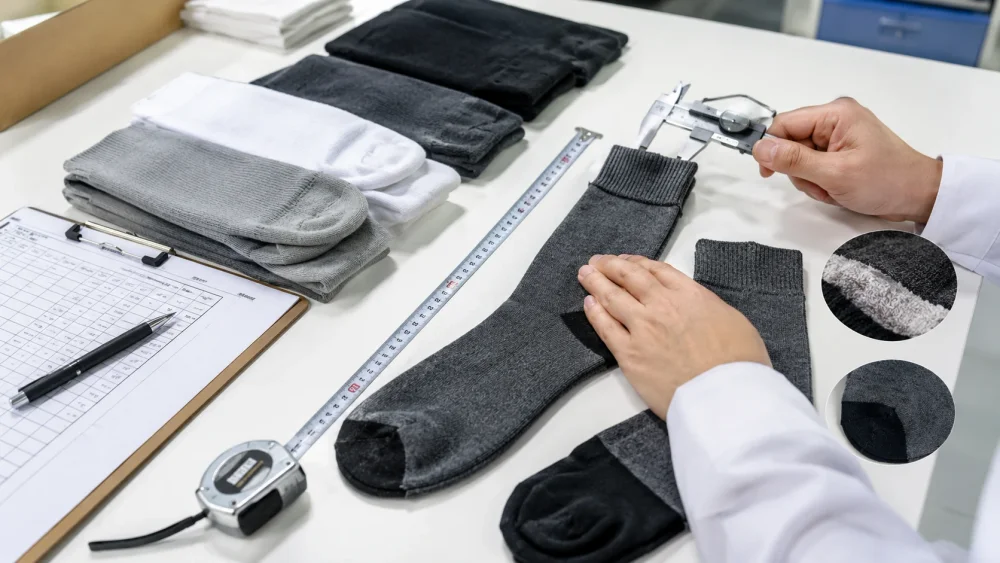
The buyer should define whether measurements are taken relaxed, flattened without tension, after washing or under another agreed condition.
Typical control points include:
- Foot length.
- Leg length.
- Cuff width.
- Overall height.
- Heel position.
Each measurement should include an acceptable tolerance.
Instead of writing:
Foot length: 25 cm
the specification should define the measurement method and the permitted variation.
That gives the inspector a clear acceptance rule.
Check the Pair, Not Only the Individual Sock
A common mistake is inspecting individual socks without checking how they look together.
Both socks in a pair should match in:
- Finished length.
- Shade.
- Heel position.
- Cuff width.
- Logo position.
- Knit appearance.
This becomes especially important for socks with logos, patterns, stripes or contrasting colours.
A small difference can look insignificant when the socks are separated but obvious when the customer opens the pack.
Heel, Toe, Cuff and Terry Construction Deserve Attention
These areas often reveal production inconsistency quickly.
The heel should sit in the approved position and remain consistent across the size range.
The toe should have clean finishing without excessive bulk, loose yarn or uncomfortable seam construction.
Where reinforcement is specified, it should appear in the correct zones.
For full terry or half terry socks, the inspector should also confirm that cushioning coverage matches the approved construction.
A factory changing terry density or coverage can change pair weight, comfort and material consumption even when the sock still looks similar from the outside.
Elastic Recovery Matters More Than Initial Stretch
Stretching a sock once by hand does not prove that the elastic performs correctly.
Buyers should consider whether the sock returns toward its original dimensions and whether the cuff continues to hold position after use.
This is particularly important for school, sports, work and uniform socks that are repeatedly worn and washed.
Where fit retention is commercially important, the approved sample should establish the reference and a repeatable testing method should be agreed.
QUALITY SHOULD BE CONTROLLED BEFORE THE ORDER IS FINISHED
Build the Inspection Standard Before Production Starts
Define size, construction, branding, packaging and acceptance criteria before bulk manufacturing so the final inspection has a clear commercial reference.
Wash Performance Should Be Measured, Not Described
Terms such as low shrinkage or colour stable are difficult to inspect unless the buyer defines a test.
ISO 6330:2021 provides standard domestic washing and drying procedures for textile testing and recognises that machine type, detergent and drying method can influence results. (iso.org)
For most commercial sock programmes, the buyer should decide:
- How the sample will be washed.
- How many cycles are relevant.
- Which measurements are recorded before washing.
- Which measurements are checked afterwards.
- What dimensional change is acceptable.
School socks, workwear, hospitality uniforms and repeat retail basics deserve particular attention because frequent laundering is part of normal use.
Branding and Packaging Are Part of Quality
A correct sock in incorrect packaging is still a commercial problem.
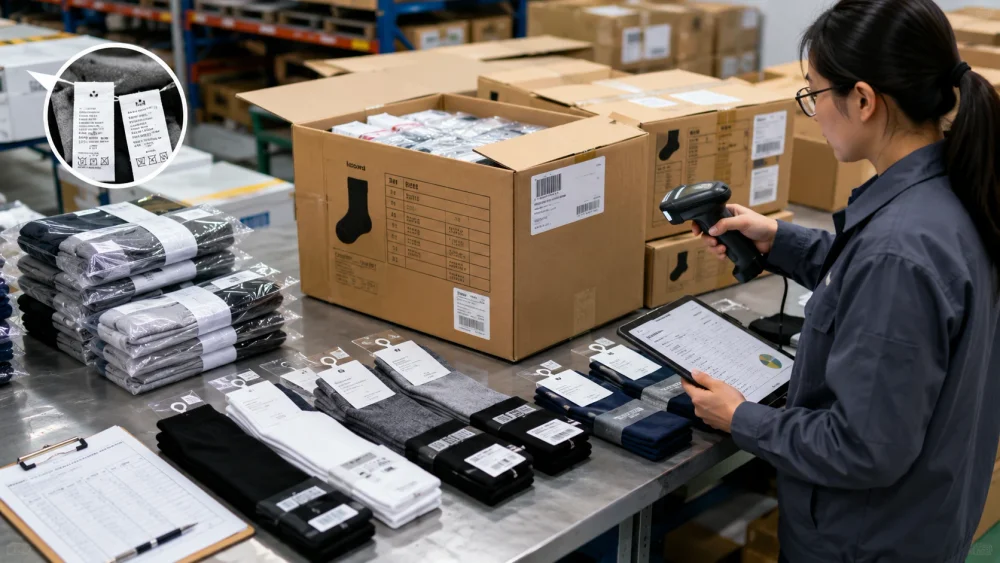
Private label buyers should check logo placement, pack quantity, size information, product code, barcode, artwork version and fibre declaration.
For Great Britain, textile labels must show fibre content, and manufacturers and retailers have responsibility for meeting the applicable labelling rules. (gov.uk)
This makes packaging approval part of product approval.
Do not finalise thousands of retail labels while fibre composition or product specifications are still changing.
The safer sequence is:
Approve the product. Confirm the composition. Approve the packaging. Then print.
Carton Accuracy Matters to the Buyer’s Warehouse
Quality control should continue beyond the retail pack.
The inspector should verify:
- Correct packs per carton.
- Correct size and colour assortment.
- Carton markings.
- Product codes.
- Gross carton condition.
- Clear SKU segregation.
Costita sock listings currently show details such as carton quantity, dimensions, pack configuration, MOQ and physical inspection because these logistics details directly affect commercial receiving and export handling. (costita.com)
A perfectly manufactured sock packed into the wrong carton assortment can still create inventory and fulfilment problems.
What Should Happen if Inspection Fails?
A failed inspection should answer three questions.
What failed?
How much production is affected?
Can it be corrected before shipment?
Possible actions can include sorting, rework, repacking, replacement production or reinspection.
The decision should be based on the approved specification rather than preference introduced after production.
Costita's Buyer Protection process combines supplier verification, quality inspection, shipment protection and dispute support. Its current process is designed to help buyers receive the expected product quality and quantity and address issues before or during shipment resolution. (costita.com)
The most useful time to identify a problem is while the goods are still close to the factory.
Why Inspect Socks Sourced From India?
India offers buyers access to a large textile manufacturing and export base, including cotton textiles, man made textiles, garments and other textile categories. Textile and apparel exports including handicrafts reached ₹3,25,339 crore in 2025 to 2026. (pib.gov.in)
For socks, that broader ecosystem supports sourcing across cotton, polyester, elastane and blended constructions.
The advantage is manufacturing flexibility.
The buyer still needs process control.
Costita's current sock listings show verified products with physical inspection included and Buyer Protection, alongside options for samples and product customisation. (costita.com)
India can provide scale and product variety.
Inspection helps make that supply repeatable.
Costita’s Recommended Buyer Workflow
A practical bulk sock order can follow five stages.
Specification
Confirm construction, fibre composition, measurements, colours, branding, packaging and quantities.
Sample approval
Approve the physical product before bulk manufacturing.
Production control
Keep the approved sample and written specification as the manufacturing reference.
Pre shipment inspection
Check product, quantity, packaging and cartons using the agreed sampling and acceptance criteria.
Shipment release
Release the goods only after inspection results and any required corrective actions are closed.
This keeps quality control connected to procurement rather than treating inspection as a separate task at the end.
DO NOT SHIP A QUESTION MARK
Approve. Inspect. Correct. Then Release.
Use Costita to coordinate product sampling, manufacturing specifications, physical inspection, packaging checks and export preparation before bulk socks ship.
Bulk Sock Inspection Checklist Before Shipment
Before approving shipment, confirm that:
- The total production quantity matches the purchase order and SKU breakdown.
- The approved sample and written specification are available to the inspector.
- Measurements are within agreed tolerances.
- Both socks in each pair match correctly.
- Knit construction, heel, toe, cuff and terry coverage are correct.
- There are no unacceptable holes, stains, broken yarn or workmanship defects.
- Shade and branding match the approved references.
- Elastic recovery and wash performance meet agreed requirements where applicable.
- Fibre composition matches the product and retail label.
- Packaging contains the correct size, quantity, barcode and artwork.
- Master carton quantities and markings are correct.
- Any failed inspection points have been corrected and verified before release.

Frequently Asked Questions
Frequently Asked Questions
What is AQL in sock inspection?
AQL means Acceptance Quality Limit. ISO 2859 1:2026 provides acceptance sampling schemes that allow buyers to inspect a defined sample rather than every product in a large lot. Costita recommends selecting acceptance limits according to the product and buyer risk rather than using one universal AQL for every sock programme.
Does every pair of socks need to be inspected?
Not usually. Large production lots can be inspected using an agreed statistical sampling plan. The sample size and acceptance criteria should be defined before inspection based on the order and quality requirement.
What are the most important sock defects to check?
Costita recommends prioritising sizing, pair matching, holes, knitting faults, shade consistency, heel and toe construction, elastic recovery, logo placement, packaging and carton accuracy. Wash performance should also be checked where it is important to the product.
Should buyers approve a sample before bulk production?
Yes. Costita recommends physical sample approval before a custom or private label order moves into bulk manufacturing. The approved sample becomes the product reference alongside the written specification.
Should bulk socks be wash tested?
Wash testing is useful when shrinkage, fit retention, colour or repeated laundering affect the product's intended use. School, workwear and hospitality programmes particularly benefit from defined wash performance requirements.
What happens if a Costita order does not pass inspection?
Costita's Buyer Protection process includes quality inspection and sourcing risk support. Where production does not meet approved requirements, the issue should be identified and corrective action addressed before shipment where possible.
What should I provide Costita before quality inspection?
Provide the approved sample, measurement chart, fibre composition, colours, logo artwork, packaging files, quantity by SKU and any agreed performance requirements. The clearer the specification, the more objective the inspection becomes.
Final Procurement View
Bulk sock inspection does not need to become a complicated technical exercise.
It needs to answer whether the production matches what the buyer ordered and approved.
For most importers, the priority controls are straightforward:
Correct quantity. Correct size. Consistent construction. Matching pairs. Approved colour. Correct branding. Verified packaging. Shipment ready cartons.
AQL sampling can make large lot inspection practical, while wash testing and measurement controls address risks that cannot be judged visually. Current ISO standards provide recognised frameworks for both sampling and textile laundering tests.
India gives international buyers access to substantial textile manufacturing capacity and a growing export base. The buyer's responsibility is to turn that capacity into a controlled product specification and verify the finished order before it moves.
Approve the standard first. Inspect against it. Ship only when the order matches it.