
The Complete Areca Palm Leaf Product Guide: Types, Sizes, Specifications and Applications
Areca palm leaf tableware may look like a simple natural alternative to conventional disposable plates, but wholesale sourcing involves far more than choosing a shape and requesting a unit price. Importers, distributors, restaurants, caterers and private-label brands must compare product profiles, usable dimensions, natural grades, food-contact suitability, packing methods, storage conditions and manufacturer consistency before approving a commercial order.
This guide explains the complete areca palm leaf product range, including plates, bowls, trays, containers, cutlery, profiles, sizes, technical specifications, branding options and commercial applications. It is designed to help buyers move from general product interest to a clearer product shortlist that can be tested, priced and prepared for bulk procurement.
Buyer starting point: Review the complete Costita areca palm leaf product range before requesting samples. Comparing several sizes and profiles together gives a more reliable view of product quality than evaluating one plate in isolation.
Explore the Complete Product Guide
Wholesale Buyer ResourceWhat Are Areca Palm Leaf Products?
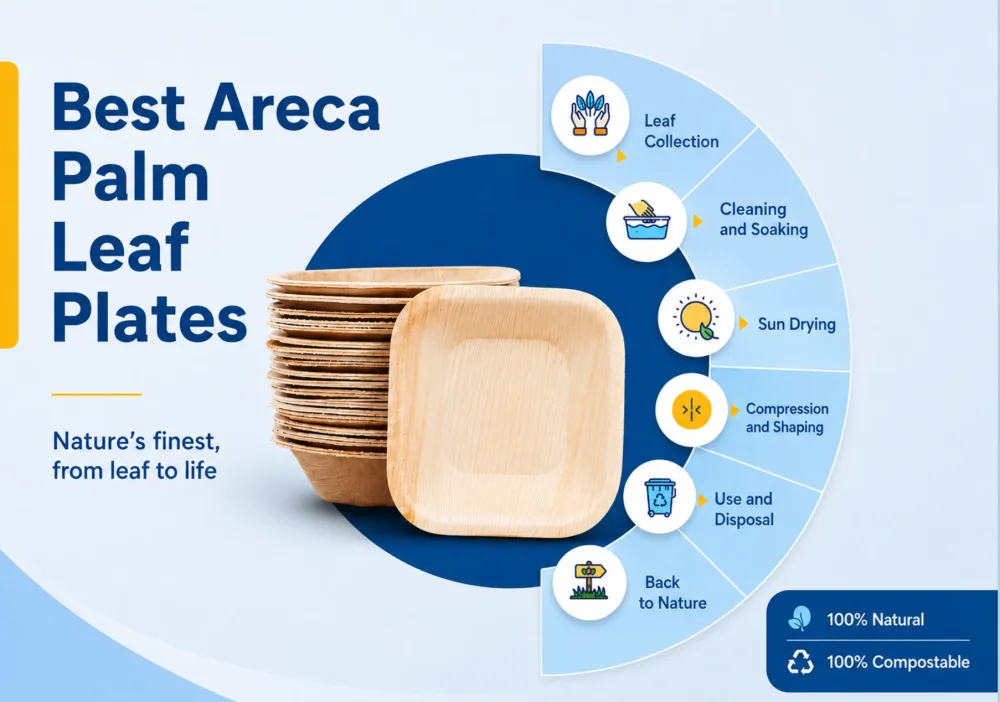
Areca palm leaf products are disposable food-service articles formed from the naturally shed leaf sheaths of the Areca catechu palm. The accepted botanical identity of the species can be reviewed through Kew Science Plants of the World Online. The fallen sheaths are collected, cleaned, dried and pressed into heated moulds that shape the material into plates, bowls, trays and other serving products.
Standard uncoated areca products are formed from one natural leaf sheath rather than pulped fibre. Their strength comes from the natural fibre structure and the pressure applied during moulding. Buyers should still confirm the exact material declaration, processing method and any surface treatment with the selected manufacturer, especially when products will be sold using plastic-free, compostable or chemical-free claims.
Every sheath develops its own grain, colour and markings. Finished products can therefore range from pale cream and beige to deeper tan and brown shades. This natural individuality is commercially valuable, but it also means procurement specifications must clearly separate acceptable natural variation from cracks, mould, poor trimming, deformation and other actionable defects.
Areca Product Identity
A quick technical description for product catalogues and buyer briefs
Raw Material
Naturally shed palm leaf sheath
Product Structure
Single natural leaf layer
Primary Forming
Heat and pressure moulding
Surface Appearance
Natural grain and pigmentation
Primary Market
Food service and retail
Typical Positioning
Natural premium disposable
How Areca Palm Leaf Tableware Is Manufactured
The manufacturing flow is straightforward, but commercial quality depends on how consistently each stage is controlled. Raw material sorting affects surface appearance and strength, drying affects moisture stability, mould temperature affects shape definition, trimming affects food-contact safety, and final packing affects how the product reaches the destination warehouse.
Buyers should request a documented production flow and inspect samples from the intended production grade. Optional steps such as sanitisation systems, controlled drying equipment, polishing or specialised inspection should be confirmed factory by factory rather than treated as universal industry practice.
Collection
Naturally shed sheaths are gathered from areca-growing areas.
Sorting
Weak, damaged or unsuitable raw material is separated before processing.
Cleaning
Surface dust and agricultural residue are removed using the factory process.
Drying
Moisture is reduced before moulding and final packing.
Heat Pressing
Heated moulds create the required shape, rim, depth and compartment layout.
Finishing
Products are trimmed, graded, counted, sealed and packed for dispatch.
Procurement implication: Two products with the same outer size can perform differently because of raw sheath quality, average thickness, mould geometry, drying control and pressing consistency. Sample testing should therefore be completed on the exact SKU and grade being quoted.
Natural Grain
Each product carries visible fibre patterns, colour gradients and natural markings from the original sheath.
Rigid Construction
Correctly pressed products offer useful rigidity for many hot, oily and moisture-rich food applications.
Multiple Profiles
Shallow, medium and deep designs support snacks, plated meals, curries, buffets and catering portions.
Broad Size Range
Buyers can build coordinated ranges from condiment dishes and dessert plates to large dinner formats.
Single-Use Service
The category is intended primarily for disposable food-service, event, hospitality and retail applications.
End-of-Life Potential
Natural products may be compostable under suitable conditions, but disposal claims should match local facilities and evidence.
Branding Options
Products can be supplied in standard bundles, plain bundles, custom-labelled packs or selected embossed formats.
Storage Sensitive
Sealed packaging and dry warehousing help protect natural products from humidity, bending and contamination.
Why Businesses Choose Areca Palm Leaf Products
Areca tableware occupies a useful position between low-cost commodity disposables and premium reusable serviceware. It gives food-service businesses a visibly natural product while offering importers and distributors a differentiated category that can be sold on appearance, menu suitability, material clarity and private-label potential.
The product is particularly effective where the plate remains visible to the customer. Wedding catering, resort dining, food festivals, premium buffets and organic retail collections can use the natural surface as part of the presentation. Buyers focused primarily on high-volume takeaway packaging may combine areca with bagasse products rather than forcing one material to serve every application.
Premium Natural Presentation
Natural grain and varied colour create a distinctive surface that works well for customer-facing food presentation. The product does not need printed decoration to communicate its material story.
Practical Food-Service Strength
Suitable products can handle many rice dishes, grilled foods, desserts, snacks and curry-based meals. Performance should be confirmed with the buyer's actual portions and holding time.
Portfolio Differentiation
Distributors can position areca above standard white disposables and build coordinated collections across dinner plates, snack plates, bowls, trays and compartment formats.
Private-Label Flexibility
Importers can begin with standard packing, move to custom sticker bundles, and later assess printed cartons or embossed products when market volume supports higher setup commitments.
Commercial Markets Served by Areca Tableware
The strongest product mix changes according to buyer type, food format and serving environment
Restaurants and Cafés
Round plates, square plates, bowls and dessert formats.
Hotels and Resorts
Premium dinnerware, buffet trays and presentation-led products.
Wedding Catering
Large deep plates, compartment plates, bowls and serving trays.
Food Trucks
Boat trays, rectangular plates, snack trays and containers.
Bakeries
Small plates, rectangular trays and shallow dessert formats.
Institutional Meals
Compartment plates and portion-controlled serving products.
Retail Brands
Mixed household packs with custom labels and barcodes.
Wholesale Distribution
Broad multi-SKU catalogues serving several customer segments.
Complete Areca Palm Leaf Product Range
Product availability depends on a manufacturer's mould library, pressing equipment and raw material dimensions. Standard ranges normally concentrate on fast-moving round and square plates, while specialised suppliers may also produce bowls, clamshells, trays, cutlery and custom moulded formats.
Importers should build the initial range around clear applications instead of offering too many similar SKUs. A coordinated starter collection can include one snack size, one dessert size, two meal sizes, a deep catering plate, a bowl, a compartment plate and one serving tray.
Plates
The largest category includes round, square, rectangular, oval, shallow, medium, deep and compartment configurations for snacks, desserts, meals, buffets and catering.
Bowls
Bowls are used for curries, salads, noodles, soups, desserts, condiments and side portions. Buyers should compare capacity, rim width, wall depth, base stability and holding time with the intended food.
Capacity descriptions should be supported by measured dimensions because products sold under the same nominal capacity may have different usable volume.
Trays and Platters
Rectangular trays, oval platters, serving trays and boat trays support bakery displays, tasting menus, appetisers, street food, barbecue, buffet counters and shared food presentation.
Product stability depends on base width, wall shape and the distribution of food weight across the tray.
Containers and Boxes
Selected manufacturers produce meal containers, burger boxes, clamshells, hinged boxes and rectangular containers with separate or integrated lids.
Buyers should test closure alignment, ventilation, stacking, grease performance, transport movement and compatibility with the intended food temperature.
Cutlery
Areca spoons, forks, knives, stirrers and serving utensils are available from selected production units. The range is less standardised than plates and may require separate supplier qualification.
Review edge smoothness, handle strength, flex, bowl depth and performance with hot or dense foods before including cutlery in a retail range.
Specialty and Custom Products
Pizza plates, festival ranges, decorative platters, branded presentation pieces and proprietary shapes may be developed when technical feasibility and order volume support custom tooling.
Discuss Custom DevelopmentCompare the full areca product catalogue
Review current plates, profiles, sizes and supplier options before building your sample request.
Customisation and Private-Label Options
Packaging customisation allows importers and distributors to convert a standard factory product into a market-ready retail or food-service range. The correct option depends on launch volume, destination labelling rules, barcode requirements, artwork readiness and whether the buyer has local repacking capacity.
Customisation should be approved before bulk production. Buyers should sign off the bundle quantity, sticker dimensions, label text, country-of-origin statement, importer information, barcode position, carton marks and final artwork colour before labels or cartons are printed.
Manufacturer-Branded Bundle
Products are supplied in the factory's standard shrink-wrapped bundle with its existing sticker, product name and pack information.
Best suited for
Market testing, smaller initial orders and buyers without finished private-label artwork.
Plain or No-Label Bundle
Bundles are sealed without a consumer-facing brand label, allowing the importer to add local labels or repack products after arrival.
Buyer must confirm
Whether completely plain packs satisfy destination traceability, origin and consumer information rules.
Custom Sticker Bundle
The factory prints or procures the buyer's approved labels and applies them to sealed bundles during the final packing stage.
Commercial considerations
Artwork approval, print cost, label MOQ, language, barcode quality and bundle-specific product data.
Heat-Embossed Logo
A logo is incorporated into the mould or tooling so that it is pressed into the product during forming.
Technical considerations
Logo size, placement, mould modification, tooling cost, trial samples, structural impact and minimum production volume.
Private-label sequence: Start with standard samples, approve product performance, confirm the final SKU mix, then develop packaging. Designing labels before product selection is complete often creates incorrect dimensions, pack counts or product descriptions.
Product Shapes and Their Commercial Applications
Shape affects far more than appearance. It changes usable serving area, nesting density, carton efficiency, plate balance, portion arrangement and how easily buyers can distinguish one range from another. Round formats normally provide familiar service and efficient stacking, while square, rectangular and oval products create a more distinctive presentation.
The quoted outer dimensions should not be treated as the usable food area. A wide rim, sloping wall or deep profile can materially reduce the flat base available for food. Buyers should request outer dimensions, inner serving dimensions and profile depth for each shortlisted SKU.
Round
Restaurants, weddings, catering, buffets and general meal service.
The most familiar and widely available format. Round products normally provide efficient nesting and support a coordinated range from small dessert plates to large deep catering plates.
Square
Premium dining, hotels, events and modern food presentation.
Square products create a contemporary appearance and usable corner space. They can require different carton planning because corners are more exposed during handling.
Rectangular
Bakery, sushi, appetisers, barbecue, sandwiches and desserts.
Rectangular plates and trays support linear food presentation and work well for narrow counters, display cases and selected takeaway applications.
Oval
Seafood, grilled dishes, platters, kebabs and buffet service.
The elongated format creates additional visual length for whole foods, mixed platters and shared servings without using an oversized round plate.
Compartment
Cafeterias, corporate meals, schools and institutional service.
Dividers help separate wet and dry meal components. Buyers should test divider height, compartment capacity and whether sauces cross between sections during actual use.
Boat Tray
Fries, nachos, snacks, finger foods and street-food service.
Raised ends help retain loose food while the open top supports fast serving. The base should be tested for stability when filled with dense or uneven portions.
Need square and compartment formats?
Compare Costita's square and compartment areca service sets across snack, meal and catering sizes.
Shallow, Medium and Deep Product Profiles
Profile describes the depth, wall angle and rim height of a product. It influences food retention, capacity, stability, presentation, nesting and carton quantity. A wider plate with a shallow wall may hold less food than a smaller plate with a deeper base.
Profile names are not always standardised across suppliers. Buyers should request the measured product depth in millimetres and review side-view photographs rather than relying only on labels such as shallow, medium or deep.
Shallow Profile
Best for snacks, cakes, cookies, appetisers, bakery products, desserts and relatively dry portions that do not require high food-retention walls.
Medium Profile
A versatile option for everyday restaurant meals, corporate catering, light curries, rice dishes, takeaway counters and mixed food portions.
Deep Profile
Designed for heavier meals, rice, curries, gravy, buffet portions and event catering where higher walls reduce food movement and spillage.
Compare real profile options: Review shallow and deep round plates together before deciding which size is suitable for your menu.
Standard Areca Palm Leaf Plate Sizes
Areca plates are commonly marketed using nominal outer dimensions measured in inches. The exact size may vary slightly because of mould design, trimming tolerance and natural material behaviour. Technical specifications should therefore define an acceptable dimensional tolerance instead of assuming every product will measure identically.
The best size is determined by food weight, number of meal components, liquid content, service style and customer expectations. Shipping also matters: larger plates can reduce the number of units packed into a carton and increase freight cost per piece.
Plate Size and Application Scale
A practical starting point for sample selection and menu testing
Condiments and Samples
Sauces, tasting portions, dips and small desserts.
Snacks and Desserts
Side servings, pastries, starters and smaller portions.
Breakfast and Starters
Breakfast service, bakery portions and medium snacks.
Light Meals
Breakfast combinations, appetisers and lighter meals.
Lunch Portions
Medium meals, plated lunches and food-service portions.
Standard Dinner
Full meals, restaurant service and standard catering.
Large Restaurant Meals
Premium dining, larger portions and composed meals.
Wedding and Catering
Buffets, rice meals, heavy portions and event service.
Size Selection Questions
How many separate food components will be served?
Will the meal include gravy, curry, oil or loose food?
What is the total weight of the intended serving?
How will the product be carried, stacked and disposed of?
How does the selected size affect carton and freight efficiency?
Recommended Sample Combination
A practical sample set should include neighbouring sizes and more than one depth. For example, a catering buyer comparing 10-inch and 12-inch plates should test both medium and deep profiles with the actual rice, curry, salad and dessert portions used during service.
6"
Snack
8"
Light Meal
10"
Dinner
12"
Catering
Technical Specifications Buyers Should Confirm
Specifications should be written for the exact SKU rather than copied across an entire product range. Thickness, weight, moisture, dimensions and performance can change according to size, mould design, raw sheath and production batch. A technical sheet should therefore include a target, an acceptable tolerance and the method used to check it.
Products sold for direct food contact must meet the requirements of the destination market. European buyers can review the European Commission food-contact materials framework and the principles in Regulation (EC) No 1935/2004. Buyers should obtain declarations and testing relevant to their product, use conditions and destination.
| Parameter | Typical Sourcing Reference | Commercial Relevance | Buyer Verification |
|---|---|---|---|
| Material | Naturally shed Areca catechu leaf sheath | Supports material identity and product claims | Supplier declaration and test documentation |
| Dimensions | SKU-specific outer size, inner area and depth | Determines portion fit and packaging efficiency | Approved drawing and measured tolerance |
| Thickness | Often approximately 1.5-2.5 mm, product dependent | Influences rigidity, feel and load performance | Multi-point measurement on approved samples |
| Moisture | Manufacturer-controlled range before sealing | Affects mould risk, odour, warping and storage stability | Agreed measurement range and packing records |
| Surface Finish | Natural grain with agreed cosmetic tolerance | Controls retail presentation and grade consistency | Approved limit samples and defect photographs |
| Hot-Food Use | Suitable use depends on food, load and holding time | Protects against leakage, softening and deformation | Application test using actual menu conditions |
| Microwave Use | Short reheating only where the SKU is validated | Relevant for takeaway and fast-casual service | Test time, wattage, food type and instructions |
| Freezer Use | Product and food-cycle dependent | Relevant to chilled and frozen meal programmes | Freeze, thaw and handling test |
| Shelf Life | Often quoted around 18-24 months under correct storage | Supports inventory and repeat-order planning | Manufacturer statement tied to packing conditions |
Important: Typical ranges are sourcing references, not universal guarantees. Temperature limits, microwave time, freezer performance, shelf life and compostability should only be stated as firm product claims when supported by evidence for the exact product and intended market.
Natural Variation, Quality Grading and Actionable Defects
Natural pigmentation, grain movement and small mineral markings can appear on structurally sound products. These characteristics help distinguish areca from uniform moulded materials, but cosmetic variation still needs to stay within the grade promised to the buyer.
The most reliable approach is to approve physical limit samples and a photographic defect guide. Written terms such as premium grade or export quality are too subjective unless they are connected to measurable tolerances for cracks, dark marks, trimming, deformation, moisture and contamination.
Acceptable Natural Characteristics
Subject to the agreed cosmetic grade
Colour Gradation
Cream, beige, tan and brown areas created by natural sheath development.
Visible Fibre Grain
Lines, curls and varied surface direction within a structurally sound product.
Minor Natural Spots
Small stable markings that are not mould, contamination or structural damage.
Slight Surface Texture
Natural tactile variation that does not create sharp edges or unsafe contact points.
Actionable Quality Defects
Review against the approved inspection standard
Cracks and Delamination
Fractures across the base or rim that can compromise strength or liquid retention.
Mould or Contamination
Growth, odour, residue or markings associated with poor drying, storage or hygiene.
Rough or Sharp Trimming
Loose fibres, jagged rims or unfinished edges that affect handling and food service.
Severe Deformation
Warping, unstable bases, poor nesting or shape loss outside the agreed tolerance.
Step 1
Approve Samples
Retain signed or sealed reference samples.
Step 2
Define Tolerances
Record acceptable variation and rejection limits.
Step 3
Inspect Production
Check quantity, dimensions, finish and packing.
Step 4
Document Results
Retain reports, photographs and corrective actions.
Domestic Packaging, Export Packaging and Transit Protection
Areca products are lightweight but volume intensive. Export packing must protect the products from humidity, dust, crushing, excessive movement and carton failure while also maintaining efficient nesting. A low unit price can quickly lose its advantage when weak cartons or poor bundle sealing cause destination-side damage.
Packaging should be designed around the route, container type, transit duration, destination climate and warehouse conditions. Desiccants, stronger corrugated cartons, palletisation and moisture protection may be used where the risk assessment supports them. These elements should be specified rather than assumed.
Domestic or Short-Distance Packing
Cost-focused protection for shorter handling cycles
Poly or Shrink Bundles
Basic protection from handling dust and contact.
Standard Cartons
Suitable where stacking and transit exposure remain limited.
Simpler Marking
Basic product, quantity and local dispatch details.
Faster Stock Movement
Designed for shorter storage and transport periods.
Export and Long-Transit Packing
Higher protection for international handling and storage
Tightly Sealed Bundles
Helps reduce moisture and contamination exposure.
Stronger Cartons
Ply and board strength selected for stacking conditions.
Moisture Management
Desiccants or liners used where justified by the route.
Export Marking
SKU, quantity, batch, destination and handling data.
Export Packing Protection Flow
Nested Products
Correct count and alignment reduce movement.
Sealed Bundle
Inner packaging protects the immediate product stack.
Master Carton
Board strength is selected for handling and stacking.
Pallet or Floor Load
Loading method is matched to freight economics and risk.
Container Control
Stowage and moisture planning protect the full shipment.
Wood Packaging Compliance
When solid-wood pallets or dunnage are used, confirm whether the destination requires treatment and marking under ISPM 15.
Shipping Responsibilities
Use the ICC Incoterms rules to define delivery, cost and risk responsibilities in the sales contract.
Costita Logistics Support
Review available payment, freight, insurance and delivery options before finalising the landed-cost comparison.

Storage and Handling Requirements
Areca products are natural and can respond to ambient humidity. Extended exposure to moisture may contribute to softening, odour, bending, surface change or mould development, while excessive pressure can deform loosely packed products. The most effective protection is to keep bundles sealed and cartons dry until stock is required.
Warehouse teams should treat opened cartons differently from sealed inventory. Once a master carton is opened, inner bundles should remain sealed, loose products should not be left exposed, and partially used stock should be protected from cleaning water, condensation, direct sunlight and pest activity.
Recommended Warehouse Practices
Store cartons on clean pallets or racking rather than directly on floors.
Maintain a cool, dry environment with controlled exposure to outside air.
Keep sealed bundles inside their original cartons until stock is required.
Protect cartons from rain, wet walls, condensation and leaking pipes.
Follow carton stacking limits and avoid concentrated loads on loose bundles.
Use first-in, first-out stock rotation and record batch movement.
Storage Risk Signals
Investigate these conditions before releasing affected stock
Soft or Bent Products
May indicate humidity exposure, compression or damaged sealing.
Unusual Odour
Can indicate moisture, contamination or poor warehouse conditions.
Condensation Inside Packs
Requires immediate review of moisture and temperature conditions.
Carton Collapse
May create hidden deformation even where bundles remain sealed.
Shelf-life planning: Manufacturers commonly quote extended shelf life under correct sealed storage, but buyers should connect any stated period to the exact packaging method, warehouse conditions and product specification. A shelf-life claim without defined storage conditions is incomplete.
Product Selection Guide by Industry and Application
The right product is selected by combining four decisions: food type, portion size, service environment and customer positioning. A premium hotel may prioritise visual consistency and square formats, while a wedding caterer may prioritise deep profiles, rapid stacking and large meal capacity.
Buyers should avoid choosing a product based only on what sells in another market. Cuisine, portion weight, customer expectations, local waste systems, warehouse space and freight economics can change the most commercially suitable range.
| Industry | Recommended Products | Profile Priority | Main Buying Requirement |
|---|---|---|---|
| Restaurants | Round, square, bowls and dessert plates | Medium | Menu fit, appearance and repeat availability |
| Hotels and Resorts | Premium square, oval, trays and platters | Shallow to medium | Cosmetic grade and presentation consistency |
| Wedding Catering | 10-inch and 12-inch plates, bowls and compartments | Deep | Heavy portions, rapid handling and low spillage |
| Food Trucks | Boat trays, rectangular plates and containers | Shallow to deep | Fast service, stability and compact storage |
| Bakeries | Small round plates and rectangular trays | Shallow | Presentation, portion control and grease handling |
| Cafeterias | Compartment plates, bowls and meal plates | Medium to deep | Portion separation and operational consistency |
| Retail Brands | Mixed household packs across popular sizes | Mixed | Packaging, barcode, shelf appeal and claims |
| Distributors | Complete multi-SKU product portfolio | Mixed | Segment coverage, carton economics and repeat supply |
Buyer Decision Path
Food Format
Dry, oily, wet, heavy, loose or compartmentalised.
Portion Size
Total meal weight and number of food components.
Shape and Profile
Select usable area, wall height and service appearance.
Sample Testing
Test food, handling, stacking and customer presentation.
Commercial SKU
Confirm specification, MOQ, packing and landed cost.
Food-Contact, Sustainability and Market Claims
Natural origin does not remove the buyer's responsibility to verify food-contact suitability. Documentation should match the destination market, intended food type, temperature, contact time and any claims printed on the packaging. Importers should also ensure that traceability records connect the final bundle and carton to the supplying factory and production batch.
Claims such as plastic-free, compostable, biodegradable, microwave safe and freezer safe should be specific and supportable. Composting is a managed biological process whose outcome depends on temperature, oxygen, moisture, microorganisms and local infrastructure. The US EPA composting guidance provides useful context on why disposal conditions matter.
EU Food-Contact Materials
Review European Commission principles for articles intended to contact food.
UK Single-Use Plastic Rules
Check current restrictions, exemptions and definitions before making compliance claims.
ISPM 15 Packaging Rules
Relevant when regulated solid-wood pallets or dunnage are used for export.
Incoterms Rules
Use recognised trade terms to define delivery, cost and risk responsibilities.
Claims Approval Checklist
Material Claim
Confirm composition and whether any coating, additive or treatment is present.
Performance Claim
Define test conditions for heat, microwave, freezer, oil or liquid use.
Environmental Claim
State the conditions, evidence and disposal route connected to the claim.
Market Claim
Confirm local legal wording, language, symbols and importer responsibilities.
Common Questions Wholesale Buyers Ask
The questions below address the practical issues that most often affect product selection, sample approval, private labelling, storage and repeat procurement.
Are all areca palm leaf products identical? +
No. Natural colour, grain and minor markings vary from product to product. Dimensions and performance can also vary according to mould design, raw sheath, pressing and trimming. Buyers should define acceptable cosmetic and dimensional tolerances for the selected grade.
Can areca products be customised? +
Yes. Common options include standard manufacturer labels, plain bundles, custom sticker packs, custom cartons and selected heat-embossed logos. MOQ, tooling, artwork requirements and lead time depend on the factory and the type of customisation.
Which areca products are commonly sourced for export? +
Frequently shortlisted products include 6-inch snack plates, 8-inch light-meal plates, 10-inch dinner plates, 12-inch deep catering plates, square plates, bowls, compartment plates and rectangular trays. The correct range depends on the destination's cuisine, buyer segment and price position.
Can areca plates be used for hot food? +
Properly produced areca plates are commonly used for many hot meals. Performance depends on product thickness, profile, food weight, oil or liquid content and holding time. Buyers should test samples with the actual menu before approving bulk production.
Are areca products microwave and freezer safe? +
Some products may be suitable for short microwave reheating or freezer use, but these should not be treated as universal claims. The exact SKU should be tested under defined conditions, including food type, temperature, appliance setting, duration and freeze-thaw handling.
How long can areca products be stored? +
Suppliers often quote a shelf life of approximately 18-24 months when products remain sealed in cool and dry storage. Buyers should confirm the period offered by the selected manufacturer and ensure that the stated shelf life is tied to defined packing and storage conditions.
Are natural spots considered defects? +
Not automatically. Small stable markings and natural pigmentation may be acceptable within the approved grade. Mould, contamination, severe dark patches, cracks, delamination and structural weakness must be assessed separately against the agreed inspection standard.
Can manufacturers develop custom moulds? +
Many manufacturers can assess custom shapes, dimensions, compartments or embossing. Development normally requires drawings, feasibility review, tooling cost, sample trials and an agreed production MOQ. The commercial commitment varies by design and factory.
Should buyers order samples before confirming a bulk order? +
Yes. Samples allow the buyer to test food performance, usable size, profile, finish, stacking and customer presentation. The approved sample should then be connected to the written specification and retained as a reference for production inspection.
Request the Complete Areca Palm Leaf Buyer's Handbook
Use a structured reference for product specifications, quality checks, packaging decisions, supplier evaluation and sample approval. The handbook is designed for importers, distributors, hospitality suppliers, retail brands and procurement teams building a commercial areca product range.
Product type and size planning
Quality and defect checklist
Export packaging review
Supplier assessment questions
Sample approval framework
Private-label planning
Costita Buyer Series
Areca Palm Leaf Wholesale Buyer's Handbook
Built for procurement, category development and private-label planning.
Build the Right Areca Palm Leaf Product Range for Your Market
Whether you are sourcing for wholesale distribution, private labelling, hospitality, retail, catering or food service, the right range begins with clear applications and approved samples. Costita can help you compare products, coordinate with verified manufacturers, review specifications, plan packaging and prepare the order for international shipment.
Discuss Your Requirement
Product catalogue and size selection
Multi-size sample kits and food-use testing
MOQ, price tiers and mixed-SKU orders
Custom labels, cartons and private-label development
Inspection, export packing and global delivery