Custom Sports Socks Sourcing Guide: Cushioning, Yarn, Fit and Performance
A sports sock may look simple on a quotation sheet, but performance depends on several decisions hidden inside the finished product. Yarn composition, cushioning placement, knitting density, stretch, heel construction, toe seam, ventilation and sizing all affect how the sock performs once it is worn inside a shoe.
For importers, distributors, sportswear brands and retail procurement teams, the right question is not simply, “What is your price per pair?” The better question is, “Can this factory reproduce the approved fit and performance consistently across thousands of pairs?”
That distinction matters even more for private label orders, where the buyer is responsible for the final product claim, label, size system and customer experience.
Start With the Sport, Not the Sock Design
Before choosing cotton percentage, colours or logos, define where the sock will actually be used.
Running, football, gym training, hiking, cycling, tennis and general fitness do not place the same pressure on the foot. Shoe construction, activity duration, climate and movement pattern should influence the sock specification.
A buyer developing running socks may prioritise moisture movement, low bulk, secure heel fit and targeted cushioning. A football sock may require calf coverage, stretch recovery and space for shin protection. Hiking products normally need more cushioning, abrasion resistance and controlled thermal comfort.
Your sourcing brief should therefore define:
- The sport or activity the product is intended for.
- The type of footwear normally used with it.
- The expected climate and temperature range.
- Typical wear duration.
- Required sock length.
- Target retail positioning.
- Men’s, women’s, children’s or unisex sizing.
- Entry level, mid market or premium performance positioning.
This information gives the factory a usable performance target rather than an image to copy.
Cushioning Should Be Engineered by Zone
More cushioning does not automatically mean a better sports sock.
Excess terry can increase bulk inside a close fitting shoe, change fit and retain more moisture. Too little cushioning can reduce comfort in repeated impact zones. Buyers should specify where cushioning is needed rather than asking only for “full cushion.”
Full Terry
Full terry uses looped construction across a larger portion of the sock. It can work well where softness, impact protection and thicker construction are required.
It is commonly considered for hiking, outdoor use, work related sports products and heavier training applications.
The buyer should check finished thickness inside the intended footwear because a heavily cushioned sample can feel comfortable in the hand but become restrictive inside a shoe.
Half Terry
Half terry places cushioning in selected portions of the sock, commonly around the footbed while keeping other areas lighter.
This is useful for sports products where buyers want cushioning underfoot without unnecessarily increasing the thickness of the entire sock.
Targeted Cushioning
For more technical products, cushioning can be concentrated around the heel, forefoot, ball of the foot or other defined pressure zones.
This allows the buyer to balance protection, shoe fit and ventilation more precisely.
The approved sample should clearly establish terry coverage because the words full terry, half terry and cushioned can be interpreted differently by different suppliers.
Yarn Choice Determines More Than Comfort
Fibre composition should be selected according to the performance required from the product.
Two socks can carry similar fibre percentages but behave very differently because of yarn quality, knitting density, yarn placement and finishing.
Cotton Rich Blends
Cotton is useful where softness, familiarity and everyday comfort are important. It is frequently blended with polyester, polyamide and elastane rather than used alone in performance products.
For general fitness, casual sports, institutional programmes and value retail, a properly developed cotton rich blend can provide a practical balance between comfort, durability and cost.
Buyers should still test shrinkage, drying behaviour, colour stability and shape retention rather than approving the product based only on cotton percentage.
Polyester
Polyester is widely used in technical and activewear products because it offers strength, durability and relatively quick drying characteristics. Textile Exchange reported that polyester represented about 59 percent of global fibre production in 2024, making it the largest fibre category globally.
For sports socks, polyester can be used as the main yarn or as part of a blended construction. Performance depends on the specific yarn, structure and treatment used, so a generic polyester declaration should not be treated as proof of moisture management.
Source: Textile Exchange Materials Market Report
Polyamide or Nylon
Polyamide is useful where abrasion resistance, strength and lower bulk are required. It may be used as a main component or concentrated in areas such as the heel and toe.
For buyers developing technical running, cycling, hiking or premium athletic ranges, polyamide can help create a lighter but durable construction when combined correctly with other fibres.
Elastane
Elastane provides stretch and recovery. Although its percentage may appear small on a fibre declaration, its placement and construction have a major effect on fit.
Poor elastic recovery can result in socks sliding down, loosening after washing or failing to hold the heel correctly.
This is why buyers should evaluate actual recovery performance rather than approving a product simply because elastane appears on the specification.
Moisture Management Needs Evidence
“Moisture wicking” is one of the most common claims in sportswear sourcing, but the claim should be linked to a material, construction or test result.
A sock can manage moisture through a combination of fibre selection, yarn engineering, knit structure and ventilation zones.
Buyers should ask the supplier what creates the claimed performance. If the answer is only “polyester,” more evidence is needed.
Mesh structures over the upper foot can improve ventilation. Hydrophobic performance fibres may support moisture movement. Reduced bulk can also help moisture escape more quickly.
For premium ranges using branded performance fibres, buyers should verify that the factory is authorised to source the specified yarn and that the final product can legally use any associated trademark or performance claim.
Fit Is a Technical Specification
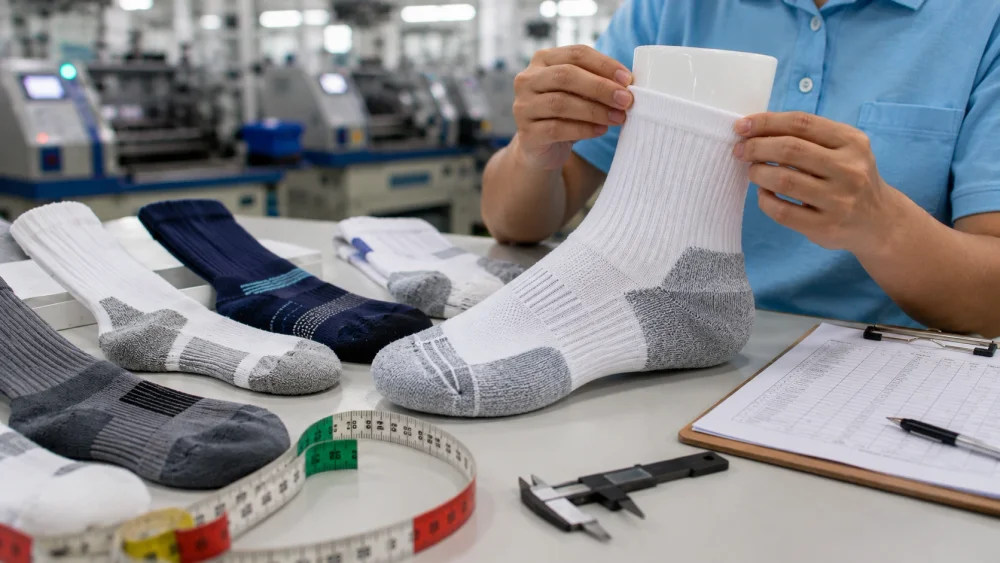
Many bulk problems begin because buyers send shoe sizes but fail to define finished sock measurements.
A sports sock has to stretch onto the foot while maintaining enough tension to stay in position during movement. That requires control over both dimensions and recovery.
The technical specification should define:
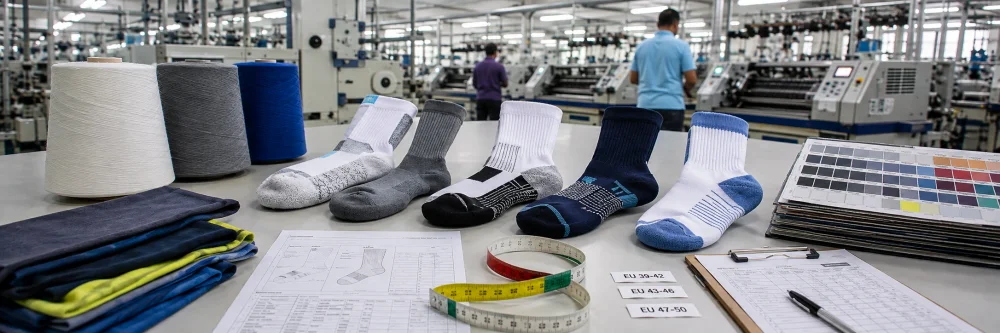
- Target shoe size range with the corresponding finished sock dimensions.
- Relaxed foot length and leg height for every size offered.
- Cuff width and required stretch without excessive pressure.
- Maximum or target stretched measurements where required.
- Heel position and heel pocket depth.
- Toe shape and finishing method.
- Acceptable dimensional tolerances.
- Size identification method on the sock or packaging.
- Required quantity ratio between different sizes.
For multi size programmes, buyers should approve the smallest and largest size rather than checking only the middle size.
Logo placement should also be checked across the complete size range. A knitted logo that looks proportionate on a large sock may become distorted on a smaller construction.
Heel, Arch, Toe and Cuff Construction Matter
The fit of a performance sock is controlled by more than overall length. Small construction differences can determine whether the sock remains stable during repeated movement.
Heel Pocket
The heel must sit in the correct position when the sock is stretched onto the intended foot size. A shallow or poorly positioned heel can cause movement inside the shoe and affect overall comfort.
Arch Support Zone
Some sports socks use additional elastic or structured knitting around the arch to improve stability.
The objective should be secure fit rather than excessive pressure. Any compression related marketing claim requires separate technical and regulatory consideration.
Toe Seam
A bulky or poorly finished toe closure can create a pressure point during repetitive movement.
The buyer should approve the seam construction by wearing the physical sample inside relevant footwear, not only by inspecting it visually.
Cuff
The cuff needs enough recovery to hold position without becoming uncomfortably tight.
This becomes particularly important for crew, football, riding and knee length sports socks where the leg section must remain stable during activity.
Build the Performance Specification Before Asking for Price
A serious quotation request should describe the product well enough for multiple suppliers to price the same construction.
Include the intended sport, user profile, destination market, sock length, fibre percentages, yarn requirements, cushioning zones, mesh areas, reinforcement, stretch zones, size chart, colour references, logo method, packaging, testing requirements, quantity and delivery terms.
Without this information, the lowest quotation may simply represent the lightest construction, cheapest yarn or simplest interpretation of the product.
Ready to Develop a Sports Sock Specification?
Send Costita your sport, target market, yarn preference, size run, cushioning requirement, logo artwork and expected quantity. We can convert the requirement into a supplier ready sourcing brief.
Testing Should Match the Performance Claim
Testing does not need to become unnecessarily complicated, but the buyer should test the characteristics that affect commercial performance and the claims that will appear on the finished product.
Fibre Composition
Laboratory analysis can confirm whether the finished product matches the declared fibre percentages.
This becomes especially important for private label products where the brand is placing fibre information on the final retail label.
Dimensional Change
Wash testing helps identify excessive shrinkage or growth.
Measure the sock before and after the agreed wash procedure and define the acceptable tolerance before bulk production begins.
Colourfastness
Dark sports socks, contrast logos and multi colour designs should be reviewed for colour change and colour transfer.
Depending on the product, testing may include washing, rubbing and perspiration exposure.
Abrasion and Pilling
Abrasion is particularly relevant around the heel, toe and other areas exposed to repeated friction.
Pilling can also affect the perceived quality of the product after repeated wear and washing, particularly for retail products positioned as premium.
Stretch and Recovery
Cuffs, arch bands and the body of the sock should recover after stretching.
A sock that appears correct immediately after manufacturing can still lose shape after repeated wear if elastic performance is weak.
Workmanship
Inspection should identify holes, loose yarns, dropped stitches, toe closing defects, uneven terry, mismatched pairs, incorrect logos and inconsistent lengths.
The inspection criteria should be written into the purchase order rather than decided after the goods have been produced.
Private Label Development Goes Beyond Adding a Logo
Custom sports socks can be developed around the complete product rather than simply changing colour or adding branding.
A private label buyer can evaluate fibre blend, yarn type, sock height, cushioning zones, mesh placement, reinforcement, rib structure, arch support, colours, knit logos, embroidery, patterns, size ranges, pair bands, hangtags, retail boxes, barcodes and export cartons.
The more variables added to the product, the more important sample control becomes.
Approve the physical sample, artwork, colour, complete size set and packaging before releasing bulk production.
Recycled Materials Are Becoming a More Serious Sourcing Conversation
Sustainability claims are moving closer to procurement documentation rather than remaining only a marketing message.
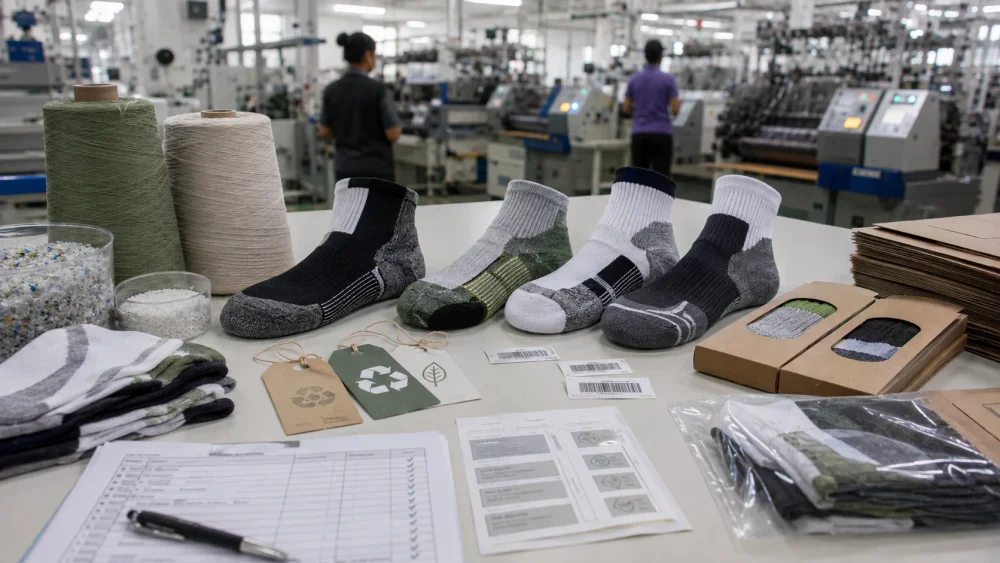
Textile Exchange reported approximately 9.3 million tonnes of recycled polyester production in 2024. Recycled polyester represented about 12 percent of global polyester production that year, while less than 1 percent of the overall fibre market came from recycled textile waste.
This is useful context for sportswear buyers because recycled polyester is commercially available, but a recycled claim should never be accepted only because the supplier writes “recycled yarn” on a quotation.
If recycled content is part of the product proposition, buyers can request recognised chain of custody evidence. Textile Exchange's Recycled Claim Standard and Global Recycled Standard are designed to verify recycled material claims and trace certified inputs through the supply chain.
Source: Textile Exchange Recycled Standards
For chemical safety requirements, buyers may also request recognised product certification where commercially appropriate. OEKO TEX STANDARD 100 evaluates textile components against a broad list of harmful substances and applies stricter criteria where products have greater skin contact.
Labelling Must Be Designed for the Destination Market
Private label packaging should not be printed until the destination market requirements have been checked.
In the United States, most covered textile products must disclose fibre content, country of origin and the identity of the manufacturer or another responsible business. Importers also need to consider separate Customs country of origin requirements.
Source: US Federal Trade Commission
In the European Union, textile products within the scope of Regulation EU 1007/2011 must use recognised fibre names and provide the required fibre composition information. The European Commission also provides guidance on how fibre composition should be determined for socks, including the treatment of certain reinforcement materials.
Retailers may impose testing, chemical, packaging or traceability requirements that go beyond the basic legal minimum. These should be confirmed before production and included in the buyer specification.
HS Classification for Sports Socks
Most ordinary knitted or crocheted socks fall within HS heading 6115. The final classification depends on construction and principal fibre.
Under current HS structures, common branches include cotton hosiery, synthetic fibre hosiery, wool hosiery and hosiery made from other textile materials. Graduated compression hosiery is classified separately.
Source: World Customs Organization
Do not copy a six digit code from another sock order simply because the products look similar.
The importer or customs broker should confirm the final national tariff line using the approved fibre composition and product construction.
India Already Has an Established Hosiery Export Base
India is not entering textile exports as a new sourcing destination. It already has a substantial textile manufacturing and export ecosystem supporting apparel, knitwear, hosiery, yarn and related products.
Government of India data reported textile and apparel exports, including handicrafts, of approximately USD 37.7 billion during financial year 2024 to 2025. India was identified as the sixth largest textile and apparel exporter globally, with about 4.1 percent of world exports in calendar year 2024.
Source: Government of India, Press Information Bureau
Product level hosiery data also demonstrates established international trade.
World Bank WITS data based on UN Comtrade reported approximately USD 25.54 million of Indian cotton knitted hosiery exports in 2023 under legacy HS classification 611592. Leading destinations included the United States, United Kingdom, France, United Arab Emirates and Spain.
Source: World Bank WITS, Cotton Hosiery
Synthetic fibre knitted hosiery exports from India under legacy code 611593 were approximately USD 18.51 million in 2023. The United States accounted for about USD 16.21 million, followed by markets including the United Arab Emirates, Australia, Canada and Saudi Arabia.
Source: World Bank WITS, Synthetic Hosiery
These figures cover broader hosiery categories rather than only sports socks. They should therefore be treated as evidence of manufacturing and export activity, not as sports sock market size.
Why Source Custom Sports Socks From India?
India offers international buyers a useful combination of textile manufacturing depth, access to different yarn categories, custom product development and an established export ecosystem.
Access to Cotton and Synthetic Supply Chains
Manufacturers can work across cotton rich, polyester, polyamide, elastane and specialised yarn combinations, allowing buyers to develop products at different performance levels and retail price positions.
Established Knitting Capability
India has established hosiery and knitwear manufacturing ecosystems that support yarn sourcing, knitting, dyeing, finishing, packaging and export operations.
Existing trade into the United States, Europe, Gulf markets and other destinations demonstrates an active international supply base.
Private Label Flexibility
Buyers can develop colour, cushioning, logo, size, fibre, packaging and construction combinations rather than relying only on standard catalogue products.
Multiple Price Positions
India can be evaluated for value retail, wholesale, institutional, sportswear and premium private label programmes.
The important comparison is landed value rather than factory price alone. Yarn quality, pair weight, rejected stock, testing, packaging, freight and order consistency can change the real cost significantly.
How to Compare Sports Sock Suppliers
Do not compare suppliers using quotation price alone.
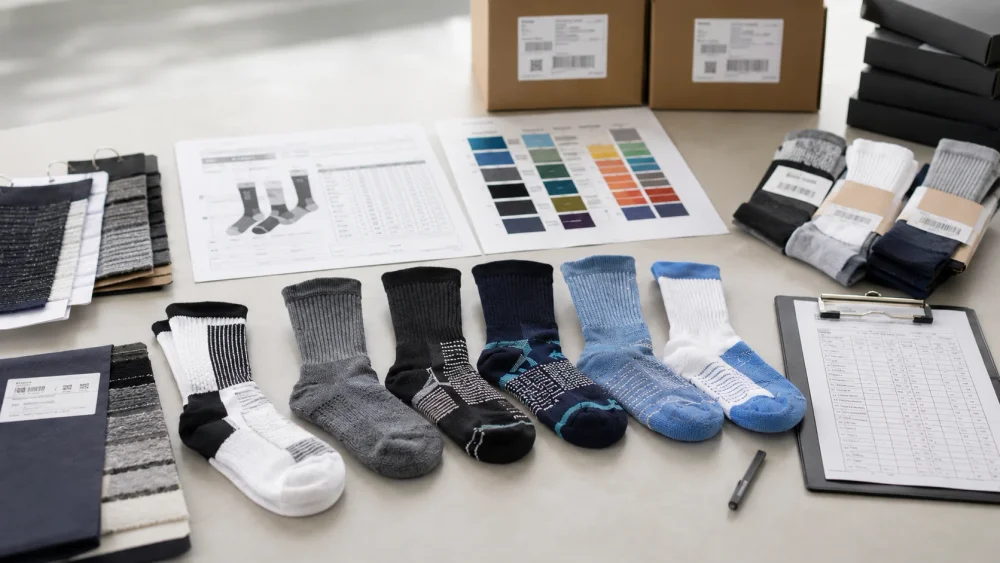
Give each shortlisted factory the same specification so that the commercial comparison reflects the same product rather than different interpretations of yarn, construction or weight.
Evaluate suppliers using:
- The proposed fibre composition and whether it matches the intended sport and retail positioning.
- The yarn specification and whether branded or specialist fibres can be verified.
- The finished pair weight because a lower quotation may come from reducing material usage.
- The factory's knitting capability for terry, mesh, reinforcement and custom performance zones.
- The exact cushioning construction offered in the sample.
- Heel and toe reinforcement where abrasion resistance is important.
- The supplier's interpretation of the required size chart and fit.
- The quality and repeatability of development samples.
- Testing evidence supporting composition, colourfastness, shrinkage and performance claims.
- The ability to produce knit logos, embroidery or other branding methods consistently.
- MOQ requirements by design, colour and size.
- Private label packaging and barcode capability.
- Production lead time from sample approval to shipment.
- The factory's in line and final inspection process.
- Previous export experience with the intended destination market.
- Final commercial terms including Incoterm, payment structure and shipment conditions.
A supplier offering a slightly lower price but changing yarn, pair weight or cushioning is not quoting the same product.
Source the Product, Not Just the Price
Already have a reference sock, specification or tech pack? Share it with Costita for supplier matching, sample coordination, commercial review, inspection planning and export support.
Frequently Asked Questions
What information should I send Costita for a custom sports sock quotation?
Send us the intended sport, target market, sock length, material preference, shoe size range, estimated quantity, colours, logo artwork, cushioning requirement and packaging preference. If you already have a physical sample or technical specification, that gives us a stronger starting point for supplier matching.
Which material is best for sports socks?
There is no single best material. Cotton rich blends can work well for comfort focused sports and general fitness. Polyester and polyamide can support lighter, faster drying and more durable performance constructions. Elastane supports stretch and recovery. Costita recommends selecting the blend around the sport, footwear, climate and target price.
Is full terry better than half terry for sports socks?
Not automatically. Full terry provides more cushioning but also creates more bulk. Half terry or targeted terry can be more suitable when the buyer needs underfoot cushioning with a lighter upper construction. Costita recommends testing the sock inside the actual type of footwear before approving the construction.
Can Costita source custom sports socks with our brand logo?
Yes. Depending on the product and supplier, custom development can include knit logos, embroidery, colours, yarn blends, patterns, sizes, pair bands, hangtags and retail packaging. MOQ depends on the number of designs, colours, sizes, yarn requirements and packaging configuration.
How should buyers check moisture wicking claims?
Ask what fibre, yarn or construction creates the performance and request supporting test evidence when moisture management forms part of the retail claim. Costita does not recommend relying only on marketing terms printed in a supplier catalogue.
Can we order sports socks using recycled polyester?
Yes, subject to supplier capability and order specifications. If your brand intends to make a recycled content claim, Costita recommends confirming the recycled percentage and requesting appropriate certification or chain of custody evidence before production.
Which HS code should we use when importing sports socks?
Most knitted sports socks fall within HS heading 6115, but the final six digit and national tariff classification depends on fibre composition and construction. Costita can provide the supplier's proposed classification, but the importer or customs broker should confirm the final code before shipment.
Final Buyer Takeaway
A reliable sports sock order is built around four controls: material, cushioning, fit and repeatability.
Lock those controls before negotiating the final price.
Define the sport first. Specify the yarn and construction. Approve the complete size set. Test the claims that will appear on the retail product. Keep the approved sample and technical specification connected to the purchase order and inspection.
That process gives importers, distributors and private label brands a much stronger basis for comparing suppliers and scaling repeat orders from India.