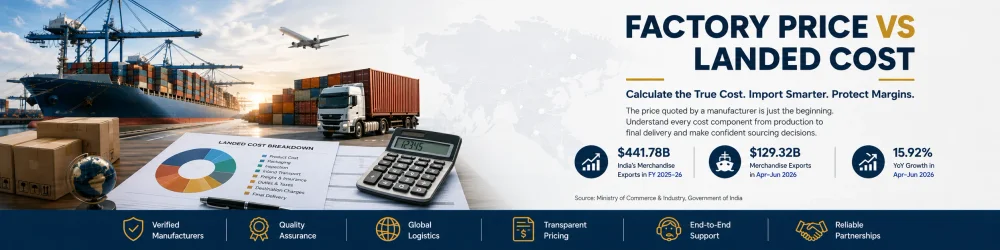
Factory Price vs Landed Cost: What Importers Must Calculate Before Confirming a Bulk Order
What Does Factory Price Actually Include?
Factory price is an informal commercial expression. It is not an official Incoterm, and different manufacturers may use it differently. One supplier may include basic cartons, while another may exclude packaging, loading and export documentation.
Before comparing quotations, buyers should ask each supplier to confirm the following points in writing.
Product Specification
Confirm the exact material, composition, dimensions, colour, construction and performance specification included in the quoted price.
Packaging and Branding
Confirm whether standard packaging, export cartons, pallets, labels, barcodes and private branding are included.
Testing and Inland Movement
Confirm whether testing, inspection, factory loading and Indian inland transportation are included or charged separately.
Export Responsibilities
Confirm whether the supplier is responsible for export customs clearance, documentation and origin terminal charges.
Commercial and Delivery Terms
Confirm the agreed Incoterm, named delivery location, quotation currency, payment terms and quotation validity period.
Factory Price Is Not Automatically EXW
EXW is an official Incoterm. Under EXW, the seller generally makes the goods available at the named location while the buyer assumes most collection, loading, export clearance and transport responsibilities.
FCA may be more practical for many export orders because the seller completes export customs clearance and delivers the goods to the buyer’s nominated carrier at the agreed location.
What Is Total Landed Cost?
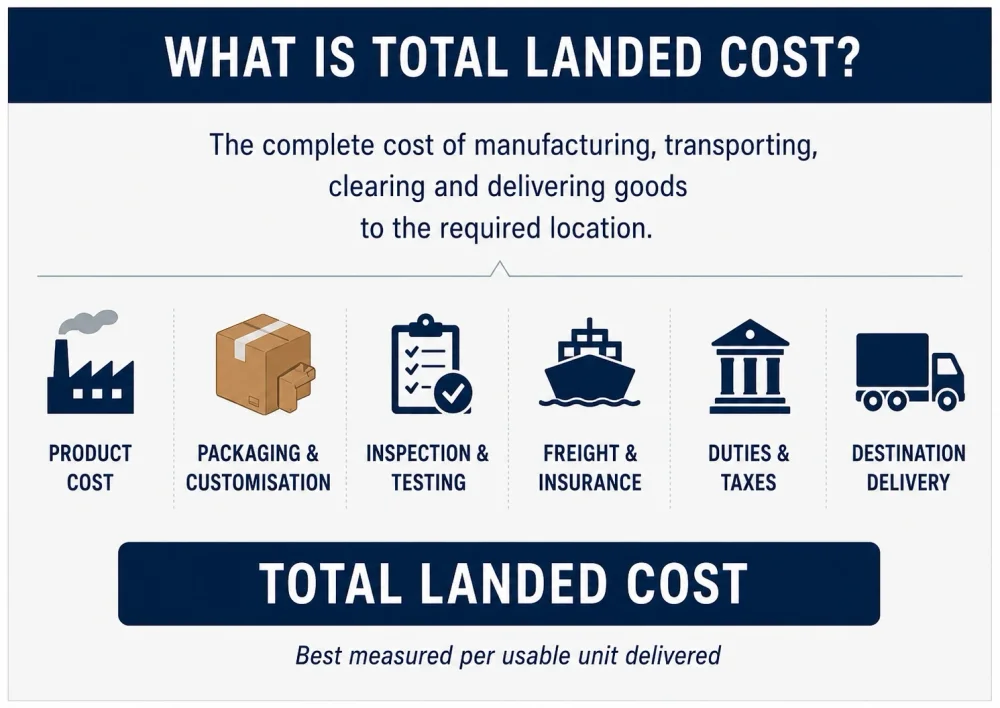
Total landed cost is the complete cost of manufacturing, preparing, transporting, clearing and delivering an imported order to the buyer’s agreed destination.
The destination must be defined before the calculation begins. Delivery to a port, customs warehouse, distribution centre or buyer warehouse will produce different cost totals.
Product Cost
Manufacturing cost based on the approved material, construction, quantity and quality specification.
Packaging
Retail packaging, export cartons, pallets, moisture protection, labels and private branding.
Quality Control
Sample approval, laboratory testing, production checks and pre shipment inspection.
Origin Charges
Indian inland movement, export clearance, documentation, port handling and cargo preparation.
Freight and Insurance
Ocean or air freight, carrier surcharges, cargo insurance and route related charges.
Destination Costs
Customs duties, taxes, brokerage, terminal handling, storage and final warehouse delivery.
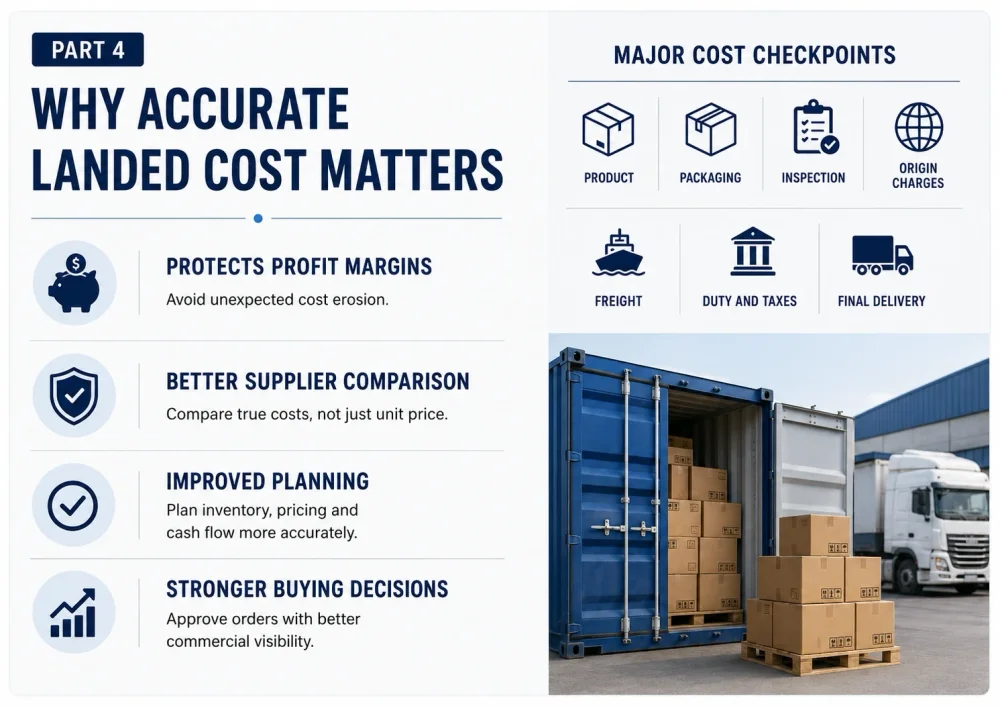
Product cost + packaging + inspection + origin charges + freight + insurance + duties + taxes + destination handling + final delivery
Total landed cost ÷ quantity of usable products received
Product, Packaging and Customisation Costs
The base product price should always be connected to an approved specification. A photograph, product name or short description is not enough for a reliable bulk quotation.
Garment and sock prices can change with fibre composition, yarn quality, fabric weight, knitting construction, colour, size ratio and branding. Tile costs can change with dimensions, thickness, finish and breakage protection. Tableware prices can change with material, size, thickness and packing density.
Private Label Costs
- Logo printing or embroidery
- Custom colours and dimensions
- Retail boxes and product inserts
- Barcodes and country of origin labels
- Moulds, dies and printing screens
Export Packaging Costs
- Stronger master cartons
- Pallets, crates and strapping
- Moisture and corner protection
- Container desiccants where required
- Destination specific carton markings
Inspection Should Be Planned Before Production
An approved sample is useful, but it does not control bulk production unless it is supported by a written specification covering material, dimensions, tolerances, colour, construction, packaging and performance requirements.
Confirms raw materials, components, specifications and production readiness before manufacturing begins.
Identifies workmanship, measurement or material problems while corrective action is still practical.
Checks finished quantity, quality, packing, labels and conformity before the goods leave the factory.
Finding a defect before shipment is normally less expensive than finding it after freight, duty, storage and distribution costs have already been incurred.
Know the Real Import Cost Before Approving Production
Compare manufacturing, packaging, inspection, freight and delivery responsibilities before committing working capital to a bulk international order.
Charges Between the Factory and Export Port
Once production is complete, the cargo must be prepared and moved through India’s export process. These expenses may be included in the supplier quotation, freight quotation or invoiced separately.
- Factory loading and transportation to the port, airport, inland container depot or consolidation warehouse.
- Container stuffing, palletisation, weighing, cargo handling and storage before departure.
- Export customs broker services, shipping bill preparation and documentation support.
- Port, terminal, container freight station and origin handling charges.
- Certificate of origin, fumigation, inspection, phytosanitary or product specific documentation where applicable.
Indian GST and Export Orders
Exports from India are generally treated as zero rated supplies under GST. International buyers should not automatically assume that domestic Indian GST must remain as a permanent additional charge on an export order.
The exporter’s commercial price may still reflect compliance work, input tax timing and working capital requirements.
International Freight Is Time Sensitive
Freight depends on the origin and destination, container type, cargo volume, weight, equipment availability, fuel cost, port congestion, carrier capacity, route security and shipment date.
Global freight indices can show the direction of the market, but they are not substitutes for a route specific quotation from the selected Indian origin to the buyer’s destination.
| Freight Detail | What the Buyer Should Confirm |
|---|---|
| Routing | Direct service or transshipment service, including the transfer port. |
| Transit time | Estimated port to port and door delivery time. |
| Surcharges | Fuel, security, congestion, peak season and environmental charges. |
| Destination fees | Charges excluded from the main international freight rate. |
| Validity | The date on which the freight quotation expires. |
| Free time | Allowed terminal and container time before additional charges apply. |
Customs Value, HS Classification and Origin
Customs value is a legal value used to assess imports. It is not the same as the buyer’s complete landed cost. The commercial invoice is usually the starting point, but customs rules may require additions or adjustments.
Customs Value
Packing, buyer supplied materials, royalties, commissions or other payments may affect the value accepted for customs purposes.
HS Classification
Material, construction, composition and intended use can change the tariff classification and applicable import requirements.
Country of Origin
Origin can influence preferential duties, marking rules, quotas and trade remedy measures.
A Certificate of Origin does not automatically provide a lower duty. The goods must satisfy the product specific rules under the relevant trade agreement, and the importer must make the claim correctly.
Duties, Taxes and Final Delivery Charges
Customs duty must be checked using the destination country, exact tariff code, country of origin, import date, applicable trade agreement and any anti dumping or safeguard measures.
Government Charges
- Customs duty
- Import VAT or GST
- Trade remedy duties
- Inspection or permit charges
- Product specific regulatory fees
Logistics Charges
- Terminal handling
- Delivery order charges
- Customs broker fees
- Storage and container handling
- Final warehouse transportation
Recoverable Import Tax
Import VAT or GST may be recoverable for an eligible registered business, but it can still create a cash flow requirement when the goods enter the country.
Procurement models should show both the gross cash required at import and the net landed cost after recoverable tax.
How a $2.00 Factory Price Becomes a $2.91 Usable Unit Cost
Consider an illustrative order of 10,000 pairs of private label socks. The figures below are an educational calculation and not a live market quotation.
| Cost Item | Illustrative Amount |
|---|---|
| Product cost | $20,000 |
| Packaging and private labels | $800 |
| Quality inspection | $400 |
| Indian inland transportation | $900 |
| Origin handling and documentation | $600 |
| International freight | $3,500 |
| Cargo insurance | $150 |
| Destination handling and brokerage | $1,200 |
| Warehouse delivery | $1,000 |
| Total before duty and import tax | $28,550 |
Calculated cost: approximately $2.86 per ordered pair.
After 200 damaged or rejected pairs, the cost becomes approximately $2.91 per usable pair.
How Buyers Can Reduce Landed Cost Without Reducing Quality
Improve Container Utilisation
Review carton dimensions, units per carton, gross weight and cubic volume before production to reduce freight cost per unit.
Confirm Packaging Early
Approve labels, barcodes, carton marks and destination requirements before production to avoid repacking and delay.
Select the Correct Incoterm
Choose the responsibility structure based on the buyer’s freight, customs and destination delivery capabilities.
Inspect Before Dispatch
Prevent unsuitable goods from generating additional freight, customs, storage, return or replacement expenses.
Confirm Duty Before Production
Review the tariff code, country of origin and trade agreement treatment before approving the purchase order.
Measure Usable Units
Compare supplier performance using products that can actually be sold or used, not only the invoiced quantity.
Why Source from India Through Costita?
India offers diverse manufacturing categories, specialised supplier regions and strong private label capability. The commercial advantage depends on matching the product with the correct supplier and defining responsibilities before production begins.
Costita helps buyers structure sourcing requirements around product specifications, supplier coordination, quality inspection, freight assumptions and delivery responsibilities.
Stop Comparing Incomplete Supplier Quotations
Share your product, quantity, destination and packaging requirements to build a clearer view of manufacturing, inspection, freight and delivery costs.
Frequently Asked Questions
Is factory price the same as EXW?
No. Factory price is an informal description and can include different costs depending on the supplier. EXW is an official Incoterm with defined responsibilities. Costita recommends obtaining a written list of every inclusion and exclusion.
Which costs are normally excluded from factory price?
Common exclusions include private packaging, inspection, inland transportation, export clearance, port handling, freight, insurance, customs duty, import tax, destination handling and final delivery.
Can Costita estimate landed cost before an order?
A provisional estimate can be prepared when the product, quantity, destination, packaging, weight, volume and transport method are available. Freight, tariffs and exchange related costs should be reconfirmed before shipment.
Which Incoterm is best for importers?
There is no single best Incoterm. FCA may suit buyers who manage their own freight, while DAP may suit buyers who want transport arranged to the named destination but will handle import clearance and duties.
Does a lower factory price mean a lower landed cost?
Not always. A lower unit price can be offset by weak packaging, high rejection rates, inefficient cartons, longer inland transportation or unexpected destination charges. Compare the delivered cost per usable unit.
Why source products from India through Costita?
India offers specialised manufacturing, product diversity and private label capability. Costita supports supplier coordination, specification clarity, inspection planning and logistics visibility so buyers can make better informed purchasing decisions.
Compare Landed Cost per Usable Unit
Factory price is only the beginning. A complete import calculation includes packaging, inspection, origin charges, freight, insurance, duties, taxes, destination handling and final delivery.