How to Source Hotel Bedding from India: Buyer Guide for Hotels and Distributors
Hotel bedding is not just a furnishing purchase. For hotels, resorts, serviced apartments and distributors, it is a working product that has to survive frequent laundering, maintain a consistent appearance and remain available for replacement orders.
That means buyers should not compare suppliers only by thread count or unit price. The stronger approach is to define the specification, test the product under realistic laundry conditions, approve a physical reference and then compare commercial terms.
Start With a Clear Hotel Bedding Specification
A request such as premium white cotton hotel sheets is too open for accurate supplier comparison. Before asking for quotations, the buyer should convert the room and laundry requirement into a measurable product specification.
The same specification should be sent to every shortlisted supplier. Otherwise, two quotations that appear similar may cover different fabric weights, dimensions, sewing standards or shrinkage performance.
Specify flat sheet, fitted sheet, duvet cover, pillowcase, protector, comforter or the required complete room set.
Provide width, length, mattress depth and the required dimensional tolerance instead of relying only on King, Queen or Double labels.
State cotton or blend percentage, weave, thread count, fabric weight and any required finishing treatment.
Define acceptable shrinkage, appearance, colour or whiteness and construction performance after laundering.
Record hem width, seams, elastic, pillowcase flap depth, duvet closure and other operational details.
Provide annual volume, order split, packaging, labels, destination country and expected replenishment requirements.
Use Actual Bed Measurements
Bed labels are not reliable manufacturing specifications. A King mattress in one market can have different dimensions from a King mattress elsewhere, while toppers and deeper mattresses can change fitted sheet requirements considerably.
For hotel groups operating multiple properties, an approved size library can prevent repeated measurement errors and make replenishment much easier.
| Product | Key Buyer Control | Common Sourcing Risk |
|---|---|---|
| Flat Sheet | Width, length, tuck allowance and finished shrinkage. | Sheet becomes too short for proper bed making after repeated laundering. |
| Fitted Sheet | Mattress width, length, pocket depth and elastic construction. | Corners release from deeper mattresses or shrink below the required fit. |
| Duvet Cover | Finished dimensions, opening position and closure method. | Duvet movement or slower housekeeping changes. |
| Pillowcase | Pillow dimensions and envelope flap depth. | Pillow remains exposed or the case becomes oversized after washing. |
| Mattress Protector | Finished fit, absorbency and waterproof layer where required. | Poor fit, excessive noise or membrane failure. |
| Comforter | Shell fabric, filling material, filling weight and quilting. | Uneven filling, excessive bulk or difficult laundering. |
Choose Material Based on Hotel Operations
There is no single best material for every hotel. The right choice depends on room positioning, guest expectations, laundry conditions, climate and replacement economics.
Comfort Led
Cotton offers a familiar natural feel, breathability and absorbency. Buyers should still control shrinkage, drying requirements and repeated wash performance.
Best suited to premium and comfort focused hospitality programmes.Operational Balance
Polycotton can support quicker drying, easier finishing and stronger dimensional stability. The exact cotton and polyester ratio should be specified.
Best suited to high turnover rooms and commercially focused laundry operations.Selected Commercial Use
Microfiber and other synthetic constructions can support quick drying and lower cost, but comfort, pilling and long term appearance should be checked.
Best suited to selected budget, institutional and staff accommodation programmes.Do Not Buy Bedding on Thread Count Alone
Thread count helps describe fabric construction, but it is not a complete quality score. A higher number does not automatically mean stronger, more comfortable or more durable hotel linen.
Buyers should review thread count together with yarn, weave, weight, shrinkage and service performance.
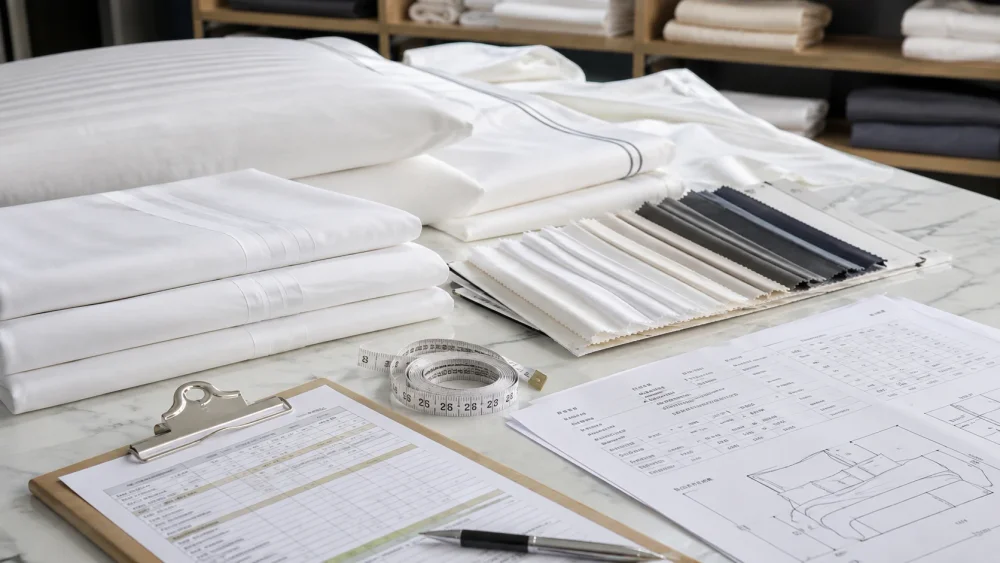
Percale and Sateen Serve Different Buying Priorities
Percale normally provides a crisp, clean hotel feel and is often considered where breathability and straightforward commercial presentation are important.
Sateen has a smoother surface with more lustre and can support a more premium room presentation. Neither construction is automatically better, so buyers should evaluate the fabric against room positioning and laundry performance.
Useful where hotels want a fresh surface, breathable feel and traditional commercial linen appearance.
Useful where guest feel and premium visual presentation carry greater importance.
Laundry Testing Should Happen Before Bulk Approval
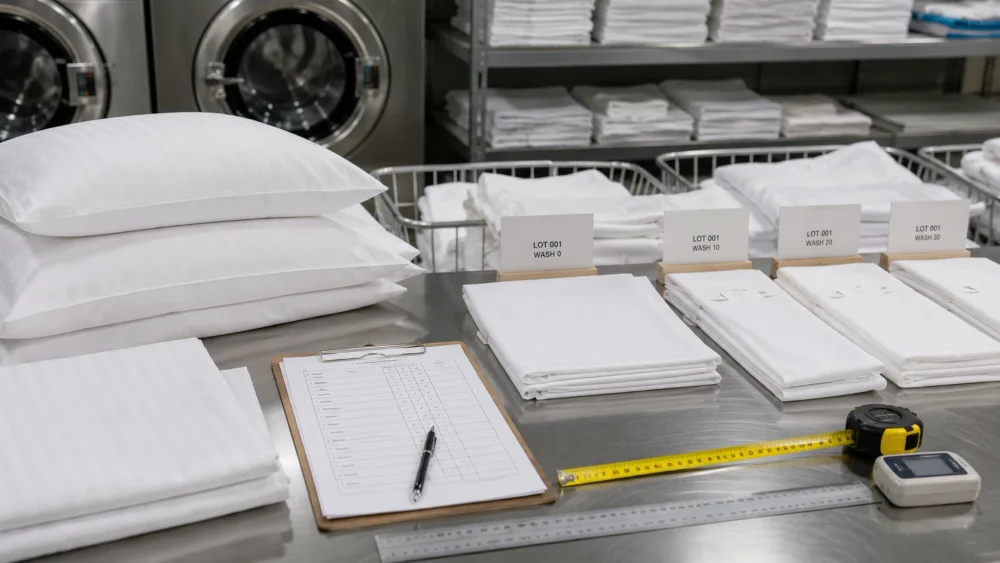
A hotel sheet should not be approved only when it is new. Commercial bedding is repeatedly washed, extracted, dried, folded and handled, which can expose problems that are invisible during first sample inspection.
A controlled laundry trial should therefore form part of product approval and reflect the intended washing and drying conditions as closely as practical.
- Measure the finished product before and after laundering to identify shrinkage, growth or distortion.
- Check white shade or colour retention after the agreed wash cycles.
- Inspect seams, hems, elastic and closures for damage or deformation.
- Review pilling, fuzzing and surface deterioration that could affect guest perception.
- Compare overall hand feel and appearance against the approved product requirement.
ISO 6330 provides standardised textile washing and drying procedures. ISO 105 C06 covers colour resistance to domestic and commercial laundering.
Set a Measurable Shrinkage Limit
Terms such as pre shrunk do not provide buyers with a measurable acceptance standard. The purchase specification should state the maximum allowable dimensional change.
This is particularly important for fitted sheets, pillowcases and duvet covers where relatively small dimensional changes can create housekeeping problems.
White Hotel Linen Needs Shade Control
White bedding from different production lots can look noticeably different when used together. One supplier may produce a cooler optical white while another produces a warmer shade.
For repeat hotel programmes, retain an approved white reference and use it when evaluating subsequent production. This becomes particularly important when replacement stock is mixed with existing room linen.
Construction Details Affect Daily Hotel Operations
Small construction details rarely appear in marketing photographs, but they directly affect housekeeping speed, fit and product life.
Control hem width, sewing consistency and finished dimensions so sheets tuck correctly after laundering.
Specify pocket depth, elastic width and whether elastic runs around the full sheet or selected sections.
Choose the required opening position and closure method based on housekeeping workflow and guest comfort.
Control finished size and envelope depth so the pillow remains fully covered after repeated washing.
Source the Specification Before the Price
Send Costita your bed sizes, mattress depth, laundry conditions, fabric preference, quantity and destination market. We can help convert the requirement into a supplier ready bedding brief.
Standardise the SKU Range Where Possible
Hotels and distributors can create unnecessary complexity by developing too many sizes, thread counts, blends and packaging variations.
Standardising the base construction while changing only necessary dimensions or room positioning can improve purchasing leverage and make replenishment easier.
Compare Suppliers Using the Same Product
Do not compare hotel bedding suppliers using quotation price alone. Every shortlisted factory should quote against the same fibre, weave, weight, dimensions, construction, packaging and testing requirement.
If one supplier changes material weight or construction, the quotations are no longer directly comparable.
| Procurement Factor | Buyer Question |
|---|---|
| Fibre | Is the declared composition identical across all quotations? |
| Thread Count | Is every supplier quoting the same construction? |
| Fabric Weight | Does the bulk proposal match the material usage of the approved sample? |
| Weave | Are all suppliers quoting the same percale, sateen or other construction? |
| Finished Size | Are dimensions and tolerances identical? |
| Shrinkage | What maximum dimensional change is being guaranteed? |
| Packaging | Are piece counts, labels and carton specifications equivalent? |
| MOQ | Is the MOQ total, per size, per colour or per construction? |
| Lead Time | Does the quoted lead time include fabric and sample approvals? |
| Repeat Supply | Can the same construction be reproduced later? |
Keep an Approved Reference Sample
Once a development sample passes size, laundering and quality review, keep it as the controlled production reference.
This gives the buyer and factory one physical standard for comparing the first bulk order and later replenishment production.
Inspection Should Cover More Than Visible Defects
Pre shipment inspection should confirm that production matches the agreed commercial specification, not only that the bedding looks acceptable.
- Verify quantities and the correct size assortment against the purchase order.
- Measure finished dimensions and compare them with the approved tolerances.
- Review fabric appearance, stains, weaving defects, shade and white consistency.
- Inspect sewing, hems, elastic, pillowcase flaps and duvet closures against the approved construction.
- Check labels, private branding, individual packs, carton markings and packing quantities.
- Confirm required laboratory evidence corresponds with the agreed product or material requirement.
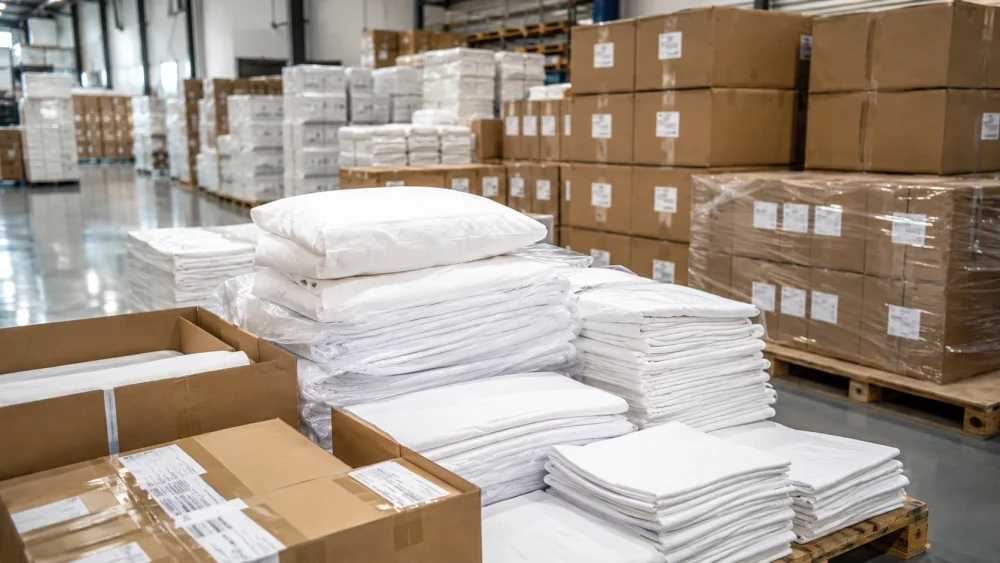
Packaging Should Match the Buyer’s Operation
Hotels may prefer simple bulk packaging because decorative retail packs add cost and waste. Distributors may need individual packs, barcodes, private labels and customer specific presentation.
Master cartons should make receiving and stock handling easy while using container space efficiently.
Focus on product protection, easy identification and efficient warehouse handling.
Add barcode, branding, size information and customer specific identification where required.
Display product, size, quantity, purchase order and property or customer reference.
Review fold method, compression and carton dimensions before calculating final landed cost.
Confirm Destination Market Labelling
Textile labelling requirements vary between markets, so private label packaging should not be finalised until the destination country's requirements are confirmed.
| Market | Key Buyer Control | Reference |
|---|---|---|
| United States | Most covered textile products require fibre content, country of origin and manufacturer or responsible business identification. | FTC Textile Labelling |
| European Union | Textile products require appropriate fibre composition information under Regulation EU 1007/2011. | EU Textile Regulation |
Consider Chemical Safety and Certification
Hotel bedding has direct and prolonged skin contact. OEKO TEX STANDARD 100 is widely used to assess textiles for harmful substances and places bed linen within its direct skin contact category.
If certification forms part of the purchase requirement, buyers should verify the validity and scope of the actual supplier certificate rather than relying on a logo or general declaration.
India Has an Established Bed Linen Export Base
India already supplies substantial volumes of cotton bed linen internationally. World Bank WITS data for 2024 records approximately USD 485.94 million of Indian exports under HS 630231 for non printed cotton bed linen, representing about 46.4 million kilograms.
India also exported approximately USD 107.44 million of printed cotton bed linen under HS 630221 during 2024. These categories cover broader bed linen rather than hotel bedding alone, but they show an established international production and export base.
Why Source Hotel Bedding From India?
India combines a large cotton and home textile manufacturing base with established international bed linen exports and access to private label production.
The advantage is strongest when buyers use that manufacturing capacity with clear specifications, controlled samples and independent quality checks.
Cotton and Blended Options
Buyers can source different cotton constructions, blends, yarn counts, weaves and commercial price positions.
Home Textile Capability
India has established weaving, processing, sewing and made up textile manufacturing serving international buyers.
Private Label Flexibility
Hotels and distributors can specify custom dimensions, fabric, thread count, labels, packaging and product combinations.
International Supply Experience
Existing bed linen exports reach major markets including the United States, Canada, Germany, United Kingdom and Australia.
Look at Landed Cost and Product Life
The lowest factory quotation is not always the lowest operating cost. Bedding is volume intensive, so packing and freight can materially change the commercial result.
Hotels should also consider how long linen remains acceptable in service. A stronger product that survives more usable wash cycles can outperform a lower priced product that needs early replacement.
Repeat Supply Is Part of the Product
Hotel bedding is rarely a one shipment purchase. Linen wears out, rooms are added and distributors need replenishment stock.
Before awarding the programme, confirm that the supplier can reproduce the same fabric, dimensions, weave, shade and sewing construction later. Changes in material or processing should be communicated before repeat production begins.
Frequently Asked Questions
What thread count is best for hotels?
There is no single best thread count. Costita recommends evaluating thread count together with fibre, yarn quality, weave, fabric weight, laundry performance and the intended room positioning.
Is cotton better than polycotton for hotel bedding?
It depends on the property. Cotton can offer a natural feel and strong guest comfort, while polycotton can support faster drying, easier care and dimensional stability. The hotel's laundry process should influence the final choice.
Can Costita source custom hotel bedding sizes?
Yes. Bedding can be developed around specific mattress, sheet, duvet and pillow dimensions, subject to supplier capability and MOQ. Exact finished measurements should be provided rather than relying only on King or Queen labels.
What MOQ should a hotel or distributor expect?
MOQ depends on fabric, weave, thread count, colour, number of sizes, customisation and packaging. Costita confirms the commercial minimum against the actual buyer specification.
Should hotel bedding be wash tested before production?
Yes. Costita recommends evaluating the sample after laundering because dimensions, appearance, seams and fabric behaviour can change during washing and drying.
Can Costita support private label hotel bedding?
Yes. Depending on supplier capability, buyers can develop custom dimensions, labels, packaging, colours and product configurations for hospitality, wholesale and private label programmes.
What should be checked before shipment?
Final inspection should check quantity, dimensions, fabric appearance, shade, stitching, closures, labels, packaging and carton markings against the approved specification and reference sample.
Final Buyer Takeaway
Hotel bedding sourcing is about consistency. Define exact dimensions, fibre, weave, thread count and fabric weight together. Approve the product after laundering and set measurable shrinkage limits.
Keep an approved physical sample, compare every supplier using the same specification and make repeat supply part of the original buying decision.
Build a Bedding Programme, Not Just One Shipment
Planning hotel or distributor bedding orders from India? Costita can support supplier matching, samples, quality control, private label packaging and export coordination.