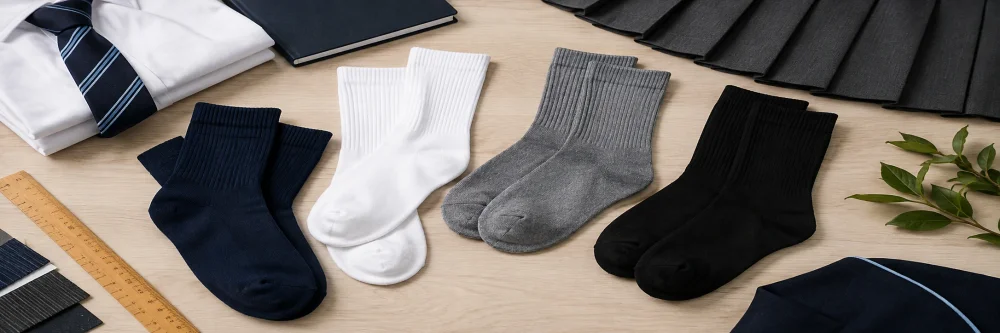
School Socks Sourcing Guide for Uniform Suppliers and Retailers
School socks are a repeat purchase uniform item, but they should not be sourced like a generic low cost sock.
For uniform suppliers, distributors and retail procurement teams, the commercial risk is usually not whether the first sample looks acceptable. The real test is whether the supplier can reproduce the same navy, grey, white or school specific stripe across several sizes, thousands of pairs and multiple replenishment orders.
A reliable school sock programme therefore starts with four controls: material, fit, colour and repeatability. Price comes after those are defined.
Start With the Uniform Standard
Before requesting quotations, convert the school requirement into a measurable product specification. A photograph of an existing sock is useful for reference, but it is not enough for production.
Two factories can copy the same photograph using different yarn blends, knit densities, elastic constructions and pair weights, producing products with very different durability and cost. Every shortlisted supplier should therefore receive the same technical and commercial brief.
Identify the programme clearly so colour, branding, packaging and repeat orders can be controlled against the correct approved sample.
Link commercial sizes to actual shoe sizes rather than relying only on age, class level or small, medium and large labels.
Define ankle, crew, mid calf or knee length together with fibre composition, cushioning and elastic performance.
Approve the physical shade, stripe width, logo method and placement before production begins.
Provide size ratios, total volume, private label requirements, destination market and required delivery date.
Record the performance requirements that will be checked during testing and final inspection.
School Socks Should Be Designed for Repeated Washing
School socks are worn frequently and often enter a harder wash cycle than fashion socks. A product that feels soft when new can still be a weak uniform product if it shrinks, pills, loses colour or develops a loose cuff after repeated washing.
For uniform procurement, buyers should judge quality after laundering, not only before it. The most useful controls are dimensional stability, colour retention, surface appearance, elastic recovery and resistance to wear around the heel and toe.
Dimensional Stability
Measure foot length, leg height and cuff dimensions before and after the agreed wash procedure to identify shrinkage, growth or distortion.
Colour Retention
Dark navy, grey and striped socks should maintain the approved shade and resist unacceptable colour transfer during repeated laundering.
Elastic Recovery
The cuff should recover after stretching and washing so the sock remains secure without becoming excessively tight.
Surface Appearance
Pilling, fuzzing and abrasion can make a technically usable sock appear worn early and reduce perceived uniform quality.
ISO 6330 provides standardised domestic washing and drying procedures for textile testing. ISO 105 C06 covers colour resistance to domestic and commercial laundering.
Cotton Rich or Synthetic Blend?
There is no universal fibre composition for school socks. The right blend depends on climate, retail price, wash frequency, school policy and the expected product life.
Fibre percentage should therefore be treated as one part of the specification rather than a complete quality measure. Yarn quality, knitting density, finishing and elastic construction can change the performance of two socks carrying similar fibre declarations.
Cotton Rich
Useful where softness and familiar everyday comfort are important. Cotton is commonly blended with polyester, polyamide or elastane to improve strength and recovery.
Best fit: everyday uniforms, warm climates and comfort led rangesPolyester Blends
Can support durability, colour stability, quicker drying and commercial cost control for high volume programmes that are washed frequently.
Best fit: high volume uniform programmes and durability led rangesPoly Viscose
Can provide a smooth uniform appearance with a different handle and cost structure from conventional cotton rich constructions.
Best fit: selected school uniform and institutional programmesCostita's current school sock range includes cotton and poly viscose constructions, showing the different sourcing options available within the Indian supplier base. View a current Costita school sock product.
Non Terry Is Often the Practical Everyday Construction
For standard classroom uniforms, non terry socks provide a lighter construction with less bulk inside the school shoe. This can suit warm climates, everyday uniform programmes and price sensitive retail ranges.
Terry construction becomes more relevant where buyers require additional cushioning or warmth, including winter ranges, heavier footwear and school sports applications. Terms such as cushioned, soft sole or thick quality should not replace an exact construction specification.
Lower bulk, practical for regular classroom use and suitable where the school shoe already fits closely.
Useful where additional cushioning is required without increasing thickness throughout the entire sock.
More suitable for colder climates, heavier school footwear or sport related uniform requirements.
Sock Weight Is an Important Commercial Control
Two school socks with the same colour, size and fibre percentages can still contain different amounts of yarn. A lower quotation may therefore reflect a lighter knit rather than better manufacturing efficiency.
Record the approved sample weight together with dimensions, yarn composition and construction. The objective is not to buy the heaviest sock, but to prevent unnoticed material reduction between sampling, bulk production and later replenishment orders.
Compare price together with pair weight, yarn specification and knit construction. If one supplier changes any of these variables, the quotation is no longer for the same product.
Fit Should Be Based on Shoe Size, Not School Class Alone
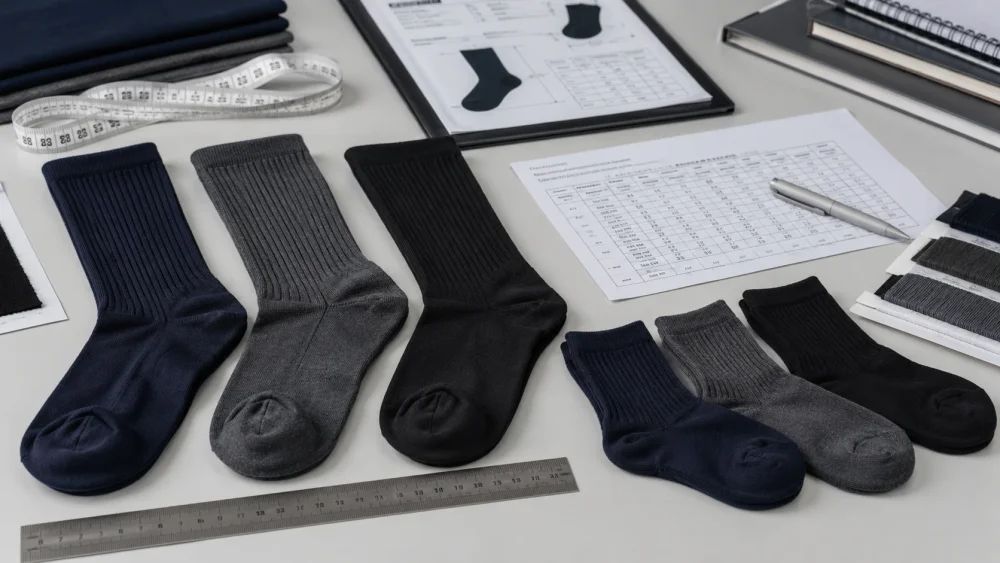
Uniform suppliers often receive requirements such as small, medium and large or Class 1 to Class 4. Those labels may work at retail, but they are not precise manufacturing specifications because children of the same age can wear different shoe sizes.
Each commercial size should therefore be linked to a defined shoe size range and finished sock measurements. Buyers should approve the smallest and largest size in the programme rather than relying only on the middle size.
Set the relaxed finished measurement and tolerance for every commercial size.
Control height from the heel to cuff so the uniform appearance remains consistent across sizes.
Specify relaxed width and stretch behaviour so the sock stays secure without excessive pressure.
Check that the heel pocket sits correctly on the intended shoe size and does not pull under the foot.
Review toe length, seam quality and fit inside the intended school footwear.
Check whether the sock returns close to its original shape after stretching and laundering.
The Cuff Must Stay Up Without Becoming Too Tight
Cuff performance is one of the most visible quality issues in school socks. A weak cuff slips during the school day, while an excessively tight cuff creates discomfort and can make the product difficult to wear.
Approve both fit and elastic recovery, then repeat the evaluation after laundering. This becomes particularly important for knee length school socks because the longer leg section places more demand on cuff recovery.
Insufficient recovery can lead to slipping, bunching around the ankle and an untidy uniform appearance.
The cuff holds its position during normal movement while remaining comfortable through a school day.
Excessive tension can create pressure marks and generate fit complaints even when the dimensions are technically correct.
Heel and Toe Construction Affect Replacement Rate
School shoes create repeated friction around the heel and toe. If these areas fail early, parents and retailers judge the entire sock as poor quality even when the remaining fabric is still usable.
Buyers should review yarn density, reinforcement strategy and workmanship around these areas. Where durability is commercially important, recognised abrasion and pilling methods can be included in the laboratory plan.
The ISO 12947 series covers Martindale abrasion testing, while the ISO 12945 series covers pilling, fuzzing and matting resistance.
Colour Consistency Is a Uniform Requirement
Fashion retailers can sometimes tolerate small shade movement between seasons. School uniform programmes often cannot. A navy sock that visibly changes shade against the trouser, skirt or blazer can be rejected even when the physical quality is otherwise acceptable.
Lock the colour reference before production and approve a physical yarn or finished sock sample. Pantone references are useful for communication, but yarn can appear different from a printed chip under different lighting conditions.
Use a defined colour reference and retain the approved physical sample for production comparison.
Require commercially acceptable shade consistency within the order and across repeat production.
Confirm stripe sequence, width and distance from the cuff across the entire size range.
Every replenishment order should reference the original approved shade rather than a new interpretation.
Logos and School Branding Need Size Control
Some uniform programmes use a knitted school name, emblem, initial or custom stripe pattern. The artwork needs to remain readable after stretching and washing, and the design must work on the smallest sock as well as the largest.
For distributors managing several schools, each colour combination, logo and size can create additional SKUs. Commercial efficiency normally improves when the underlying sock construction is standardised and customisation is concentrated on the visible uniform elements.
Lock the Specification Before You Request Bulk Pricing
Send Costita your school colours, size range, sock length, material preference, annual volume and delivery market. We can turn the requirement into a supplier ready sourcing brief.
Build a Size Ratio Before Placing the Order
Buying equal quantities of every size is rarely the strongest inventory strategy. A uniform distributor should use historical sales, enrolment data or retailer sell through information to create a size ratio that reflects actual demand.
The purchase order should show quantity by size rather than only total pairs. A distributor can technically have enough total inventory while still losing sales because the highest demand size is unavailable.
School Calendar Planning Matters More Than Factory Lead Time Alone
A uniform order is tied to a fixed school opening date, which makes late delivery more commercially damaging than in many standard apparel categories.
The sourcing calendar must include colour approval, sample development, size approval, packaging, laboratory testing where required, bulk production, inspection, freight and customs clearance. Replenishment programmes should also confirm that the supplier can reproduce the same yarn, colour and construction later in the school year.
Lock construction, colour, size range and packaging.
Approve physical product, sizing and branding.
Complete required wash, colour and compliance checks.
Manufacture against the approved specification.
Check quantity, workmanship, colour and packaging.
Leave sufficient time for freight and destination clearance.
Packaging Should Support Fast Retail Handling
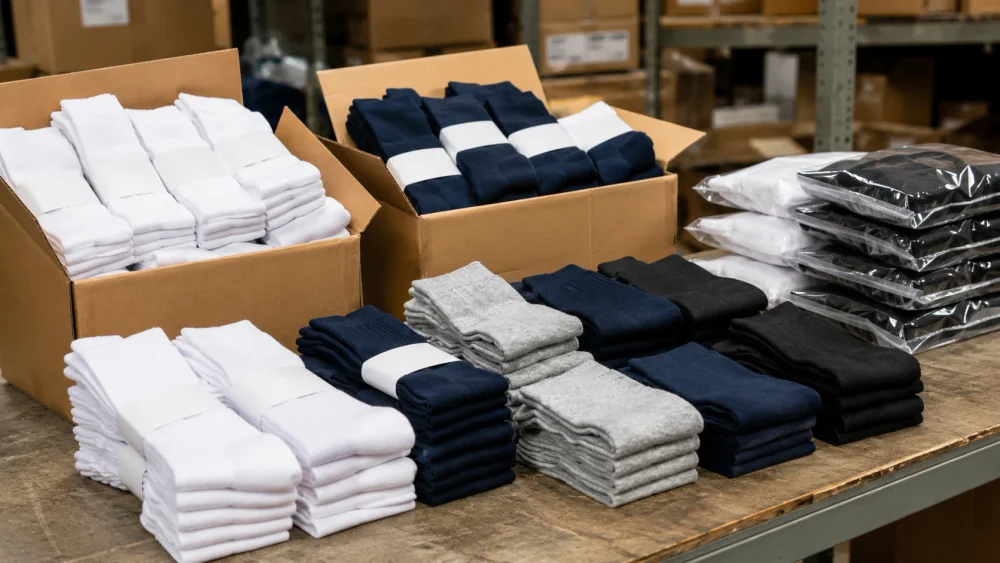
School socks are often handled in high volumes during a short back to school selling period. Packaging should therefore make the product easy to identify, scan, store and replenish.
Master carton organisation is equally important. Clear size separation helps warehouse teams locate the required SKU without opening several mixed cartons during peak demand.
| Packaging Element | Buyer Requirement | Operational Value |
|---|---|---|
| Size | Clearly visible on the pair band or retail pack. | Reduces picking errors and improves customer selection. |
| Colour / School | Identify the school, programme or approved uniform colour. | Supports multi school inventory management. |
| Barcode | Use the retailer or distributor approved barcode format. | Supports POS and warehouse processing. |
| Fibre and Care | Include legally required textile and care information. | Supports compliance and consumer information. |
| Carton Marking | Show SKU, size, colour, quantity and shipment references. | Speeds receiving, storage and replenishment. |
Product Testing Should Reflect Real School Use
Testing should support the agreed purchasing specification rather than become a generic checklist. The buyer first defines what the product must do, and the laboratory then confirms the appropriate test method.
For school socks, the testing plan normally focuses on composition, washing performance, colour, surface durability, elastic recovery and workmanship.
Fibre Composition
Confirm that the finished product matches the composition that will appear on the retail label.
Dimensional Stability
Measure before and after laundering to identify excessive shrinkage, growth or distortion.
Colourfastness
Check whether the base colour or contrast stripes change or transfer during the agreed wash procedure.
Pilling and Abrasion
Review surface deterioration where product life and long term appearance are commercially important.
Stretch and Recovery
Confirm that cuffs and the sock body recover adequately after stretching and laundering.
Workmanship
Inspect toe closing, holes, dropped stitches, loose yarns, pair matching, dimensions, stripes and packaging.
Chemical Safety Is Becoming More Visible in Textile Procurement
School socks spend many hours in direct contact with the skin, so chemical compliance should be considered alongside physical quality.
OEKO TEX STANDARD 100 is a voluntary textile certification that tests yarns, fabrics and finished products against a broad range of harmful substances. Requirements become stricter as skin contact becomes more intensive.
School socks are worn directly against the skin for extended periods, making product safety requirements commercially important.
Do not rely only on supplier statements when the product or packaging will carry a recognised certification claim.
The documentation needed depends on the claim, destination market and retailer requirement.
Review OEKO TEX STANDARD 100. OEKO TEX also announced tighter requirements in its 2025 standard updates, showing how chemical expectations for textile products continue to evolve.
Destination Market Labelling Must Be Confirmed Before Packaging
Private label buyers should not print thousands of sock bands before confirming the destination market requirements. Fibre composition, country of origin, responsible business information and other labelling obligations differ between markets.
Retailers can also impose standards beyond the legal minimum. Packaging artwork should therefore be treated as a controlled approval stage rather than a final design task after production.
| Market | Buyer Control | Reference |
|---|---|---|
| United States | Most covered textile products require fibre content, country of origin and identification of the manufacturer or another responsible business. | FTC Textile Labelling Guidance |
| United Kingdom | Textile products require appropriate fibre composition information. | UK Textile Labelling Guidance |
| European Union | Regulation EU 1007/2011 governs textile fibre names and fibre composition labelling. | European Commission Textile Guidance |
| European Union Product Safety | The General Product Safety Regulation has applied since 13 December 2024 and strengthens product safety and economic operator responsibilities. | EU GPSR Overview |
Sustainability Is Moving Into Uniform Procurement
Sustainability requirements are increasingly connected to durability, material evidence and traceability rather than simple environmental claims.
The European Commission's textile strategy sets a 2030 direction in which textile products placed on the EU market are expected to become more durable, repairable, recyclable and increasingly use recycled fibres while reducing hazardous substances.
For uniform procurement, one practical sustainability question is simple: how many reliable wears can the product deliver before replacement? Review the European Commission Strategy for Sustainable and Circular Textiles.
HS Classification Depends on Fibre and Construction
Knitted socks and similar hosiery generally fall within HS heading 6115, but the final tariff line depends on fibre composition, construction and the destination country's tariff schedule.
Buyers should not automatically reuse a customs code from a previous cotton sock shipment for a synthetic or materially different product. The exporter can propose a classification, but the importer or customs broker should confirm the final code before shipment.
Final classification may change according to principal fibre, construction and national tariff subdivisions.
India Has an Established Textile Export Base
India's school sock opportunity sits inside a much larger textile manufacturing and export ecosystem supporting yarn, knitting, apparel, packaging, testing and international shipment.
Government of India data reported textile and apparel exports, including handicrafts, of ₹3,25,339 crore in FY 2025 to 2026. Ready made garment exports reached ₹1,39,350 crore, cotton textiles ₹1,02,427 crore and man made textiles ₹46,254 crore, based on provisional DGCI&S data.
The same government release identifies major textile and apparel markets including the United States, Bangladesh, UAE, United Kingdom, Germany, Netherlands, Spain, France and Italy. View the Government of India textile export release.
Hosiery Trade Shows Existing International Demand
School socks do not have a dedicated international customs category, so broader hosiery data should not be presented as the size of the school sock market.
It is still useful as an indicator of India's existing manufacturing and export activity in cotton and synthetic knitted hosiery.
Indian exports under the WITS legacy HS classification reached approximately 1.18 million kg in 2023.
Indian exports under the corresponding WITS classification reached approximately 737,071 kg in 2023.
These figures cover broader knitted hosiery products. They demonstrate export activity and should not be interpreted as the value of India's school sock market.
Why Source School Socks From India?
India offers uniform buyers a combination of cotton and man made fibre supply chains, established hosiery manufacturing, private label development and an export ecosystem serving major international markets.
The advantage is strongest when manufacturing capability is combined with a controlled specification, approved samples, destination market compliance and pre shipment inspection.
Cotton and Man Made Fibres
Factories can develop cotton rich, polyester, poly viscose and blended constructions for different comfort, durability and cost positions.
Established Hosiery Capability
India already exports cotton and synthetic knitted hosiery to markets across North America, Europe, the Gulf and Asia Pacific.
Private Label Flexibility
Uniform programmes can combine custom colours, stripes, sock lengths, size ranges, school branding and retail packaging.
International Supply Infrastructure
India's broader textile export base supports access to packaging, testing, documentation and international freight services.
How to Compare School Sock Suppliers
Do not send different requirements to five factories and compare only the final price. Every shortlisted supplier should quote against the same material, dimensions, colour, construction, packaging and testing requirement.
If one supplier reduces pair weight, changes the yarn or simplifies construction, the quotations are no longer directly comparable.
- Confirm the fibre composition and yarn specification proposed for the finished product.
- Compare pair weight and knit construction against the approved sample rather than price alone.
- Check how each supplier interprets the size chart, finished measurements and allowable tolerances.
- Compare colour matching, stripe accuracy and the ability to reproduce the same shade on replenishment orders.
- Review cuff recovery, heel construction, toe closing and overall workmanship in the development sample.
- Confirm testing capability and the evidence available for composition, washing, colour and durability requirements.
- Compare MOQ by colour, design and size because size fragmentation can significantly change commercial feasibility.
- Check private label branding, barcode, retail packaging and master carton capability.
- Review production lead time together with the supplier's ability to support repeat orders during the school year.
- Evaluate previous export experience, inspection procedures, payment terms and the final landed cost.
Evaluate Total Programme Risk, Not Only Pair Price
A small saving on the factory price can disappear quickly if the order creates excess inventory, inconsistent colours, failed sizes, late replenishment or high replacement rates.
For uniform suppliers, the stronger commercial comparison is the cost of delivering the correct sock, in the correct size mix, at the correct quality level, through the complete school season.
Compare equivalent specifications and include testing, packaging, freight and expected rejection risk.
Evaluate dimensions, shade, elastic recovery, workmanship and wash performance.
Use demand based size ratios and assess the supplier's replenishment capability.
Protect the required selling window with realistic sampling, testing, production and freight planning.
Frequently Asked Questions
What information should I send Costita for a school sock quotation?
Send us the required colour, stripe design, sock length, student size range, material preference, quantity by size, destination country, branding requirement and required delivery date. A physical reference sample or approved technical specification also helps us match the requirement accurately.
Which material is best for school socks?
There is no universal best material. Cotton rich blends work well where softness and everyday comfort are priorities. Polyester and other blends can support durability, drying and cost control. Costita recommends selecting the blend around climate, wash frequency, school requirements and target retail price.
Can Costita source custom school colours and stripes?
Yes. School socks can be developed in custom colours and stripe combinations subject to supplier capability and MOQ. We recommend approving a physical colour sample and stripe layout before bulk production.
Can we add our school logo or private label brand?
Yes. Depending on the supplier and design, buyers can develop knitted school names, logos, customised pair bands, barcodes and private label packaging. Branding should be checked on the complete size range because smaller socks provide less usable knitting area.
What is the MOQ for custom school socks?
There is no single MOQ for every programme. MOQ changes according to supplier, yarn, colour, number of sizes, logo requirements and packaging. Costita confirms the applicable MOQ against the actual buyer specification before production planning.
Should buyers approve every sock size?
For larger size programmes, Costita recommends approving at least the critical smallest and largest sizes together with the main commercial size. This helps identify fit, proportion, stripe and logo problems before bulk production.
What quality checks should be completed before shipment?
Final inspection should verify quantity, size assortment, finished measurements, colour, stripe placement, workmanship, pair matching, packaging, labels and carton markings. Where required, laboratory testing should be completed against the agreed composition, wash, colour and durability requirements before shipment release.
Final Buyer Takeaway
School sock sourcing is primarily a repeatability problem. A reliable programme should reproduce the same colour, fit, construction and appearance across the first order and every replenishment that follows.
Define the uniform specification before requesting quotations, approve the size logic, test the product after washing, control shade and stripe placement, retain the approved sample and confirm destination labelling before packaging.
Build a Repeat School Uniform Supply Programme
Planning bulk or repeat school sock orders? Costita can support supplier matching, sample approval, quality checks, private label packaging and export coordination for your destination market.