Sugarcane Bagasse Disposables: Product, Procurement and Export Guide for International Buyers
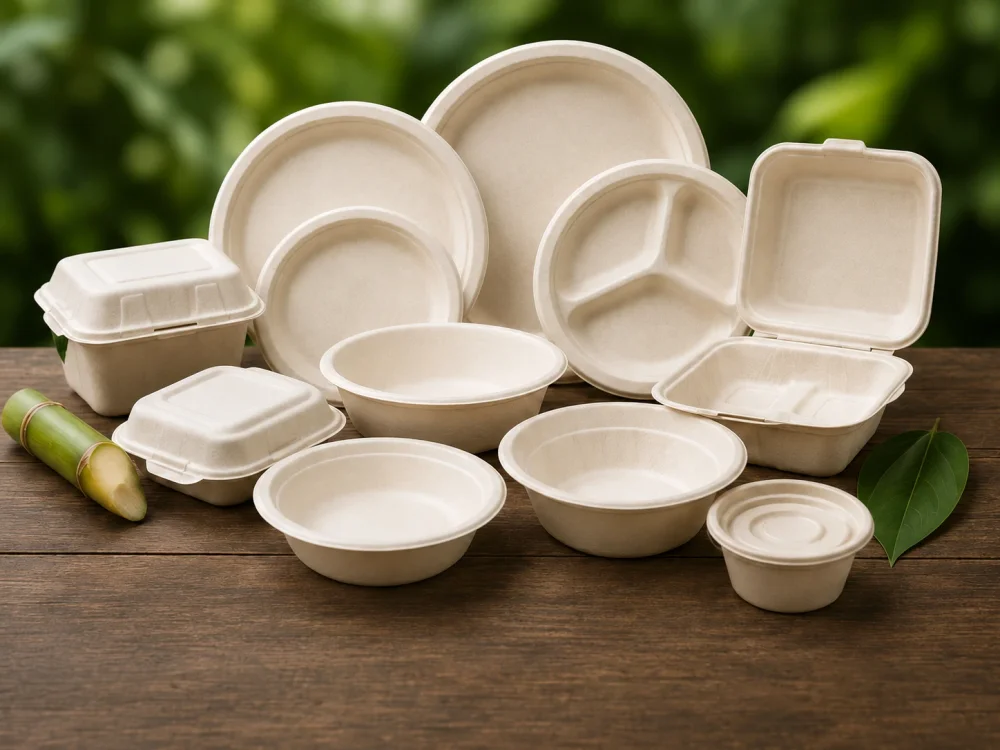
Sugarcane bagasse disposables now cover much more than basic disposable plates. Restaurants, takeaway businesses, catering companies, cloud kitchens, institutional foodservice operators and distributors can source bagasse plates, bowls, compartment trays, clamshells, lids and meal containers in multiple sizes.
The challenge is not simply finding a product described as plant based. Businesses need the correct size, depth, compartment layout, lid, packing format and order quantity for the foodservice application they are supporting.
A small plate designed for snacks will not perform like a full-size dinner plate. A bowl used for dry food faces different conditions from one filled with hot curry. A clamshell that closes correctly when empty may behave differently after it is packed with hot food and transported.
Costita helps businesses manage these decisions by connecting them with verified Indian manufacturers and coordinating product selection, sample ordering, MOQ clarification, physical inspection, packaging requirements and international logistics. Costita does not manufacture bagasse products. It provides a structured sourcing layer between businesses and verified manufacturers. Source
Costita’s current internal bagasse product data covers 28 variants across plates, bowls, lids, clamshells and rectangular takeaway containers. This guide explains the available formats, their applications and the sourcing factors that should be confirmed before placing a bulk order.
Costita’s role: Costita connects businesses with verified Indian manufacturers and supports product shortlisting, samples, MOQ discussion, physical inspection, packing coordination and international logistics. Costita is not the manufacturer.
Why Businesses Are Adding Bagasse Disposables to Their Product Range
Foodservice businesses rarely need only one disposable product.
A restaurant may need small plates for desserts, standard plates for meals, bowls for curries and clamshells for takeaway orders. A catering company may need larger plates, compartment formats and products that can be stacked and handled quickly during high-volume service.
Distributors have an even broader requirement. They need a product catalogue that can serve restaurants, caterers, cloud kitchens, institutional canteens, meal-delivery businesses and food-packaging retailers.
Sugarcane bagasse can be formed into multiple three-dimensional food-packaging formats. Research on moulded-pulp food packaging identifies bagasse as one of the plant-fibre sources used to produce plates, trays, bowls and other shaped packaging products. Source
For Costita, the opportunity is not to promote bagasse as a single product. It is to help businesses build a practical product mix with clearer specifications, order quantities and sourcing support.
Sugarcane Bagasse Products Available Through Costita
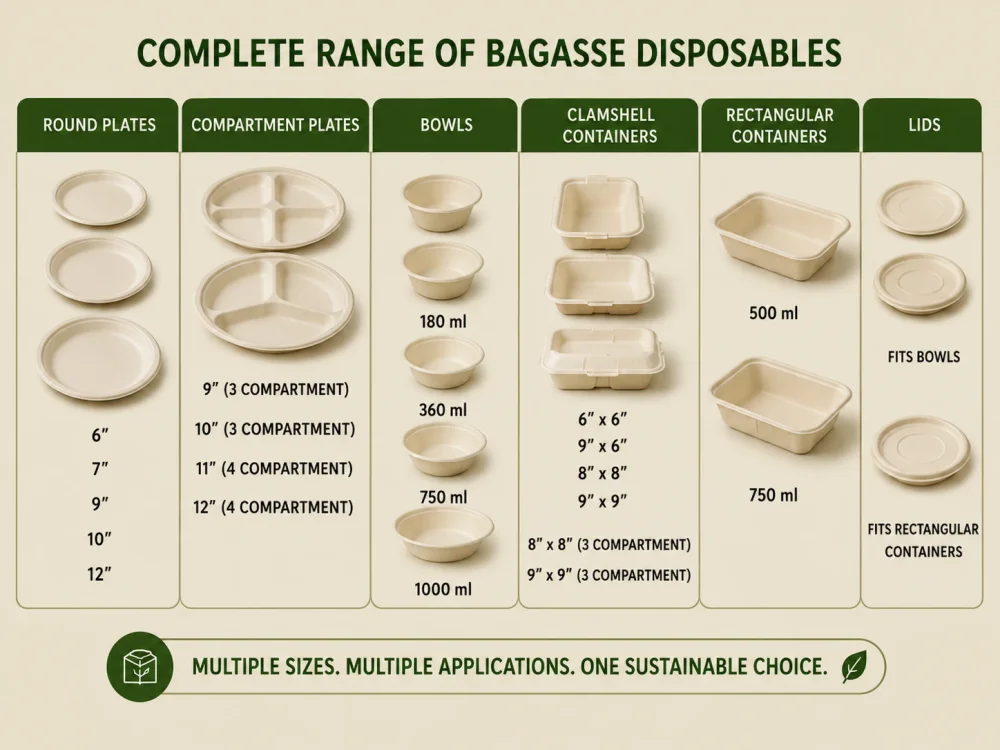
Costita’s current internal product range is organised into eight main product groups.
| Product group | Available sizes or capacities | Typical applications |
|---|---|---|
| Compact round plates | 6 and 7 inches | Desserts, snacks, bakery items and small servings |
| Standard round plates | 9, 10 and 12 inches | Full meals, buffet service, catering and institutional dining |
| Compartment plates | 9-inch and 10-inch 3-compartment; 11-inch and 12-inch 4-compartment | Structured meals and separated portions |
| Small round bowls | 180 ml, 240 ml and 360 ml | Dips, sauces, desserts, sides and small servings |
| Medium and large bowls | 500 ml, 750 ml and 1000 ml | Curries, noodles, rice bowls, soups and meal delivery |
| Hinged clamshells | 6 × 6, 9 × 6, 8 × 8 and 9 × 9 inches | Snacks, burgers, wraps, sandwiches and takeaway meals |
| Compartment clamshells | 8 × 8 and 9 × 9 inches | Main-course and side separation |
| Rectangular containers | 500 ml and 750 ml, with selected matching lids | Meal delivery, prepared food and stacked dispatch |
Several live Costita listings show bagasse products with a total MOQ of 600 pieces, size variations, quantity-based manufacturing timelines, sample-order options, physical inspection and buyer-protection information. Exact terms should still be checked on the selected product page before confirming an order. Source
How Bagasse Tableware Is Generally Made
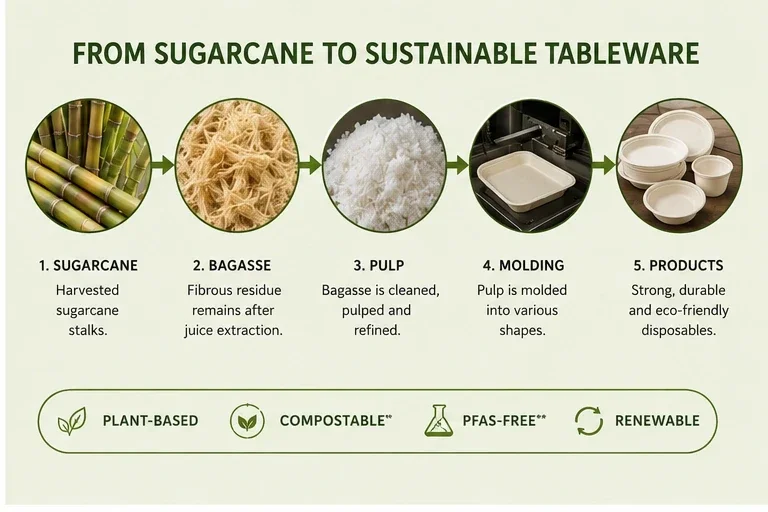
Bagasse is the fibrous material left after sugarcane is crushed to extract its juice.
For moulded-fibre tableware, the material is generally cleaned and processed into pulp. The pulp is distributed across product moulds, formed into the required shape, pressed, dried and trimmed. Finished products are then inspected and packed.
The exact process can vary between manufacturers. Some products may use bagasse as the primary fibre, while others may include bamboo, wood pulp or other plant fibres to achieve particular forming or strength characteristics. Research has shown that bagasse can be blended with longer fibres such as bamboo to improve selected mechanical properties. Source
For businesses sourcing through Costita, the manufacturing explanation is only the starting point. The more important questions are whether the finished product meets the required size, strength, appearance, food application, packing and order specifications.
Choosing Bagasse Products by Foodservice Application
The correct product should be selected according to the food and service model, not only by its diameter or stated capacity.
Small plates for desserts and snacks
Six-inch and seven-inch round plates are suitable for applications such as:
- Desserts and cakes
- Bakery items
- Appetisers
- Snacks
- Small side dishes
- Food samples
These sizes can be useful where a larger plate would add unnecessary material, storage volume and serving space.
Standard plates for complete meals
Nine-inch, ten-inch and twelve-inch plates support progressively larger meal formats.
Nine-inch plates are commonly considered for standard meals. Ten-inch plates provide additional space for full meal combinations, while twelve-inch plates can support large portions, buffets, events and catering applications.
Diameter alone does not confirm plate strength. Large plates should be tested with the actual meal because food weight, moisture and handling pressure can affect performance.
Compartment plates for structured meals
Three-compartment plates can separate a main item from two accompaniments. Four-compartment plates support meals with additional sides.
These products are useful for:
- Institutional canteens
- Catering programs
- Meal-distribution services
- Schools and workplaces
- Foodservice operations with portion standards
Compartment walls should not automatically be treated as liquid barriers. Thin sauces and gravies may move between sections during transport.
Bowls for sauces, curries and meal portions
Costita’s internal product range begins with compact 180 ml bowls and extends to 1000 ml formats.
Smaller bowls suit sauces, desserts and side portions. Medium bowls can support soups, salads, noodles and rice dishes. Larger bowls are more suitable for full meals, mixed dishes and substantial portions.
Businesses should confirm depth, rim strength and lid compatibility rather than selecting a bowl by capacity alone.
Clamshells for takeaway and delivery
Bagasse clamshells combine a base and hinged lid in one product.
Compact formats may be used for snacks, small burgers and bakery products. Larger square and rectangular formats support full meals, sandwiches, wraps and takeaway combinations.
Costita currently lists clamshell sizes including 6 × 6, 9 × 6, 8 × 8 and 9 × 9 inches, with selected compartment options. The current listing includes a 600-piece MOQ and quantity-based manufacturing timelines. Source
Rectangular containers for organised dispatch
Rectangular containers are useful when products need to fit efficiently inside delivery bags, storage shelves and dispatch cartons.
Costita’s internal range includes 500 ml and 750 ml rectangular containers with selected matching lids.
Similar-looking containers and lids are not necessarily compatible. The base and lid should be checked by exact model rather than by capacity alone.
Start With a Clear Product Requirement
Many sourcing problems begin before a manufacturer is contacted.
A request such as “send your bagasse container price” does not give enough information to identify the correct product.
A useful product requirement should include:
- Product type
- Required diameter or capacity
- Number of compartments
- Intended food
- Hot or cold application
- Oily or liquid-rich food
- Expected holding time
- Lid requirement
- Estimated order quantity
- Inner-pack preference
- Custom printing or packaging requirements
- Destination country
- Required delivery period
Costita can use this information to identify relevant products and coordinate the requirement with suitable verified manufacturers.
This is more efficient than asking multiple suppliers for catalogues without a clear product specification.
Request Samples Before Confirming a Bulk Order
Product images cannot show how a plate, bowl or container behaves with an actual meal.
Sample testing helps businesses check whether the selected size, structure and closure suit the intended application.
Costita states that sample ordering is available across many product categories so buyers can evaluate material, workmanship and product quality before placing a bulk order. Source
What to test with a sample
- Product dimensions
- Plate or bowl depth
- Edge finish
- Surface cleanliness
- Wall thickness
- Product stability
- Hot-food performance
- Oil and moisture exposure
- Portion weight
- Holding time
- Lid closure
- Stacking
- Transport movement
- Odour
- Colour consistency
Restaurants should test the sample with actual menu items.
Catering companies should also test rapid handling, stacking and service-line use.
Delivery businesses should fill the container with hot food, close it, stack it and hold it for the expected delivery duration.
The result should be shared before the bulk specification is locked.
Understand MOQ, Price Tiers and Manufacturing Lead Time
MOQ affects more than the minimum quantity that can be ordered.
It can influence unit price, carton planning, freight efficiency, product mix and inventory exposure.
Many Costita bagasse listings currently show:
- Total MOQ of 600 pieces
- MOQ per variation where applicable
- Quantity-based prices
- Manufacturing lead-time bands
- Sample-order options
For example, live plate and clamshell listings show estimated manufacturing ranges of 3–5 days for selected lower quantity bands, followed by longer production ranges for larger orders. These values refer to manufacturing time and do not include international shipping or customs clearance. Source
Questions to confirm before ordering
- What is the total MOQ?
- Is there a separate MOQ for each size?
- Can multiple sizes be combined?
- Can plates, bowls and containers be mixed?
- Which quantity bands change the unit price?
- How many manufacturing days apply to the order?
- Is the product made to order or available in stock?
- Does custom packaging change the MOQ?
- Does private labelling extend production time?
Costita can coordinate these questions with the manufacturer and help structure a product mix that is more practical for the intended market.
Why the Lowest Unit Price Is Not Enough
A low product price can become expensive when the wrong size, weak packaging or poor carton utilisation is discovered after production.
The full sourcing decision should consider:
- Product price
- MOQ
- Sample cost
- Units per carton
- Carton dimensions
- Carton weight
- Product nesting
- Inspection
- Freight
- Customs
- Inland transport
- Damage risk
- Inventory holding
For lightweight disposable tableware, freight volume can matter as much as product weight.
Poor nesting can increase the number of cartons. Oversized cartons can reduce container utilisation. Weak master cartons can increase transit damage.
Costita’s platform is designed to combine product sourcing with inspection and logistics coordination, including freight forwarding, customs support, warehousing and last-mile delivery options. Source
Product Quality Checks Before Shipment
Bulk quality control should compare the finished production against the approved product specification and sample.
Costita’s supplier-verification process includes document checks, physical factory visits, capability assessment and review of manufacturer quality-control processes. The platform also states that bulk orders undergo quality inspection before shipment. Source
Bagasse product inspection checklist
| Inspection area | What should be checked |
|---|---|
| Dimensions | Diameter, capacity, depth and compartment layout |
| Formation | Even walls, clearly formed corners and stable base |
| Surface | Clean finish without excessive loose fibre |
| Edges | Clean trimming without sharp or damaged sections |
| Strength | Resistance to normal handling and expected food load |
| Colour | Acceptable consistency across the production batch |
| Odour | No unusual or unacceptable smell |
| Closure | Correct lid or clamshell engagement |
| Quantity | Correct pieces per pack and carton |
| Packing | Inner packs, master cartons and product protection |
| Labelling | SKU, quantity and required shipping marks |
Inspection does not remove every sourcing risk, but it can identify mismatches before the shipment leaves the manufacturer.
Costita remains involved in coordinating manufacturers, inspection partners, logistics providers and buyers when an order is managed through the platform. Source
Packaging and Container Planning
Bagasse products are normally nested to reduce packing space.
The efficiency of this nesting directly affects carton size, warehouse space and freight cost per piece.
Before confirming the order, businesses should review:
- Pieces per inner pack
- Inner packs per carton
- Units per master carton
- Carton dimensions
- Gross and net weight
- Corrugated-carton strength
- Moisture protection
- Palletised or floor-loaded shipment
- Mixed-SKU loading
- Shipping marks
- Storage recommendations
Container quantities should be treated as indicative until final carton dimensions, SKU mix and loading method are confirmed.
Costita can coordinate packing details with the selected manufacturer and connect those specifications with freight and delivery planning.
Environmental and Compliance Claims Still Need Verification
Bagasse products are often described using terms such as biodegradable, compostable, PFAS-free, microwave-safe and food-safe.
These claims should not be assumed only because the main material is sugarcane fibre.
The finished product may contain fibre blends, additives, processing aids, surface treatments, printing or separate lid materials. Moulded-pulp research also notes that fibre packaging can face moisture and barrier-performance limitations that may require product-specific material solutions. Source
Before using a claim commercially, businesses should request the relevant declaration, test report or certification for the selected product.
Costita can help coordinate these document requests with manufacturers, but the exact compliance requirement will depend on the destination market and intended application.
How Costita Supports Bagasse Product Sourcing
Costita is not the manufacturer of the products listed on the platform.
Its role is to create a more organised sourcing process between businesses and verified Indian manufacturers.
1. Product discovery
Businesses can review available plates, bowls, clamshells and containers with visible size options, MOQs, prices and manufacturing timelines.
2. Requirement clarification
Costita can help organise the product requirement according to food type, size, lid, quantity, packing and destination.
3. Manufacturer coordination
The requirement can be shared with relevant manufacturers that have completed Costita’s verification process.
Costita states that its onboarding process includes business-document verification, physical factory visits, capability assessment and quality-control review. Source
4. Sample ordering
Samples can be coordinated so the selected product can be tested before a larger order is confirmed.
5. MOQ and product-mix planning
Costita can help clarify total MOQ, MOQ per variation, quantity-based production timelines and possible combinations of plates, bowls and containers.
6. Physical inspection
Finished bulk orders can be inspected against the agreed specification, quantity and packing before shipment.
7. Logistics coordination
Costita coordinates international freight, customs processes and delivery through logistics partners, depending on the agreed shipping scope. Source
8. Custom product requirements
When a required size, packing format or quantity is not listed, businesses can submit a custom sourcing request. Costita states that its sourcing team can look for a suitable manufacturer for unlisted products or volume customisation. Source
Bagasse and Areca Can Support Different Foodservice Needs
Businesses building an eco-disposable range do not always need to choose only one material.
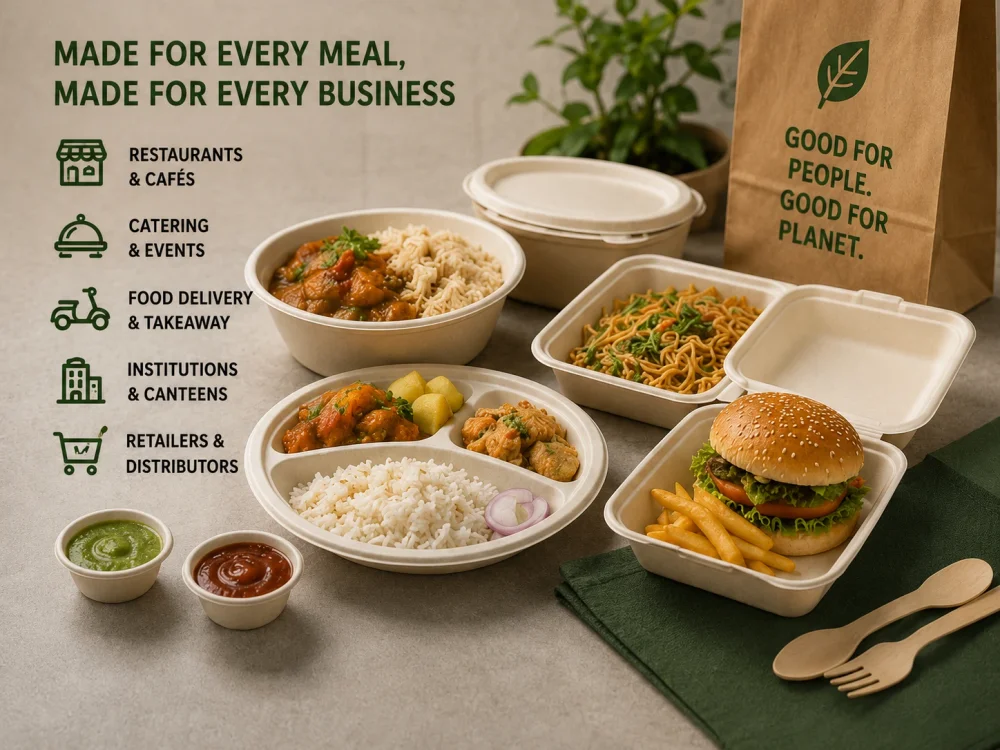
Bagasse products are particularly practical for:
- Takeaway meals
- Delivery bowls
- Clamshell containers
- Cloud kitchens
- Institutional dining
- QSR packaging
- High-volume foodservice
Areca palm leaf products can complement bagasse where a more distinctive natural presentation is required for catering, weddings, buffets, events and hospitality service.
A mixed portfolio can allow distributors and foodservice suppliers to serve both presentation-led and high-volume packaging requirements.
Costita’s areca sourcing guide also identifies this mixed-product opportunity, positioning areca for premium presentation and bagasse for takeaway, delivery and higher-volume packaging formats. Source
A Practical Bagasse Sourcing Checklist
Before placing a bulk order, confirm:
- Product type and size
- Capacity or compartment layout
- Food application
- Hot, cold, oily or liquid use
- Sample approval
- Total MOQ
- MOQ per variation
- Price tiers
- Manufacturing lead time
- Lid compatibility
- Units per carton
- Carton dimensions and weight
- Product and carton labels
- Compliance documents
- Inspection criteria
- Freight method
- Destination requirements
- Required stock date
This checklist helps move the order from a general product enquiry to a structured sourcing requirement.
Conclusion
Sugarcane bagasse disposables provide businesses with a broad product range rather than a single alternative to plastic.
Restaurants and foodservice operators can use small plates, full-meal plates, bowls and takeaway containers. Caterers can use larger plates and compartment formats. Distributors can build a wider catalogue covering multiple foodservice applications.
The correct product depends on the meal, serving size, temperature, moisture, holding time, lid, packaging and expected order volume. These factors should be clarified before comparing only the unit price.
Costita helps businesses move from product research to structured sourcing by connecting them with verified Indian manufacturers and supporting product shortlisting, samples, MOQ discussion, specification coordination, physical inspection, packaging review and international logistics.
Businesses can begin with Costita’s listed sugarcane bagasse products or submit a custom sourcing request when a particular product, packaging format or quantity is not currently available.
Source Sugarcane Bagasse Disposables Through Costita
Compare bagasse plates, bowls, clamshells and food containers from verified Indian manufacturers with sample coordination, clear MOQ information, physical inspection and international shipment support.
Frequently Asked Questions
What sugarcane bagasse products can be sourced through Costita? +
What is the MOQ for bagasse disposable products? +
How long does manufacturing take? +
Should businesses order samples before buying in bulk? +
Does Costita manufacture bagasse products? +
Does Costita inspect bagasse orders before shipment? +
Can Costita help with international shipping? +
How This Guide Was Prepared
This article was developed using Costita’s internal product workbook covering 28 sugarcane bagasse product variants, live Costita product listings, Costita’s supplier-verification and logistics information, and published research on moulded-pulp food packaging.
Product specifications, certifications and performance limits can vary by manufacturer and SKU. Final requirements should be confirmed for the selected product before ordering.