Sugarcane Bagasse Disposables: Complete Guide to Products, Uses, Benefits and Limitations
Sustainable Foodservice Packaging
A practical guide to understanding sugarcane bagasse plates, bowls, clamshells and food containers, including how they are made, where they are commonly used and what should be verified before making performance or environmental claims.
Guide at a glance
8
Product groups
28
Product variants
6–12"
Plate range
180–1000
Bowl capacity in ml
Editorial disclosure
Costita is a B2B marketplace connecting businesses with verified Indian manufacturers. Costita does not manufacture the products described in this guide. Exact materials, performance limits, certifications and specifications can vary by manufacturer and SKU.
Introduction
Why bagasse disposables need a closer look
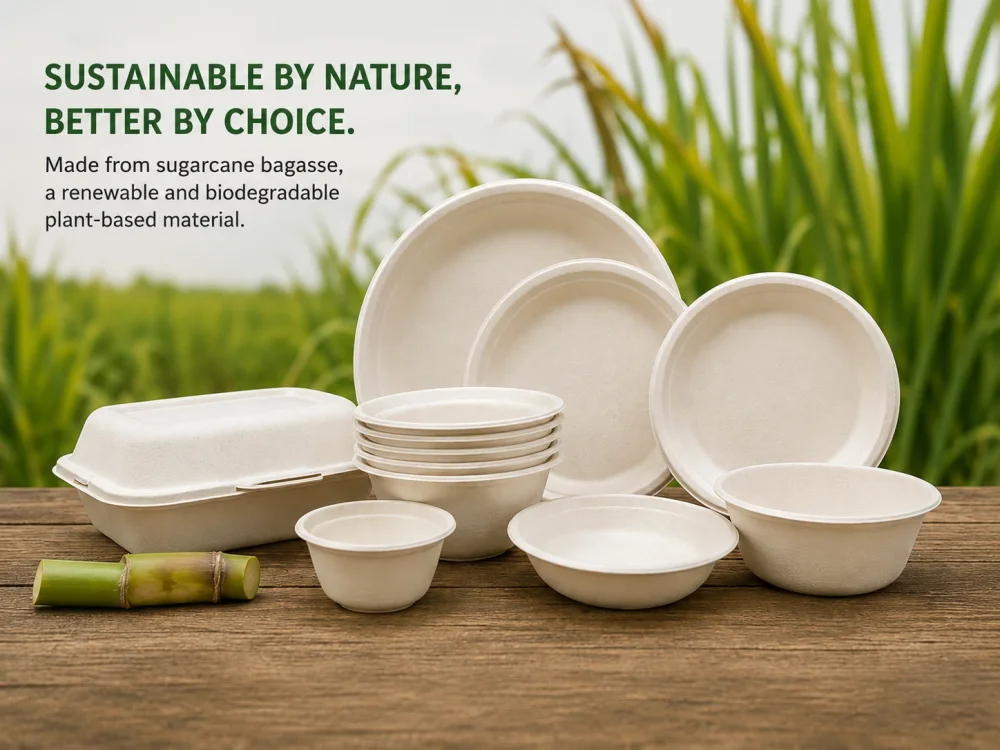
Sugarcane bagasse disposables are molded fibre products made using material recovered after sugarcane stalks are crushed to extract juice. The fibre can be converted into plates, bowls, meal trays, clamshells, lids and takeaway containers.
These products are widely considered alternatives to conventional plastic and foam disposables in catering, restaurants, institutional dining, events and food delivery. However, the word bagasse does not automatically confirm how a finished product will perform.
Product thickness, fibre composition, mould quality, grease resistance, storage conditions, lid fit and food-contact documentation can all affect the final result. Compostability, PFAS-free status and heat resistance should also be verified for the specific finished product rather than assumed from its plant-fibre origin.
What is bagasse?
The fibrous residue left after juice is extracted from sugarcane stalks.
How is it used?
The prepared fibre is converted into pulp and moulded into foodservice products.
Is it compostable?
Finished-product compostability depends on composition, certification and disposal conditions.
Is it PFAS-free?
The bagasse material alone does not prove that the finished item is PFAS-free.
Material origin
Sugarcane
Juice extraction leaves behind a fibrous residue that can be cleaned, pulped and formed into molded fibre packaging.
What is sugarcane bagasse?
Sugarcane bagasse is the fibrous material that remains after sugarcane stalks are crushed to extract their juice.
The residue contains plant-fibre components such as cellulose, hemicellulose and lignin. These components allow the material to be processed into pulp and used for products including paper, trays, plates, bowls and food containers.
Bagasse is also used in energy production, construction materials, composite products and other industrial applications. For disposable tableware, it is generally cleaned, pulped, shaped and dried through a molded-fibre manufacturing process.
View Supporting Scientific Research ↗What are sugarcane bagasse disposables?
Sugarcane bagasse disposables are single-use or limited-use foodservice products made primarily from processed sugarcane fibre. They belong to the wider category of molded fibre food packaging.
The material can be formed into several shapes and depths, allowing it to support different food portions and service formats.
Two products with the same diameter or stated capacity may still differ in weight, depth, thickness, fibre blend, rim strength and surface treatment. The raw-material name therefore does not confirm the complete composition or performance of the finished product.
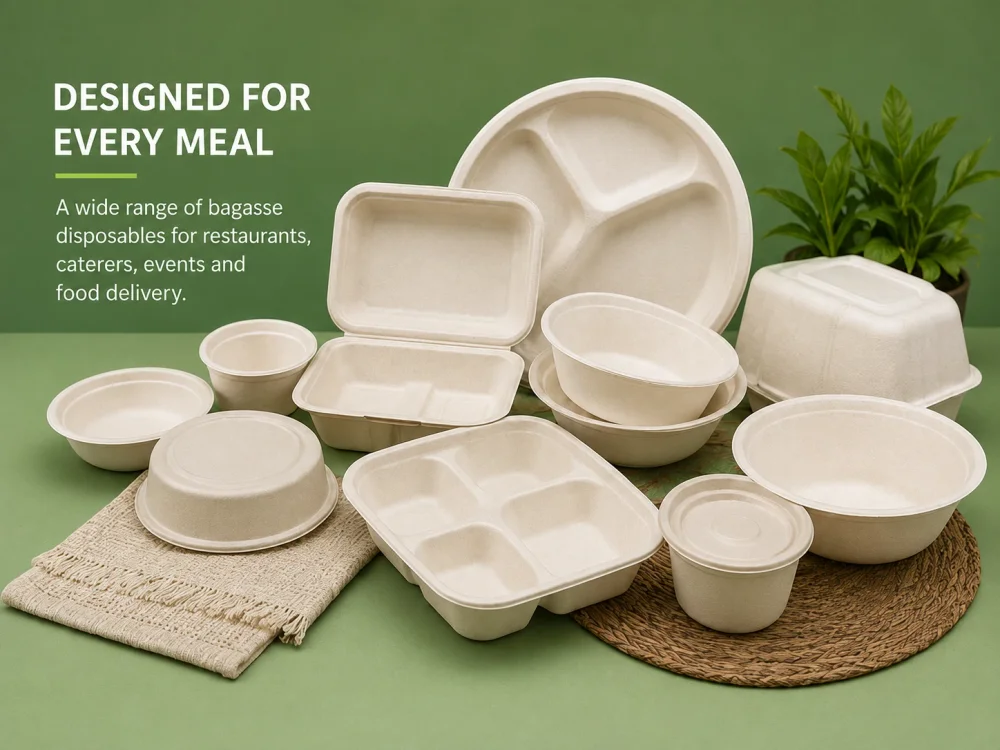
Common bagasse product formats
- Round disposable plates
- Three- and four-compartment plates
- Small and deep food bowls
- Matching bowl lids
- Hinged clamshell containers
- Compartment takeaway containers
- Rectangular meal containers
- Molded fibre food trays
Important distinction
The term bagasse identifies the main fibre source. It does not automatically prove that the finished product is certified compostable, PFAS-free, microwave-safe, oven-safe or compliant with every food-contact market.
Production overview
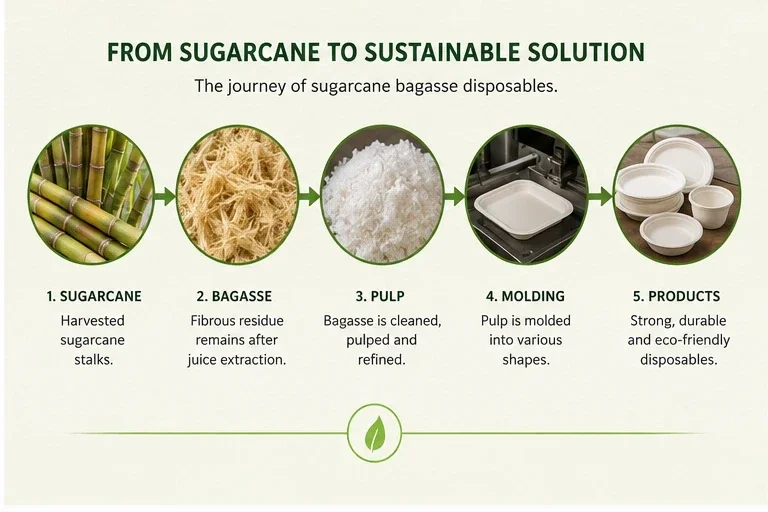
How are bagasse disposables generally made?
Manufacturing methods differ between facilities, but molded bagasse tableware normally follows a series of fibre preparation, forming, drying and finishing stages.
Residue collection
Bagasse is collected after sugarcane crushing and juice extraction.
Cleaning and preparation
Dirt, pith, sugar remnants and unsuitable material are removed before pulping.
Pulp formation
Prepared fibres are mixed with water to create a pulp suspension suitable for moulding.
Product forming
The pulp is distributed across a plate, bowl, tray or container mould and excess water is removed.
Heat pressing and drying
Heat and pressure develop the final shape, density, surface and structural rigidity.
Trimming and inspection
Edges are trimmed and products are checked before counting, nesting and carton packing.
Composition note
Is every product made from 100% sugarcane fibre?
Not necessarily. Some products may be made predominantly from bagasse pulp, while others may contain bamboo, wood pulp or other plant fibres.
Manufacturers may also use processing aids, wet-strength agents or oil-resistant treatments. Exact fibre blends, additives and surface treatments should be confirmed through a material declaration when product-specific claims are required.
Product portfolio
Types and sizes of sugarcane bagasse disposables
Costita’s current internal product data covers 28 variants across eight principal product groups. The following applications are general recommendations and should be checked against product depth, rim design, food type and actual capacity.
| Product category | Available sizes or capacities | Common applications |
|---|---|---|
| Compact round plates | 6 and 7 inches | Desserts, snacks, sides, appetisers and controlled portions |
| Standard round plates | 9, 10 and 12 inches | Main meals, catering, buffet service and larger portions |
| Compartment plates | 9-inch 3-compartment, 10-inch 3-compartment, 11-inch 4-compartment and 12-inch 4-compartment | Structured meals and separated food portions |
| Small round bowls | 180 ml, 240 ml and 360 ml | Dips, sauces, desserts, sides, soup and small servings |
| Medium round bowls | 500 ml and 750 ml | Curries, noodles, rice bowls, salads and takeaway meals |
| Deep round bowls | 1000 ml | Large meals, mixed dishes and sharing portions |
| Hinged clamshells | 6 × 6, 9 × 6, 8 × 8 and 9 × 9 inches | Snacks, burgers, wraps, sandwiches and complete meals |
| Compartment clamshells | 8 × 8 and 9 × 9 inches with 3 compartments | Main-course and side separation for takeaway orders |
| Rectangular containers | 500 ml and 750 ml | Meal delivery, prepared food retail and stacked dispatch |
| Matching lids | Selected 500 ml, 750 ml and 1000 ml formats | Takeaway containment, transport and stacking |
Plate selection
Bagasse plate sizes and applications
Plate diameter affects serving space, but it should not be the only selection factor. Plate depth, rim strength, thickness and the expected food load also influence performance.
Practical rule
Large plates should be tested with the intended meal because the distance between the centre and rim increases the structural load placed on the product.
6"
Compact plate
Desserts, cakes, snacks, appetisers, small sides and product samples.
7"
Small meal plate
Breakfast items, bakery products, larger snacks and light meals.
9"
Standard meal plate
Main meals with one or two accompaniments, depending on depth.
10"
Full meal plate
Catering, buffet service, banquets and multi-item portions.
12"
Large-format plate
Suitable for large entrées, buffet meals, event catering and sharing portions where greater serving space is required.
Compartment bagasse plates
Compartment plates divide a meal into separate sections within one product. They are useful for structured portions and food presentation.
Three-compartment plates are generally used for one main serving and two accompaniments. Four-compartment plates support more complex combinations such as a main item, grains, vegetables and an additional side.
The compartment walls should not automatically be treated as liquid barriers. Thin sauces and gravies may move between sections, particularly during transport.
Current compartment range
- 9-inch plate with 3 compartments
- 10-inch plate with 3 compartments
- 11-inch plate with 4 compartments
- 12-inch plate with 4 compartments
Bowl selection
Bagasse bowl capacities and common uses
Bowl capacity helps estimate portion size, but liquid performance also depends on wall strength, rim stability, product density, temperature, holding time and lid fit.
180 ml
Dips, sauces, chutneys, desserts, tasting portions and small sides.
240 ml
Fruit, desserts, side dishes, salads and liquid accompaniments.
360 ml
Soups, breakfast dishes, rice portions and smaller takeaway meals.
500 ml
Curries, soups, noodles, salads and moderate meal portions.
750 ml
Grain bowls, larger curries, noodles and full takeaway portions.
1000 ml
Large meals, substantial mixed dishes and sharing portions.
Hinged format
Bagasse clamshell containers
A clamshell combines a container base and attached lid in one product. This reduces the need to manage separate lid inventory.
- 6 × 6 inches: snacks, desserts and small burgers
- 9 × 6 inches: wraps, sandwiches and rolls
- 8 × 8 inches: burgers, sides and standard meals
- 9 × 9 inches: larger main-course portions
- 3 compartments: entrée and side separation
Closure should be tested after filling because hot food, steam and portion weight can affect how securely the lid remains closed.
Stackable format
Rectangular food containers
Rectangular containers can support efficient use of space in delivery bags, food displays, dispatch racks and secondary packaging.
- 500 ml meal containers with matching lids
- 750 ml meal containers with matching lids
- Suitable for rice, noodles, curries and prepared meals
- Useful for controlled portions and stacked dispatch
Similar shape or capacity does not guarantee lid compatibility. Each lid should be matched to the exact container model.
Natural versus white bagasse products
Bagasse tableware is commonly available in natural beige and white finishes. Colour should be considered a visual and processing characteristic rather than a direct measure of product quality.
Natural bagasse
Natural products usually retain a beige, light-brown or off-white appearance. Minor fibre marks and colour variation may be visible.
Small variations are not always defects, although major differences within one production batch should be examined.
White bagasse
White products undergo additional fibre processing or bleaching to achieve a lighter appearance.
The bleaching method should be confirmed before using claims such as chlorine-free or unbleached.
Product performance
How do bagasse disposables perform with food?
Bagasse product performance depends on the finished item, not only on the raw fibre. Food type, contact time, temperature and product construction should be evaluated together.
Product factors
Thickness, density, rim design and fibre composition
Food factors
Heat, moisture, oil, acidity and portion weight
Time factors
Filling, serving, transport and holding duration
Storage factors
Humidity, carton condition and handling pressure
Hot food
Many bagasse products are designed for hot foodservice, but maximum temperatures and contact times should be confirmed for the specific item. Dry snacks and hot liquid meals place different demands on a product.
Cold food
Bowls and containers may be used for salads, fruit, desserts and chilled meals. Freezer and thawing suitability should still be confirmed.
Oily food
Grease resistance can depend on product density, additives and surface treatment. Lightly fried food may not produce the same result as hot oil or fatty gravy.
Liquid-rich food
Deep bowls are generally more suitable for soup and curry than shallow plates. Temperature, movement and holding time should be included in testing.
Microwave use
Microwave suitability is product-specific. Confirm heating time, power level, lid use and whether repeated reheating is allowed.
Oven use
Only products supported by clear oven-use specifications should be placed in an oven. Microwave suitability does not prove oven suitability.
End-of-life claims
Are bagasse disposables compostable?
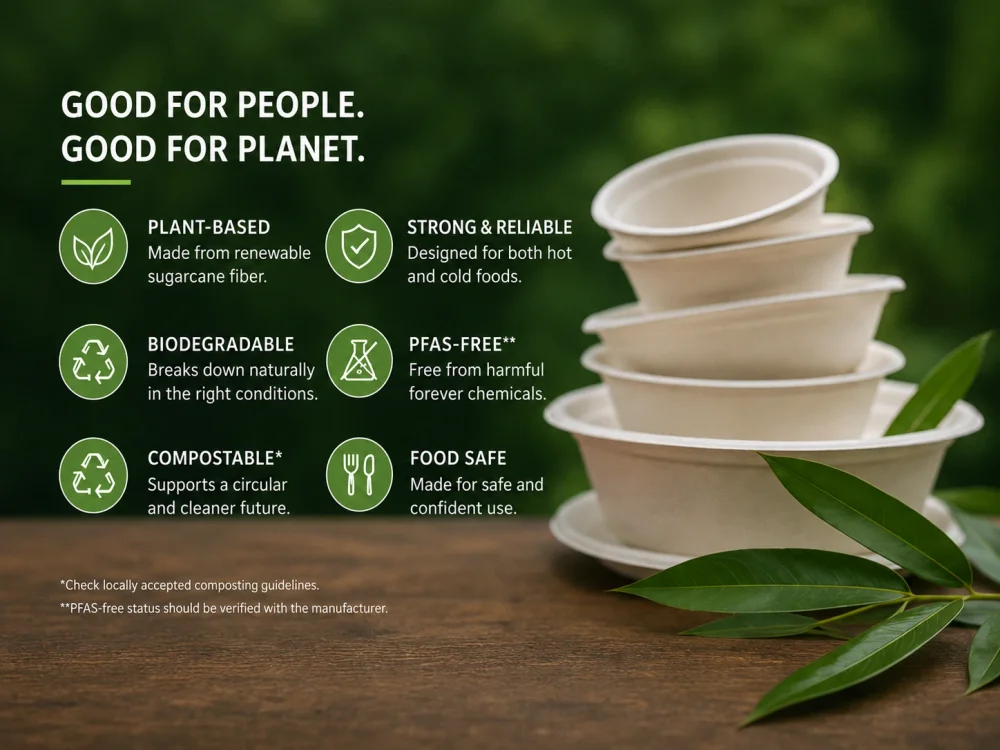
Bagasse fibre is biodegradable, but the compostability of a finished product depends on its complete composition and the conditions in which it is discarded.
Additives, surface treatments, printing inks, labels and lid materials may affect whether a product qualifies for compostability certification.
Commercial composting and home composting are also different. Commercial facilities operate with managed temperature, moisture, oxygen and processing cycles. Home composting generally takes place under less controlled conditions.
Verify these details before making a claim
- The name of the certification body
- The certification standard applied
- The company and facility covered
- The exact products or SKUs covered
- Commercial or home compostability status
- Whether printed products are included
- Whether lids and accessories are included
- The certificate’s current validity
Biodegradable and compostable do not mean the same thing
Biodegradable
Biodegradable broadly means that microorganisms can break down a material over time. The term alone may not explain the required environment, duration or residue remaining after breakdown.
Compostable
Compostable refers to breakdown under defined composting conditions and may involve specific requirements for biodegradation, disintegration and material safety.
A product should not be described as home compostable merely because it is made from plant fibre. Home-compostability claims require separate supporting evidence.
Chemical declarations
PFAS and bagasse food packaging
PFAS are a large group of chemicals that have historically been used in some fibre food packaging to improve grease, oil and water resistance.
The use of bagasse as the main fibre does not automatically prove that the finished product is PFAS-free.
Evidence used for product-specific PFAS claims
- Declaration of no intentionally added PFAS
- Total fluorine test report
- Targeted PFAS laboratory test
- Information about coatings and processing aids
- Certificate with clearly defined fluorine limits
Food-contact safety
A plant-based product is not automatically suitable for direct food contact. Finished products may need to be evaluated for their intended food type, temperature and contact duration.
Food-contact statements should clearly identify the market, test method and product covered. Broad claims such as “approved everywhere” should be avoided.
The phrase “FDA approved” should also be used carefully because food-contact compliance often relates to substances, manufacturing conditions and intended uses rather than broad approval of every finished bagasse item.
Food-contact assessment may consider
- Raw materials and fibre composition
- Additives and wet-strength agents
- Bleaching methods and colourants
- Coatings, inks and printing systems
- Migration into food
- Heavy metals and restricted substances
- Odour and microbiological cleanliness
- Temperature and contact duration
Bagasse compared with other disposable materials
No packaging material is automatically the best option for every application. Selection depends on food, performance, transport, disposal systems, regulations and commercial requirements.
| Material | Main characteristics | Points to consider |
|---|---|---|
| Bagasse | Molded plant fibre with a firm and natural appearance | Performance and compostability vary by formulation |
| Paperboard | Lightweight, printable and available in many formats | May require coatings for wet or oily food |
| Conventional plastic | Strong, lightweight and moisture-resistant | Single-use restrictions and end-of-life concerns may apply |
| Foam | Lightweight with useful insulation properties | Restricted in several markets and difficult to recover |
| PLA | Plant-derived bioplastic available in clear and opaque forms | Heat limits and industrial composting requirements vary |
| Areca palm leaf | Pressed natural leaf with a distinctive appearance | Shape, supply consistency and finish differ from molded pulp |
| Aluminium | Strong and suitable for selected high-temperature uses | Recycling, lids and energy use should be considered |
Potential benefits
Why bagasse products are widely considered
- Creates an additional use for sugarcane-processing residue
- Can be formed into plates, bowls, lids and containers
- Supports multiple foodservice and takeaway formats
- Can provide a firm, heat-pressed product structure
- Allows products to be nested for packing and storage
- Provides a natural fibre-based visual appearance
Practical limitations
What should not be overlooked
- Product quality can vary between moulds and manufacturers
- Fibre origin does not prove certification or PFAS status
- Humidity and moisture can affect storage performance
- Hot liquids and oil can weaken unsuitable products
- Lids require exact dimensional compatibility
- Composting infrastructure may not be locally available
- Environmental performance depends on the full life cycle
Product care
Storage and handling
Bagasse is a fibre-based material. Cartons should therefore be protected from moisture, excessive pressure, strong odours and unsuitable warehouse conditions.
- Store cartons in a dry and ventilated place
- Keep cartons away from floors and walls
- Protect products from rain and direct moisture
- Avoid prolonged exposure to high humidity
- Keep cartons away from strong odours
- Avoid excessive stacking pressure
- Inspect cartons for moisture and compression damage
- Keep products sealed until they are required
- Follow first-in, first-out inventory handling
- Confirm supplier-specific storage instructions
Costita’s current internal data recommends storage in a dry, ventilated area with relative humidity below 60%. This figure should be confirmed against the final manufacturer specification before it is presented as a universal requirement.
Product selection
How to choose the right bagasse product
Start with the food and service conditions rather than choosing a product only because it is described as plant based or compostable.
Select the correct size
Choose enough capacity for the intended serving without excessive empty space or product waste.
Match shape to the food
Dry snacks may use a shallow plate, while soup and curry generally require a deeper bowl or container.
Use compartments where needed
Compartment plates and clamshells help separate meal components, but may not completely block thin liquids.
Confirm operating limits
Check expected filling, holding, serving, microwave and oven temperatures.
Test realistic delivery conditions
A meal eaten immediately creates different requirements from food held in delivery packaging for an extended period.
Test lids after filling
Hot food, steam and product weight can change closure performance during transport.
Test the intended food, not only water
Include the actual portion, sauces, oil, temperature, lid, movement and expected holding time when evaluating a bagasse product.
Inspection
Bagasse product quality checklist
Visual inspection should be combined with application testing using the intended food, temperature, portion and holding time.
- Consistent product dimensions
- Even wall thickness
- Stable and level base
- Cleanly trimmed edges
- Firm and even rim
- Clearly formed compartments
- Reliable lid engagement
- No visible cracks
- No large thin areas
- No loose fibres
- No unusual odour
- No mould or moisture damage
- Consistent batch colour
- Correct quantity and packing
Frequently asked questions
Sugarcane bagasse disposables FAQ
What are sugarcane bagasse disposables made from? +
Are bagasse products the same as paper products? +
Can bagasse plates hold hot food? +
Are bagasse bowls suitable for soup? +
Can bagasse containers be microwaved? +
Can bagasse products be used in an oven? +
Are all sugarcane bagasse products compostable? +
Are all bagasse products home compostable? +
Are all bagasse disposables PFAS-free? +
What is the difference between natural and white bagasse? +
How should bagasse disposables be stored? +
Conclusion
Material origin is only the starting point
Sugarcane bagasse disposables provide a broad range of fibre-based options for foodservice, takeaway, events, catering and meal delivery. The material can be formed into plates, bowls, clamshells and containers with different sizes, depths and layouts.
However, a bagasse product should not be assessed only by its plant-fibre origin. Composition, forming quality, storage, lid compatibility, food-contact documentation and realistic food performance all matter.
A reliable product is defined by verified specifications and its suitability for the intended application.
Research
About this guide
Developed from internal product data and external reference sources
This guide uses Costita’s internal bagasse product data covering 28 plate, bowl, lid, clamshell and rectangular-container variants.
Costita connects businesses with verified Indian manufacturers and helps organise product, documentation and sourcing requirements. Costita is not the manufacturer of the products discussed in this guide.
Continue learning
Recommended bagasse content cluster
Buying guide
How to Choose Bagasse Tableware
Size guide
Bagasse Plates, Bowls and Container Sizes
Import guide
Importing Bagasse Tableware from India
Compliance guide
Bagasse Certifications and Compliance
Quality guide
Bagasse Product Quality Control
Comparison guide
Bagasse vs Paper, PLA and Plastic
Replace the # placeholders with the final article URLs after the supporting cluster pages are published.
Source from India
Compare sugarcane bagasse product requirements
Explore plate, bowl, clamshell and food-container options and connect with relevant Indian manufacturers through Costita.
External references
- Scientific research on sugarcane bagasse composition and utilisation
- Biodegradable Products Institute certified-product database
- United States FDA update on PFAS grease-proofing substances in food packaging
Last reviewed: July 28, 2026. Product information is provided for general educational purposes. Confirm final specifications, composition, certifications and operating limits for the selected product and manufacturer.