The Complete Wholesale Socks Sourcing Guide: Types, Materials, Sizes, Specifications, Private Label and Export Buying
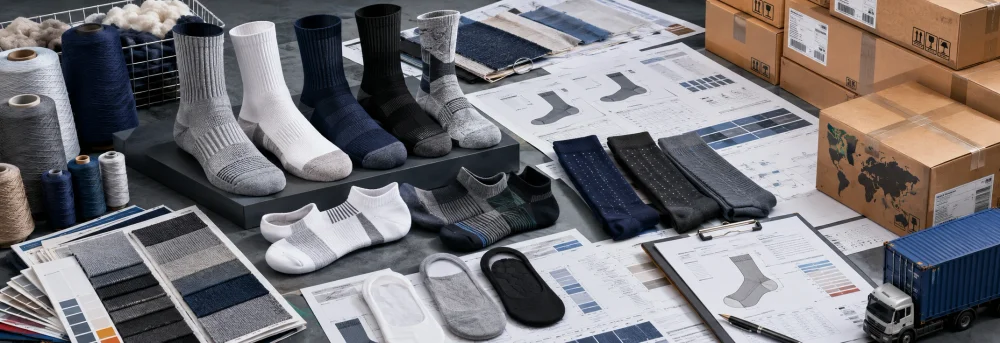
Wholesale sock sourcing requires more than choosing cotton, polyester, ankle or crew styles. Importers and private-label buyers must define fibre composition, yarn, needle count, terry construction, sizing, finishing, branding, packaging, testing and destination-market labels before requesting a final quotation.
Indian suppliers can support retail, school, workwear, sports and promotional programmes through Costita’s wholesale socks category . However, MOQ, price, lead time, packaging and compliance vary by product specification and destination. Buyers should use approved samples, written tolerances and verified documentation before confirming bulk production.
What Must a Wholesale Sock Buyer Define Before Requesting a Quotation?
A complete sock specification should define the intended user, application, length, material percentages, yarn, knitting construction, size range, finished measurements, stretch, terry coverage, heel and toe construction, colours, branding, labels, packaging and testing requirements.
“Men’s cotton crew socks” is a product description, not a production-ready specification. Two socks can use the same broad description while differing substantially in fibre blend, yarn quality, knitting density, weight, cushioning, dimensions and wash performance.
What Are Wholesale Socks?
Wholesale socks are knitted hosiery products produced in commercial quantities for importers, distributors, retailers, uniform suppliers, institutions, hospitality buyers and private-label brands. Orders may use an existing supplier design, a modified stock product or a fully customised specification.
The buyer should decide at the beginning whether the requirement is a standard item, a customised version or a new development. This affects sampling, machine setup, yarn booking, packaging minimums, production planning and final cost.
| Buying Model | Best Suited For | Main Buyer Responsibility |
|---|---|---|
| Standard supplier product | Distributors and price-led retail | Confirm size, material, colour and packaging |
| Modified stock product | School, workwear and promotional buyers | Approve changes to colour, logo and labels |
| Full private-label development | Brands and organised retail | Control the complete specification and testing |
Build the Product Requirement in the Right Order
Define the user and product construction before deciding branding, packaging and order quantities. This keeps quotations and samples aligned with the actual market requirement.
Define User
Men, women, children, unisex or institutional users.
Choose Length
No-show, ankle, crew, mid-calf or knee-high.
Select Material
Define fibres, percentages, yarn and stretch.
Set Construction
Confirm terry coverage, reinforcement and finishing.
Approve Details
Finalise sizing, branding, labels and packaging.
Sock Types, Lengths and Constructions
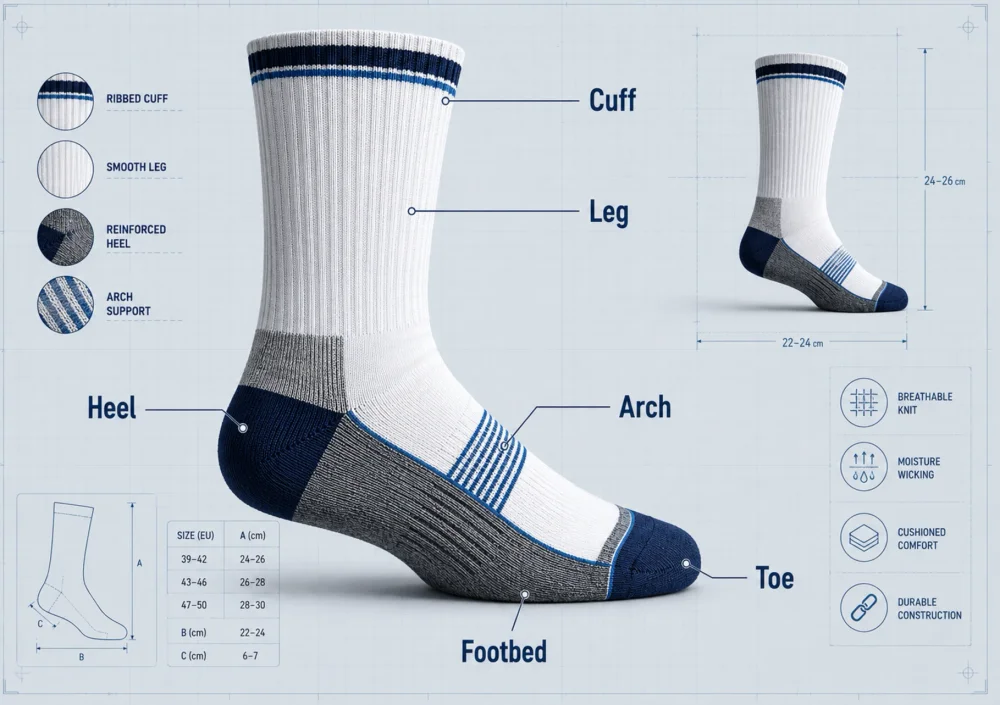
Product names such as ankle, crew and knee-high are useful, but suppliers may interpret them differently. A bulk specification should include measured foot length, leg length, cuff width and size tolerances rather than relying only on the profile name.
The intended application should guide the construction. A school sock requires repeatable colour and size grading, while a work sock may require cushioning and reinforcement. A fashion sock may prioritise yarn appearance, design detail and retail presentation.
| Type | Common Applications | Key Buyer Checks |
|---|---|---|
| No-show socks | Casual, sports and lifestyle retail | Heel grip, opening shape and slippage |
| Low-cut socks | Sneakers and warm-weather retail | Finished height and shoe coverage |
| Ankle socks | Everyday, school and sports | Cuff position and size grading |
| Crew socks | Casual, workwear, school and promotion | Leg length, cuff fit and logo area |
| Mid-calf socks | Formalwear and uniforms | Stay-up performance and shoe fit |
| Knee-high riding socks | Riding, uniforms and sports | Leg measurements and cuff tension |
| Work and boot socks | Workwear and outdoor use | Thickness, cushioning and boot fit |
| Kids socks | School and children’s retail | Foot-length grading and label clarity |
| Promotional socks | Events and merchandise | Logo reproduction, colour and deadline |
| Construction | Description | Typical Use |
|---|---|---|
| Non-terry | No looped cushioning in the specified area | Lightweight and formal products |
| Half-terry | Terry applied to selected zones, often the footbed | Work, sports and comfort ranges |
| Full-terry | Wider looped cushioning | Boot, outdoor and heavier products |
| Ribbed | Vertical knit structure for fit or appearance | Crew, school and formal socks |
| Mesh-zone construction | More open knit in selected areas | Sports and warm-weather designs |
| Reinforced heel and toe | Additional yarn in high-wear zones | Workwear and repeat-use retail |
| Jacquard or knit-in design | Pattern created during knitting | Private label and promotional socks |
Sock Materials and Fibre Blends
No single fibre is suitable for every sock programme. Cotton-rich blends may work well for school and everyday retail, while polyester or polyamide can support durability, colour retention and selected functional constructions. Elastane is normally added in small proportions to support stretch and recovery.
Fibre composition should never be treated as the full specification. Two products with the same blend can differ in yarn quality, knitting density, weight, terry coverage, fit, wash result and durability.
| Material | Common Role | Buyer Verification |
|---|---|---|
| Cotton | Main comfort fibre | Exact percentage, yarn type and shrinkage |
| Combed cotton | Cleaner cotton yarn option | Yarn declaration and sample quality |
| Polyester | Main or supporting synthetic fibre | Percentage, construction and performance evidence |
| Polyamide or nylon | Reinforcement or supporting fibre | Percentage and placement |
| Elastane or spandex | Stretch and recovery | Percentage and recovery performance |
| Wool or merino wool | Thermal or premium range | Fibre identity, care and testing |
| Viscose or rayon made from bamboo | Regenerated cellulosic fibre | Correct legal fibre name and claim evidence |
| Organic cotton | Certified sourcing claim | Valid certificate, scope and chain of custody |
| Recycled fibre | Recycled-content positioning | Traceability evidence and verified percentage |
Fibre-Labelling Check for Bamboo-Derived Textiles
For products sold in the United States, regenerated fibres made from bamboo should use the correct generic fibre name, such as “rayon made from bamboo” or “viscose made from bamboo.” Performance and environmental claims also require substantiation under FTC bamboo-textile guidance .
Yarn, Needle Count and Finishing
The RFQ should specify yarn type, yarn count, single or plied construction, reinforcement yarn, elastane construction and any recycled or certified-material requirements. Buyers should also ask how yarn lots and colour batches will be controlled for repeat orders.
Needle count refers to the number of needles used by the sock machine. A higher count can support finer construction and more design detail, but it does not automatically mean better quality. The final result also depends on yarn, stitch length, product size, terry construction, machine diameter and finishing.
Yarn Specification
Confirm fibre, count, construction, reinforcement and lot-control requirements.
Machine Selection
Review needle count together with yarn, size, pattern and terry construction.
Finishing Approval
Approve toe closing, boarding, washing, trimming, pairing and treatments.
| Technical Point | What the Buyer Should Confirm |
|---|---|
| Yarn count | Fineness and suitability for the intended construction |
| Needle count | Machine suitability for design, size and detail |
| Stitch density | Product weight, appearance and durability |
| Terry coverage | Exact cushioning zones |
| Toe closing | Seam method and comfort expectation |
| Boarding | Shape, presentation and dimensional consistency |
| Finishing treatment | Chemical name, purpose and supporting evidence |
Wholesale Sock Sizing
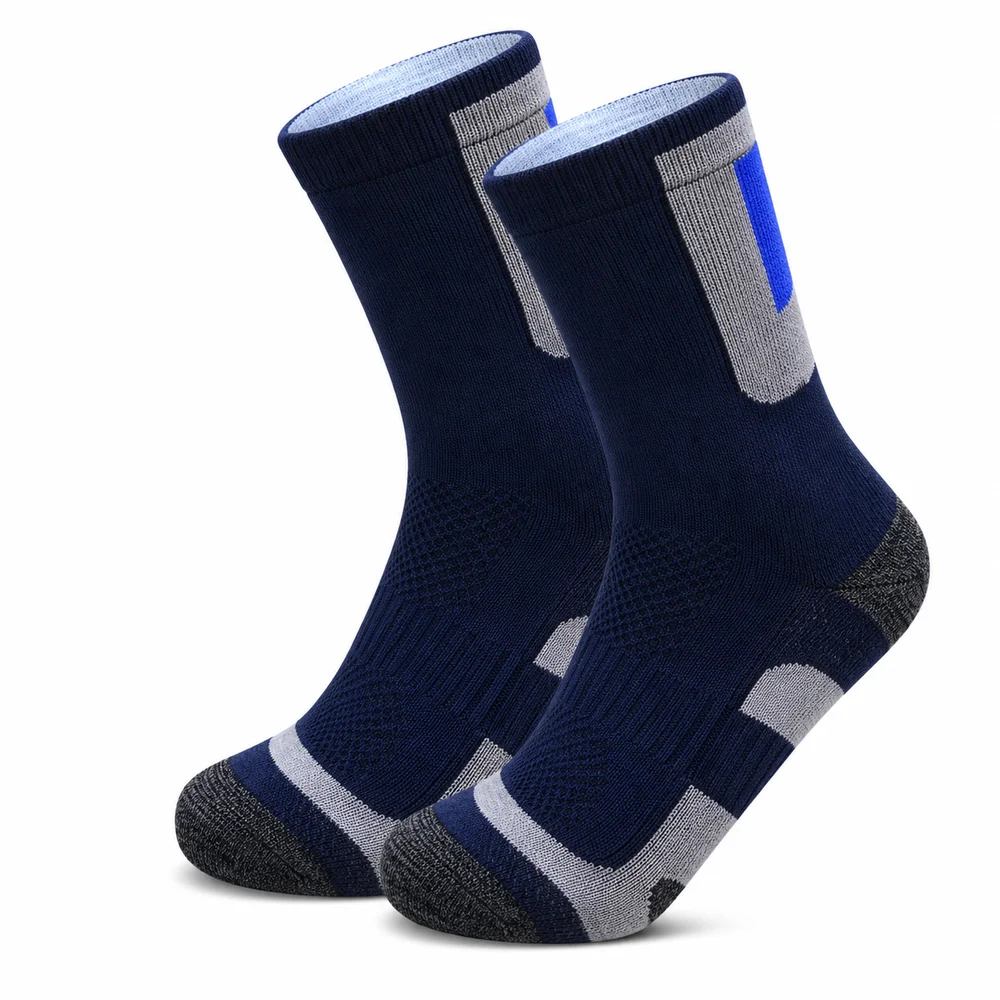
Sizing differs across markets, and labels such as S, M, L or UK 6-10 are not enough for production control. The approved size chart should include actual relaxed measurements, stretch requirements and tolerances.
For multi-size orders, buyers should approve a complete size set, including the smallest and largest sizes. Logo scale, pattern placement, labels and packaging should also be checked across every size before bulk production.
| Sizing Field | Required Decision |
|---|---|
| Target market | US, UK, EU, Canada or another size system |
| Intended user | Men, women, unisex, children or infant |
| Shoe-size range | Market-specific size range |
| Foot length | Relaxed finished measurement |
| Leg length | Measurement from a defined reference point |
| Cuff width | Relaxed and stretched measurements where required |
| Size tolerance | Permitted manufacturing variation |
| Assortment ratio | Quantity by size within each order or carton |
Wholesale Sock Specification Sheet
A complete specification sheet should be attached to the RFQ, sample approval, purchase order and inspection instruction. It gives the buyer, supplier, inspector and freight team one controlled reference for the order.
Where a commercial or technical value is not yet available, mark it as confirm with Costita based on product, quantity and destination market rather than using an estimated figure.
| Specification Field | Information Required |
|---|---|
| Style number | Unique buyer or supplier code |
| Product type | Length, user and intended application |
| Fibre composition | Generic fibre names and percentages |
| Yarn and needle count | Required technical construction |
| Terry profile | Non-terry, half-terry or full-terry |
| Size range | Destination-market size system |
| Measurements | Foot, leg, cuff and other critical points |
| Tolerances | Permitted variation by measurement |
| Heel and toe | Construction, reinforcement and seam |
| Colours | Pantone or approved physical reference |
| Branding | Knit-in logo, embroidery, print or label |
| Packaging | Pair band, bag, box, multi-pack and carton |
| Testing | Product, buyer and market-specific protocol |
| Inspection | Defect classes and acceptance criteria |
| Destination | Country, sales channel and Incoterm |
From Buyer Requirement to Approved Bulk Order
Each approval stage should remove uncertainty from the order. Product development moves forward only after the previous stage has been reviewed and recorded.
Buyer Requirement
Define user, market, application, quantities and target positioning.
Technical Specification
Confirm fibre, yarn, construction, sizing, measurements and tolerances.
Sample Approval
Review fit, colour, workmanship, wash result, logo and size set.
Production Control
Track yarn, knitting, finishing, labels and packaging.
Inspection and Release
Verify quantity, quality, assortment and documents.
How Socks Are Manufactured
Sock production usually begins with specification review, yarn sourcing and machine programming. The sock is then knitted, the toe is closed, and the product may be washed, boarded, softened, trimmed and paired.
After finishing, the factory checks workmanship, measurements, colour, labels and packaging. Approved retail packs are then placed into export cartons according to the confirmed size and colour assortment.
| Stage | Buyer Control Point |
|---|---|
| Product development | Approve construction, measurements and artwork |
| Yarn sourcing | Confirm fibre, colour and lot control |
| Knitting | Verify machine and sample construction |
| Toe closing | Approve seam appearance and comfort |
| Boarding and finishing | Confirm shape, treatment and wash result |
| Inspection | Check defects, dimensions, quantity and labels |
| Packing | Approve pack format, assortment and carton marks |
Quality Standards and Production Variations
Knitted textiles can show controlled variation in shade, dimensions, pair weight, terry density, elastic recovery and artwork placement. These differences are not automatically acceptable. The buyer and supplier should agree measurable tolerances and visual standards before production.
Inspection should cover workmanship, measurements, pair matching, labels, barcodes, size ratios and packaging. Avoid using the phrase “standard AQL” unless the inspection level, defect classes and acceptance values are written into the order.
| Test Area | Why Buyers May Request It |
|---|---|
| Fibre composition | Confirms the declared blend |
| Dimensional change | Measures shrinkage or growth after washing |
| Pilling | Assesses surface fuzzing and pilling |
| Abrasion | Evaluates wear resistance |
| Colourfastness | Checks colour change and transfer |
| Stretch and recovery | Evaluates fit retention |
| Restricted substances | Supports market or retailer chemical requirements |
| Product weight | Checks consistency against the approved sample |
Knitting Defects
Holes, dropped stitches, broken elastic and loose yarn.
Pairing Defects
Unequal lengths, mixed shades, sizes or constructions.
Branding Defects
Incorrect logo, colour, position, label or barcode.
Packing Defects
Wrong assortment, missing labels or incorrect carton marks.
Private Label and Customisation
Private-label sock development can range from a simple logo change to a fully customised material, construction, size range and retail pack. Costita’s live sock pages currently list options such as custom colours, logo knitting, embroidery, labels and packaging, but availability varies by product and supplier.
Buyers should approve artwork at actual size, physical colour references, the complete size set, wash performance and final packaging before production. Custom requirements should be included in both the approved sample and purchase order.
Product Build
Fibre blend, length, terry, cuff, heel and toe.
Design
Colours, stripes, patterns and contrast zones.
Branding
Knit-in logo, embroidery, print and labels.
Packaging
Pair bands, hangtags, bags, boxes and cartons.
Recommended Approval Sequence
Buyer Brief
Artwork Review
Physical Sample
Pack Approval
Bulk Production
Packaging, Storage and Freight
Packaging should be treated as part of the product. Confirm pairs per pack, packs per carton, carton dimensions, net weight, gross weight, calculated CBM and assortment by size and colour.
Current Costita sock pages contain conflicting pack descriptions and carton-volume calculations. Container loading should therefore be calculated only after the final pack and carton are approved.
| Pack Format | Typical Use |
|---|---|
| Pair band | Simple wholesale and retail display |
| Hangtag | Peg display and brand communication |
| Single-pair bag | Product protection and barcode placement |
| Multi-pair pack | Value retail and distributor supply |
| Retail box | Premium or gift presentation |
| Bulk institutional pack | Uniform and operational supply |
Storage Controls
Keep cartons in a clean and dry environment.
Protect stock from direct sunlight and excess humidity.
Separate production lots for traceability.
Avoid water, chemical and strong-odour exposure.
Maintain pest-control and warehouse inspection records.
Inspect cartons after long storage or high-humidity exposure.
Product-Selection Matrix
Buyers should shortlist products according to the intended sales channel, footwear, climate, wash routine and retail price position. The same sock should not be assumed to suit school, sports, workwear and promotional applications.
Costita’s live range includes school socks , half-terry workwear socks and knee-high riding socks .
| Requirement | Recommended Starting Point | Key Decisions |
|---|---|---|
| Everyday retail | Cotton-rich or polyester non-terry ankle or crew | Blend, weight, size and pack |
| School programme | Cotton-rich ankle or crew | Colour, stripes and grading |
| Workwear | Half-terry or full-terry crew or boot sock | Cushioning and abrasion |
| Sports | Ankle or crew with targeted construction | Fit, wash and performance evidence |
| Formalwear | Fine non-terry crew or mid-calf | Yarn, colour and cuff |
| Riding | Knee-high sock | Leg size, boot fit and cushioning |
| Promotional | Standard profile with custom logo | Artwork, deadline and packaging |
| Premium private label | Custom yarn, construction and pack | Testing and consistency |
| Kids retail | Child-specific sizing and artwork | Size system and label clarity |
MOQ, Price and Lead-Time Guidance
MOQ depends on yarn minimums, machine setup, colour count, size breakdown, logo method, packaging and the number of variations. Lead time depends on sample approval, yarn booking, production scheduling, testing, inspection and packaging.
Current Costita product pages show different minimums and production periods across school, low-cut, workwear and private-label socks. These figures are product-page listings, not standard category-wide commercial terms.
| Current Product Example | Page-Listed MOQ | Page-Listed Lead Period | Buyer Check |
|---|---|---|---|
| Kids school ankle socks | 100 pieces | 8 to 25 days | Confirm whether the order unit means individual socks or pairs |
| Men’s low-cut cotton-rich socks | 2,000 pairs | 45 days | Confirm final composition, pack format and carton data |
| Men’s half-terry workwear socks | 2,000 pairs | 15 to 45 days | Confirm blend, sizing, test requirements and delivery basis |
| Supplier-described organic cotton crew socks | 2,000 pairs | 15 to 45 days | Review certification scope and chain-of-custody evidence |
Quotation Control
Confirm currency, price validity, taxes, packaging scope, Incoterm, sample cost, testing cost and inspection cost in the quotation. Final MOQ, price and production period vary by specification and destination.
HS Classification for Socks
Most knitted or crocheted socks fall under HS heading 6115. Under the current WCO HS 2022 nomenclature , ordinary hosiery is generally separated by principal fibre.
A supplier-provided HSN code should be treated as preliminary. Final classification can depend on fibre composition, construction, intended use and the importing country’s national tariff subdivisions.
| Product Description | Likely HS 2022 Branch |
|---|---|
| Graduated compression hosiery | 6115.10 |
| Other hosiery of wool or fine animal hair | 6115.94 |
| Other hosiery of cotton | 6115.95 |
| Other hosiery of synthetic fibres | 6115.96 |
| Other hosiery of other textile materials | 6115.99 |
Confirm the final national tariff line, duty treatment and origin requirements with the importer, customs broker or relevant customs authority before shipment.
Global Demand and India’s Export Trade
The tables below use 2023 World Bank WITS extracts based on UN Comtrade data under legacy code 611592, covering cotton knitted or crocheted hosiery. Current HS 2022 schedules use 611595 for the cotton branch.
These figures show established trade relationships and market scale. They do not represent retail-market size, Costita sales, buyer margin or immediately available demand.
Selected Global Import Markets, 2023
| Reporter | Partner | Flow | Trade Value, US$000 | Quantity, kg |
|---|---|---|---|---|
| Germany | World | Import | 675,081.95 | 36,394,100 |
| United States | World | Import | 591,257.30 | 48,422,400 |
| France | World | Import | 368,481.43 | Not reported in summary |
| United Kingdom | World | Import | 339,938.35 | 22,835,500 |
India’s Reported Exports, 2023
| Reporter | Partner | Flow | Trade Value, US$000 | Quantity, kg |
|---|---|---|---|---|
| India | World | Export | 25,540.22 | 1,180,390 |
| India | United States | Export | 6,112.35 | 282,495 |
| India | United Kingdom | Export | 3,833.86 | 177,190 |
| India | France | Export | 2,718.07 | 125,621 |
| India | United Arab Emirates | Export | 2,416.72 | 111,694 |
| India | Spain | Export | 1,595.82 | 73,754 |
Source: World Bank WITS using UN Comtrade . Current India trade figures should be extracted from India TradeStat using the final confirmed HS classification.
Why Buyers Evaluate India for Wholesale Socks
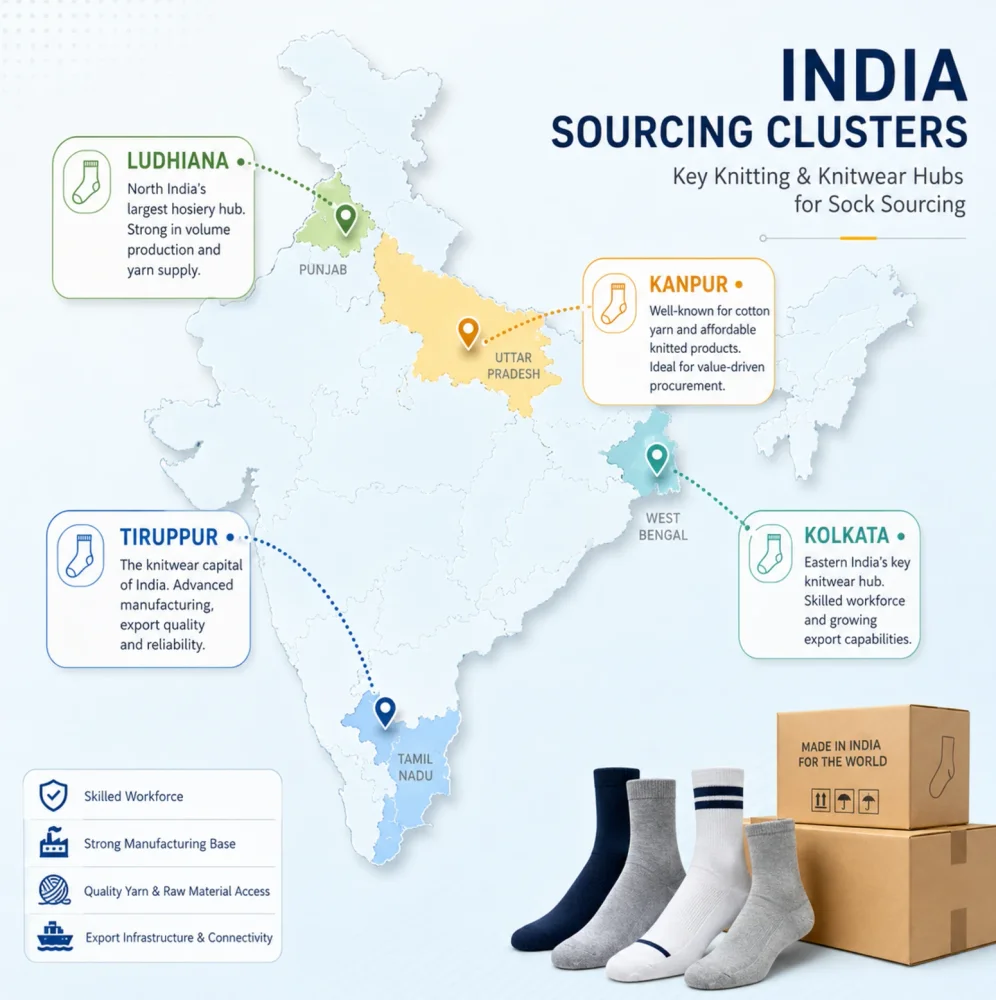
India has established knitting and knitwear ecosystems in locations including Ludhiana, Tiruppur, Kolkata and Kanpur. These clusters support access to yarn, knitting skills, dyeing, finishing, packaging and export services.
Buyers can evaluate India for cotton-rich, polyester, school, workwear, riding and private-label programmes. The sourcing decision should still be based on specification compliance, total landed cost, quality consistency, communication and delivery reliability.
Textile Ecosystem
Access to yarn, knitting, processing, packaging and supporting services.
Product Flexibility
Multiple lengths, blends, terry profiles and private-label options.
Export Experience
Existing trade relationships across North America, Europe and the Gulf.
Custom Development
Support for colours, logos, labels, packaging and coordinated ranges.
Limitations Buyers Should Plan For
Yarn-price and raw-material changes
Shade and yarn-lot variation
Sample-to-production differences
Packaging and carton-data errors
Unverified fibre or performance claims
Destination-rule and tariff changes
Destination-Market Requirements
Textile labelling and product-safety obligations differ by destination. Fibre content, responsible-company details, country of origin, care information, chemical restrictions and traceability should be reviewed before labels and packaging are printed.
Retailers may also apply testing or documentation requirements that exceed general legal minimums. Final compliance should be confirmed with the importer, customs broker, laboratory or relevant authority.
| Market | Main Requirements to Review | Official Reference |
|---|---|---|
| United States | Fibre disclosure, responsible-company identity, country of origin, care and tariff classification | FTC textile-labelling guidance |
| European Union | Approved fibre names, fibre percentages, GPSR traceability and REACH restrictions | EU textile regulation |
| Great Britain | Textile labelling, business identification and General Product Safety Regulations 2005 | UK textile-labelling guidance |
| Northern Ireland | EU GPSR responsibilities and an eligible responsible economic operator | Northern Ireland GPSR guidance |
| Canada | Fibre names and percentages, dealer identity and bilingual fibre information | Canadian textile guidance |
Main Buyer Risks and Controls
Most sourcing problems begin with an incomplete specification, unclear approval records or unverified claims. These issues are easier to control before production than after goods have been packed.
The purchase order should refer to the approved sample, measurement chart, artwork, labels, packaging and inspection criteria. Any change should be recorded before the factory proceeds.
| Risk | Practical Control |
|---|---|
| Incomplete specification | Use a signed product specification sheet |
| Unclear size system | Approve a measured size set |
| Fibre misdescription | Test composition and review labels |
| Unsupported organic claim | Verify certificate and transaction scope |
| Bamboo mislabelling | Use the correct generic fibre name |
| Shade variation | Approve colour standards and lot controls |
| Incorrect carton data | Recalculate CBM from final packaging |
| Wrong HS code | Confirm with the importer or customs broker |
| Unsupported performance claim | Require product-specific test evidence |
| Missed destination rule | Complete a market compliance review before printing labels |
Supplier-Selection Checklist
Supplier evaluation should combine business verification, technical capability, product evidence and commercial clarity. A strong sample is useful, but it does not replace factory, documentation and production checks.
Business and Factory
- Verify legal company details and factory address.
- Confirm manufacturing, trading and subcontracting roles.
- Review machines, needle counts and relevant experience.
Product Evidence
- Approve composition, measurements and wash results.
- Review test reports against the correct product.
- Check certification scope, validity and certificate holder.
Commercial Terms
- Confirm MOQ by size, colour, design and pack.
- Define price validity, currency and Incoterm.
- Record sample, testing, inspection and rework costs.
Final Order Control
- Keep the approved sample with the purchase order.
- Approve packaging proof, barcode and carton marks.
- Define inspection, claims and shipment-release procedures.
How Costita Supports Wholesale Sock Buyers
According to Costita’s supplier-verification process and buyer-protection information , its sourcing support can include document checks, factory visits, capability review, sample coordination, production monitoring and inspection.
Costita can also coordinate freight and export documentation through order-specific arrangements. These controls can reduce avoidable sourcing risks, but buyers should still approve the product specification, test protocol, labels, payment terms and destination compliance.
Supplier Review
Documents, factory and capability checks.
Sample Control
Product, branding and packaging approvals.
Production Checks
Monitoring, inspection and issue follow-up.
Shipment Support
Freight and order-specific documentation.
Payment and shipping options vary by transaction. Review Costita’s payments and shipping information and confirm the final commercial terms in the quotation.
Wholesale Socks FAQs
What should I include in a wholesale socks quotation request?
Include the sock profile, intended user, fibre composition, size range, quantities by size and colour, terry construction, branding, packaging, destination and required delivery period. Add artwork, testing and label requirements where available.
Which material is suitable for school, workwear and everyday socks?
Cotton-rich blends are common in school and everyday ranges. Workwear may use additional cushioning, reinforcement and supporting synthetic fibres. The final selection should be based on application, approved sample and testing requirements.
Can wholesale socks be customised?
Customisation may include fibre blend, length, terry construction, colours, knit-in logos, embroidery, labels, pair bands, bags, boxes and export cartons. Availability and minimums vary by product and supplier.
What determines MOQ and production lead time?
Yarn minimums, machine setup, size and colour combinations, logo method, packaging, testing and production scheduling affect MOQ and lead time. Confirm the final figures in the quotation.
Which tests may be required for imported socks?
Buyers may request fibre composition, dimensional change, pilling, abrasion, colourfastness, stretch, restricted-substance and workmanship testing. The programme should match the product, destination and retailer requirements.
Which HS code is used for socks?
Most knitted socks fall under heading 6115. Cotton, synthetic, wool and other textile fibres use different six-digit branches. Final classification should be confirmed with the importer or customs broker.
How can Costita support a private-label sock order?
Costita can coordinate supplier review, samples, product communication, production monitoring, inspection, shipping and documentation. Final services and commercial terms vary by order.
Prepare Your Wholesale Socks Requirement
Share the required sock profile, fibre composition, size range, quantities, colours, branding, packaging and destination. MOQ, price, samples, production period and shipping terms vary by specification and destination.