
Areca Palm Leaf Plate Quality & Inspection Guide for Importers: Grades, Natural Variations and Defect Criteria
A bulk shipment of areca palm leaf plates should not be judged by colour alone. Every leaf sheath carries its own grain, fibre structure and natural shade, while cracks, broken edges, severe deformation and contamination point to a different quality problem. Importers need a specification that clearly separates acceptable natural variation from defects that can affect presentation, packing or use.
This guide is designed for importers, distributors, hospitality suppliers, food-service procurement teams and private-label brands preparing samples or commercial orders from India. It explains how to define cosmetic expectations, compare products, document tolerances and create a more objective inspection process before production begins.
Buyers who are still comparing formats, dimensions and profiles can first review Costita's complete areca palm leaf product guide and then return to this quality framework before approving representative samples.
Buyer starting point
Ask the supplier to approve a written visual range, dimensional tolerance and defect list. A grade name such as premium or export quality is not specific enough unless it is supported by photographs, samples and measurable acceptance criteria.
Explore the Quality and Inspection Guide
Part 1 of 4Quick buyer answer
How should importers inspect areca palm leaf plates?
Separate cosmetic variation from structural defects. Approve a visible colour and grain range, define measurable dimensions and trimming tolerances, identify zero-tolerance defects, confirm packing requirements and record how samples will be selected before shipment approval.
Approve a Visual Range
Use several accepted samples to show the permitted colour, grain, spots and surface variation.
Define Defect Limits
Classify cracks, broken edges, severe burns, deformation and contamination before production.
Measure the Product
Confirm dimensions, profile, stack alignment, bundle count and carton configuration.
Inspect Before Dispatch
Compare production against the approved specification before the shipment is released.
Compliance boundary: A cosmetic or physical inspection does not establish legal food-contact compliance. United States buyers should review the official FDA notice on Areca catechu palm-leaf dinnerware before beginning commercial sourcing.
Audience
Importers, distributors, hospitality and private-label buyers
Main Decision
What variation to accept and which defects to reject
Last Verified
July 30, 2026
Method
Product-page review, buyer criteria and official compliance checks
Natural material behaviour
Why areca palm leaf plate quality varies naturally
Areca plates are formed from individual palm leaf sheaths rather than a uniform manufactured sheet. Each sheath develops its own fibre density, colour, veins and surface markings before it reaches the production facility. Two correctly pressed plates can therefore look different even when their dimensions and functional condition meet the same buyer specification.
Manufacturing can control cleaning, forming, trimming, sorting and packing, but it cannot make a natural material visually identical without changing the buyer's product expectation. The practical procurement goal is controlled variation: a clearly approved appearance range combined with tighter limits for structural, hygiene and packing defects.
The Natural-to-Commercial Quality Path
Variation begins in the leaf and is controlled through sorting and inspection.
Natural Input
Grain, shade and fibre vary.
Controlled Forming
Shape and trim are managed.
Buyer Acceptance
Samples define the limits.
Before production
Raw-Material Condition
Leaf maturity, brittleness, fibre density and storage condition influence the available production result.
During production
Forming Conditions
Heat, pressure, mould geometry, trimming and handling influence appearance and dimensional consistency.
After production
Sorting and Packing
Cosmetic sorting, stack checks and protective packing decide what reaches the commercial shipment.
Inspection boundary
Natural characteristics versus manufacturing defects
A natural characteristic comes from the original leaf and can remain acceptable within the approved visual range. A manufacturing or handling defect is created or worsened during production, trimming, storage, packing or transport and may affect presentation, structural condition or usability.
The distinction should not be decided after the shipment is complete. Buyers should approve photographs of acceptable variation and rejected defects before production, then reference those images in the purchase specification and inspection instruction.
| Inspection Area | Usually Acceptable Natural Variation | Usually Treated as a Defect | Buyer Control |
|---|---|---|---|
| Grain | Visible veins and stable fibre patterns | Fibre separation, raised splinters or structural splitting | Approve maximum visible grain and surface condition |
| Colour | Cream, beige, tan or light-brown range | Severe charring, contamination or unapproved discolouration | Approve lightest and darkest acceptable samples |
| Surface | Minor texture or shallow natural wrinkles | Loose fibres, holes, cracks or unstable separation | Define the acceptable food-contact-face appearance |
| Heat Marks | Light localised marks within the approved class | Large dark burns, charring, brittleness or burnt odour | Define size, darkness, location and rejection threshold |
| Shape | Minor movement within the agreed dimensional tolerance | Warping, poor nesting or incorrect profile | Measure dimensions and run a defined stack test |
| Edge | Small natural irregularity within the approved limit | Broken, sharp, cracked or badly trimmed rim | Approve trimming reference and zero-tolerance conditions |
Acceptable range
Natural Characteristics
Leaf Grain
Visible veins within the approved range
Colour Range
Cream to light brown as agreed
Minor Texture
Stable surface variation
Small Spots
Natural pigmentation within limits
Light Marks
Localised cosmetic heat marks
Minor Movement
Within dimensional tolerance
Corrective action
Manufacturing or Handling Defects
Cracks
Structural opening or split
Broken Edges
Damage affecting handling or use
Poor Trimming
Uneven or sharp rim condition
Deformation
Warping or poor nesting
Severe Burns
Charred or brittle surface
Contamination
Mould, fungus or foreign matter
Buyer decision diagram
Convert subjective appearance into an inspection decision
Inspectors should not decide quality from personal preference. Each observed condition should be compared with an approved visual reference, measured where possible and classified according to the buyer's written defect criteria.
Observe
Identify colour, grain, marks, shape, edge and surface condition.
Compare
Match the product against approved and rejected reference samples.
Measure
Check dimensions, marked area, stack condition and permitted tolerance.
Classify
Accept, record as minor, segregate or reject under the agreed plan.
Procurement principle: The specification should control variation without promising identical natural products. Repeat orders should use the same visual range, tolerances and inspection language wherever practical.
Product-specific inspection
Apply the quality framework to the exact product profile
A shallow plate, deep plate and compartment plate should not share one generic inspection sheet. Profile depth, rim geometry, nesting and compartment definition create different production and packing risks.
Round Shallow Plates
Prioritise flatness, rim consistency, surface appearance and stack alignment across the selected sizes.
Round Deep Plates
Check profile depth, base stability, rim formation, warping and nesting consistency within cartons.
Compartment Plates
Inspect compartment definition, wall integrity, profile balance, trimming and stack stability.
Still deciding between areca palm leaf and bagasse?
Compare presentation, consistency, food-service formats and procurement considerations before building a mixed disposable range.
Part 1 buyer action
Approve a representative quality range before requesting bulk production
Share the required product, sizes, destination, estimated quantity and presentation expectations. Costita can help coordinate product samples and prepare a clearer quality discussion with the selected manufacturer.

Part 2 of 4
Define the cosmetic quality class before comparing supplier prices
Grade names such as premium, natural or commercial have little value unless the supplier and buyer attach measurable expectations to them. This part converts those broad descriptions into a practical framework for samples, quotations and bulk-order inspection.
Navigate Part 2
Cosmetic Quality FrameworkBuyer-defined grading system
A practical three-class framework for areca palm leaf plate quality
There is no single cosmetic grading vocabulary applied consistently by every areca palm leaf manufacturer. One supplier's premium grade may resemble another supplier's standard natural grade, especially when colour, heat marks and trimming have not been defined in writing.
The following Class A, Class B and Class C structure gives buyers a common starting point. It should always be supported by approved samples, visual tolerance photographs, dimensional limits and defect criteria before production begins.
Cosmetic sorting spectrum
Greater cosmetic control normally requires stricter sorting
Structural defects remain controlled across all three classes.
Commercial Natural Finish
Function-led selection
Allows wider natural cosmetic variation while maintaining the agreed structural and packing requirements.
Natural Export Finish
Authenticity with control
Maintains visible natural character while applying practical limits to marks, trimming and batch variation.
Premium Uniform Finish
Presentation-led selection
Applies tighter cosmetic sorting for retail, hospitality and customer-facing presentation.
Class B
Natural Export Finish
Class B provides a practical balance between natural appearance and commercial consistency. It allows visible grain, controlled colour variation and limited cosmetic marks while maintaining clear limits for cracks, mould, severe burns, major deformation and poor trimming.
This is often the most suitable starting point for distributors, restaurants, caterers and general retail buyers because it preserves the character of the material without requiring the strictest cosmetic sorting.
Typical buyer expectation
Colour
Controlled cream, beige and light-brown range
Grain
Visible natural veins within approved limits
Marks
Minor heat marks accepted within the visual range
Structure
Strong control of cracks, shape and trimming
Best suited to: food-service distributors, restaurants, catering companies, wholesalers, hospitality suppliers and general retail programmes.
Class C
Commercial Natural Finish
Class C accepts a broader cosmetic range for applications where function, volume and commercial value matter more than close visual uniformity. Products may show more visible grain, shade differences and accepted heat marks.
Commercial finish should never be used as a label for damaged or contaminated products. Cracks, mould, broken edges, dangerous fibres and severe deformation must remain controlled separately from the cosmetic grade.
Typical buyer expectation
Colour
Wider approved natural shade range
Grain
More prominent natural fibre patterns
Marks
More visible cosmetic marks within defined limits
Function
Structural requirements remain fully applicable
Best suited to: high-volume catering, institutional food service, community events, budget wholesale and applications where cosmetic uniformity is not the main purchasing factor.
Self-contained comparison
Compare the three areca quality classes
Use this table during supplier discussions to identify where the buyer requires stricter sorting and where natural variation can remain visible. The final purchase specification should replace descriptive words with approved examples and measurable limits.
| Quality Area | Class A: Premium Uniform | Class B: Natural Export | Class C: Commercial Natural |
|---|---|---|---|
| Main priority | Customer-facing appearance | Balance of appearance and availability | Function and commercial value |
| Colour range | Narrower approved range | Moderate natural range | Wider natural range |
| Grain visibility | Limited prominent grain | Visible natural veins accepted | More prominent patterns accepted |
| Heat marks | Minimal and tightly controlled | Minor marks accepted within limits | More visible marks may be accepted |
| Trimming | Cleaner and more uniform | Commercially consistent | Functional within agreed limits |
| Structural defects | Controlled under the defect plan | Controlled under the defect plan | Controlled under the defect plan |
| Typical buyer | Premium retail and hospitality | Distributors, restaurants and caterers | Institutional and price-sensitive wholesale |
Important: The class controls cosmetic presentation. It should not weaken requirements for contamination, mould, dangerous edges, structural cracks, incorrect dimensions or packing errors.
Procurement selection matrix
Choose the quality class according to the sales channel
The highest cosmetic class is not automatically the best commercial decision. Buyers should select the class that matches customer expectations, packaging, selling price, available supply and the importance of presentation in the final application.
Premium retail
Start with Class A
Prioritise colour range, clean trimming, retail-pack appearance and repeat-order presentation.
PRESENTATION FIRSTHospitality
Class A or Controlled B
Select according to the venue, food presentation and whether the product remains visible to guests.
EXPERIENCE LEDDistribution
Start with Class B
Balance repeat supply, natural appearance, carton consistency and a commercially workable cost.
BALANCED VALUEInstitutional volume
Class B or C
Focus on function, quantity accuracy, carton condition, stacking and landed commercial value.
FUNCTION FIRSTBuying for restaurants, catering or food-service distribution?
Review how commercial buyers compare product sizes, suppliers, packaging and bulk-order requirements before confirming a sourcing programme.
Cosmetic inspection
How buyers should evaluate heat marks
Heat marks can develop when differences in leaf thickness, fibre density and moisture respond to the forming process. A small localised mark may remain acceptable, while a large dark area, charring, brittleness or burnt odour can fall outside the approved quality requirement.
Buyers should define marks by visible area, darkness, location and effect rather than using vague wording such as minimal heat marks. Cosmetic evaluation must also remain separate from destination-market food-contact compliance.
Heat-Mark Inspection Scale
Final limits should be supported by approved physical or photographic samples.
Level 1
Light and Localised
May be accepted according to the Class A or Class B visual limit.
Level 2
Moderate but Stable
May be accepted in Class B or Class C when within the agreed range.
Level 3
Severe or Charred
Segregate or reject when appearance, odour or structure is affected.
| Inspection Question | What to Record | Possible Decision |
|---|---|---|
| How large is the mark? | Approximate surface area or reference photograph | Accept, classify or reject according to the approved limit |
| How dark is the mark? | Light brown, dark brown, blackened or charred | Compare with the visual tolerance board |
| Where is it located? | Food-contact surface, rim, base or reverse side | Apply location-specific acceptance criteria |
| Does it affect the product? | Check brittleness, odour, surface breakdown and shape | Reject when structure or intended use is affected |
Colour approval system
Approve a colour range instead of one perfect plate
Approving one pale sample can create an unrealistic expectation that every item in a natural-material shipment will match it. A better approval set shows the lightest and darkest accepted products, together with the maximum permitted grain and heat-mark appearance.
Colour should remain a cosmetic criterion. It does not independently prove strength, hygiene, moisture stability, food-contact compliance or environmental performance.
Example Approved Colour Range
Use physical samples for final approval.
Light Cream
Cream Beige
Natural Tan
Light Brown
Lightest Accepted
Defines the pale end of the approved range.
Darkest Accepted
Defines the darker end of the cosmetic range.
Maximum Grain
Shows the strongest acceptable natural vein pattern.
Maximum Heat Mark
Shows the accepted mark size and darkness.
Rejected Reference
Shows conditions outside the approved class.
Dimensional inspection
Shape and stack consistency affect packing, retail presentation and use
Importers purchase stacks, bundles and cartons rather than individual showcase pieces. Dimensional inconsistency can affect nesting, carton count, shelf presentation, automatic packing and the ability to repeat the same product specification in future orders.
The inspection specification should define the target dimensions and tolerances for diameter or length, profile depth, rim alignment, compartments and stack height for a fixed number of pieces.
Accepted stack
Consistent Nesting
Alignment
Stack remains upright
Nesting
Products separate normally
Review required
Deformed or Uneven Stack
Alignment
Stack leans or spreads
Nesting
Gaps or sticking appear
| Stack Test | What the Inspector Checks | Commercial Impact |
|---|---|---|
| Stack height | Height of a defined number of products | Affects bundle size and carton planning |
| Vertical alignment | Leaning, shifting and rim inconsistency | Affects packing appearance and stability |
| Nesting gaps | Excessive spaces between products | Reduces carton efficiency |
| Product separation | Sticking, damage or difficulty separating pieces | Affects service speed and receiving quality |
Continue your product research
Connect cosmetic grading with product selection and import planning
Quality-class decisions should be made alongside product dimensions, food-service applications, supplier capability, destination eligibility, packaging and the complete import process.
Product selection
Complete Areca Palm Leaf Product Guide
Compare product types, shapes, sizes, specifications and applications.
Material comparison
Areca Palm Leaf Plates vs Bagasse Plates
Compare consistency, presentation and food-service applications.
Bulk procurement
Restaurant and Catering Bulk Sourcing Guide
Review supplier selection, MOQ, packaging and commercial buying steps.
Import planning
Complete Areca Import Guide for 2026
Review market access, supplier verification, samples, shipping and documentation.
Part 2 buyer action
Define the required quality class before requesting the final quotation
Share your target market, product formats, customer segment, quantity and cosmetic expectations. Costita can help structure a clearer sample and quality discussion before commercial production.

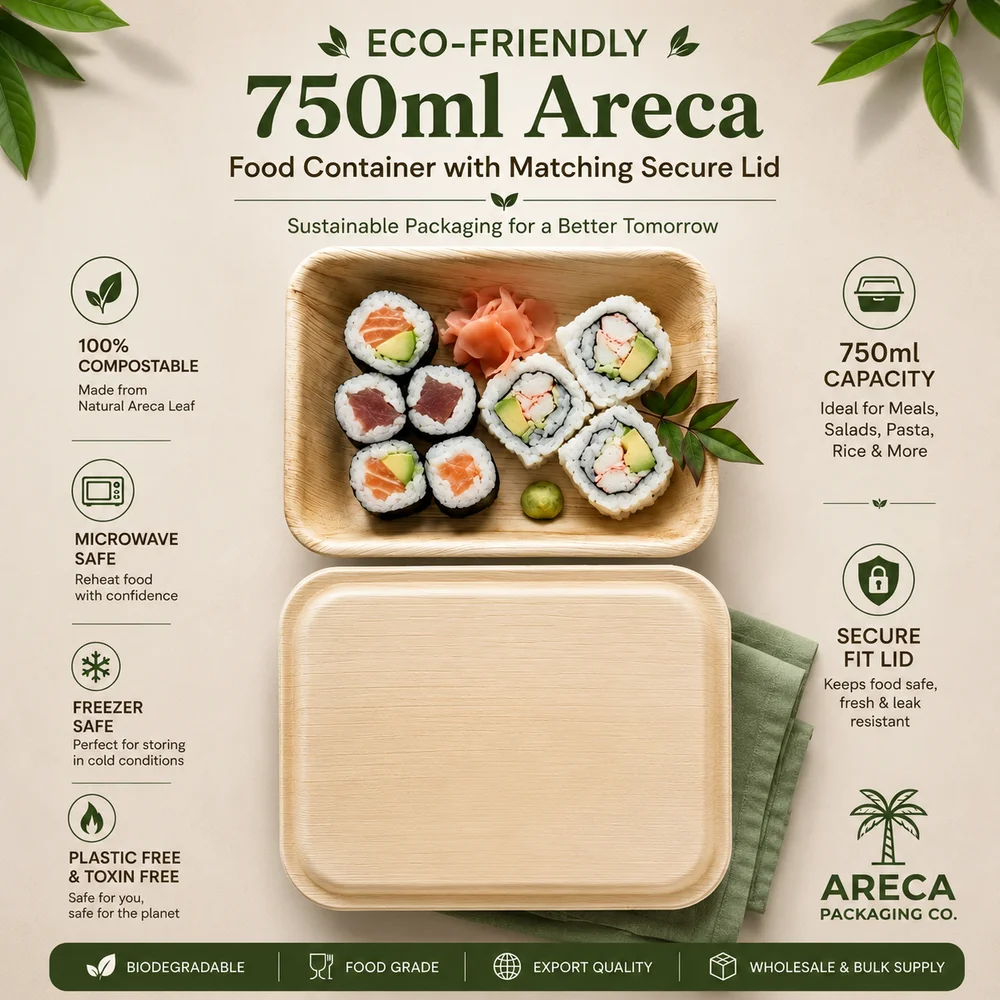
750ml Areca Palm Leaf Rectangle Food Container with Lid Biodegradable Food Storage Box
Part 3 of 4
Convert the approved quality class into a shipment inspection plan
Cosmetic approval is only one part of procurement control. Importers must also define moisture condition, dimensions, structural defects, packaging, quantity checks, inspection sampling and shipment-release responsibilities before production is completed.
Navigate Part 3
Inspection and Shipment ControlNatural-material stability
Moisture condition can affect shape, stacking and warehouse stability
Areca palm leaf products can respond to humid storage, incomplete drying, damaged inner packs or water exposure during transport. Visible effects may include bending, changing stack height, carton softening, surface odour, condensation or microbial growth.
The buyer and supplier should agree on a measurable moisture requirement, the test method, the number of readings and the production stage at which testing will occur. An exact percentage should not be copied from another order without checking the product profile, packing system, climate and destination route.
Moisture Risk Indicators
Inspect the product, inner pack and export carton together.
Warping
Loss of expected flatness or profile
Condensation
Moisture visible inside sealed packaging
Musty Odour
Unexpected warehouse or moisture-related smell
Carton Damage
Soft, stained or weakened export cartons
Mould
Visible microbial growth requiring segregation
Stack Change
Increased gaps, leaning or sticking
Stability-control diagram
Moisture protection must continue from production to the buyer's warehouse
Drying
Prepare stable product condition
Testing
Record agreed moisture readings
Inner Pack
Seal the counted product bundle
Carton
Use the approved export configuration
Transport
Control loading and water exposure
Storage
Keep cartons dry and protected
Buyer control: Record where moisture testing occurs, which instrument or method is used and what action will be taken when results fall outside the agreed specification.
Export-pack inspection
Packaging quality should be inspected as part of the product
A correctly formed plate can still reach the buyer in poor condition when the inner pack is loose, the carton is underspecified, quantities are inaccurate or the load is exposed to moisture and compression. Packaging should therefore be included in sample approval and pre-shipment inspection.
Buyers should define bundle count, inner-pack material, seal method, master-carton configuration, labels, barcodes, pallet requirements and any moisture-protection measures. Every customised element should be linked to approved artwork and packing instructions.
Four-Layer Export Packaging Structure
Each layer should have a clear protective and commercial purpose.
Layer 4
Pallet or Shipping Unit
Controls movement, stacking, loading and shipment handling.
Layer 3
Export Carton
Protects bundles and carries shipment markings.
Layer 2
Inner Bundle
Maintains count, cleanliness and product grouping.
Layer 1
Inspected Product Stack
Must match the approved quality and quantity specification.
| Packing Area | Buyer Specification | Inspection Check | Commercial Risk |
|---|---|---|---|
| Inner quantity | Pieces per bundle or retail pack | Open and count selected packs | Customer shortages and inventory errors |
| Inner seal | Approved material and sealing method | Check closure, tears and visible openings | Moisture, dust or handling exposure |
| Master carton | Carton type, size, quantity and closure | Review condition, compression and dimensions | Breakage, crushing and freight inefficiency |
| Artwork and labels | Approved artwork, barcode and markings | Compare print with signed approval | Retail rejection or relabelling cost |
| Palletisation | Pallet size, stacking and stretch wrapping | Check stability and final loading condition | Movement, collapse or warehouse difficulty |
Production quality workflow
The eight-stage areca palm leaf quality inspection process
Inspection should begin before the finished cartons are ready. Early controls help the supplier remove unsuitable raw material, correct process issues and prevent rejected products from being packed into the shipment.
The exact workflow may differ between factories, but buyers should confirm who performs each check, what evidence is recorded and when corrective action can still be completed without delaying dispatch.
Raw Leaf Selection
Remove brittle, damaged, decomposed or visibly unsuitable raw material before production.
Cleaning and Preparation
Prepare the leaf sheath according to the supplier's documented production process.
Drying and Conditioning
Establish a stable material condition before the forming stage.
Heat Pressing
Form the required shape using the correct mould, temperature, pressure and cycle.
Trimming
Remove excess material and create the agreed rim and final dimensions.
Cosmetic Sorting
Compare colour, grain and marks with the approved Class A, B or C range.
Structural Inspection
Check cracks, holes, deformation, sharp edges and unstable fibre separation.
Packing and Release
Confirm counts, packaging, artwork, carton condition and shipment readiness.
| Control Stage | Main Question | Evidence to Record |
|---|---|---|
| Before production | Are specifications, samples and materials approved? | Signed specification, sample record and production instruction |
| During production | Is output staying within quality and dimensional limits? | Process checks, defect records and corrective action |
| Before packing | Have rejected products been removed? | Sorting results and inspected production samples |
| Before shipment | Does the packed order match the purchase specification? | Inspection report, quantity check and packaging photographs |
Defect decision framework
Classify defects by commercial impact, not by appearance alone
A defect classification system helps the inspection team apply the same decision across multiple cartons and production batches. Critical, major and minor categories should be defined for the exact product and destination rather than copied without review.
The buyer, supplier and inspection agency should agree on the sampling plan and permitted number of defects before inspection. This guide does not prescribe a universal acceptance level because order size, product use and buyer risk differ.
Highest concern
Critical Defects
Contamination, mould, dangerous edges or another serious legal or safety concern
Commercial failure
Major Defects
Cracks, holes, broken edges, severe deformation, incorrect dimensions or significant specification failure
Limited commercial impact
Minor Defects
Cosmetic conditions that exceed the approved range without materially preventing the intended use
| Defect Class | Example Conditions | Typical Inspection Response |
|---|---|---|
| Critical | Mould, foreign matter, dangerous sharp fibres or prohibited material | Stop, segregate and investigate before shipment release |
| Major | Structural crack, hole, incorrect profile, broken edge or severe warping | Rework, replace or reject according to the agreed sampling plan |
| Minor | Cosmetic mark or trimming issue outside the approved visual range | Record and compare with the permitted minor-defect limit |
Sample approval system
One ideal sample cannot represent a complete natural-material shipment
A single attractive plate may confirm the general product direction, but it does not show the full range of colour, grain, heat marks and dimensional variation that can appear during commercial production.
Buyers should approve a controlled sample set containing acceptable limits and clearly rejected conditions. Copies or photographs should be held by the buyer, supplier and inspection team with the same approval reference.
Master approval file
Buyer Visual Tolerance Set
Standard approved product
Lightest and darkest accepted colour
Maximum accepted grain and heat mark
Clearly rejected defect samples
Product Sample
Confirms the intended size, profile and general finish.
Colour Range
Defines the lightest and darkest accepted appearance.
Maximum Variation
Shows the accepted limit for grain, spots and marks.
Rejected Conditions
Prevents cracks or contamination being described as natural.
Sample-to-bulk control
Why an approved sample may not match commercial production
Commercial production may use a different raw-material batch, production machine, mould, trimming team or packaging line from the one used for the sample. Natural variation may also widen when the order contains thousands of pieces rather than a small selected set.
Buyers should connect the sample approval to a written specification and pre-shipment inspection. The supplier should also disclose any planned change in material source, production facility, mould or packaging before implementing it.
Risk 01
Selected Sample Bias
The sample may have been chosen from an unusually uniform batch.
Risk 02
Raw-Material Change
Bulk production may use a different leaf batch or seasonal supply.
Risk 03
Process Change
Different presses, moulds or trimming settings may be used.
Risk 04
Subcontracted Output
Part of the order may be produced at an unapproved facility.
Risk 05
Packing Substitution
Inner packs or cartons may differ from the approved configuration.
Risk 06
Transit Damage
Compression, water or handling may affect accepted production.
Buyers planning their first commercial shipment can review Costita's complete areca palm leaf import guide for supplier verification, sample approval, payment, documentation and shipment-planning steps.
Shipment acceptance specification
Export acceptance criteria should be agreed before production
Terms such as export quality, premium finish or strong carton are too subjective for shipment approval. Each requirement should identify what will be checked, how it will be measured and which approved document or sample will be used as the reference.
Private-label and retail programmes require additional control because artwork, barcode, pack count and legal markings can make an otherwise usable product commercially unsellable.
| Inspection Item | What Is Checked | Approval Reference | Possible Action |
|---|---|---|---|
| Material declaration | Declared raw material and any treatment, coating or additive | Supplier declaration and buyer requirements | Clarify before shipment release |
| Dimensions | Diameter, length, width, depth and permitted tolerance | Technical specification and approved sample | Rework, replace or approve concession |
| Cosmetic class | Colour, grain, natural spots and heat marks | Approved visual tolerance set | Sort, replace or accept within limits |
| Structural condition | Cracks, holes, deformation and unstable fibres | Defect classification and sampling plan | Segregate or reject affected output |
| Trimming | Rim smoothness, edge consistency and loose fibres | Approved trimming reference | Re-trim where commercially possible |
| Moisture condition | Agreed readings and visible stability indicators | Test instruction and inspection report | Hold, investigate, dry or repack |
| Quantity | Pieces per bundle, packs per carton and total order | Purchase order and packing specification | Correct counts before dispatch |
| Packaging | Inner seal, carton condition and shipment protection | Approved packing sample and instruction | Repack or replace damaged materials |
| Artwork and markings | Labels, barcode, artwork and carton information | Signed artwork and destination instruction | Correct before shipment release |
Buyer note: Final classification, documentation and destination compliance checks will be covered in Part 4. Passing the physical inspection does not independently confirm that a product can legally enter or be sold in the destination market.
Pre-shipment decision
Release the shipment only after every control gate is reviewed
Shipment release should be based on the complete inspection result, corrective-action status, final quantity, approved packaging and document readiness. A pass decision should not be issued only because production is complete or freight has already been booked.
Product
Quality and dimensions pass
Quantity
Packs and cartons are correct
Packaging
Inner and export packs pass
Corrective Action
Open issues are resolved
Shipment Release
Written approval is recorded
Pass
Shipment meets the agreed inspection criteria.
Conditional Release
Buyer accepts a documented concession or corrective action.
Hold
Shipment remains blocked until the issue is resolved.
Continue your procurement research
Connect inspection planning with product and bulk-order decisions
Inspection criteria should reflect the exact product format, sales channel, order volume, destination and supplier arrangement.
Product specifications
Complete Areca Palm Leaf Product Guide
Compare product formats, sizes, profiles and applications.
Commercial procurement
Restaurant and Catering Bulk Sourcing Guide
Review MOQ, supplier selection, packaging and bulk planning.
Import execution
Complete Areca Import Guide for 2026
Review samples, supplier checks, payment, shipping and documents.
Part 3 buyer action
Build the inspection plan before the supplier completes production
Share the product specification, quality class, quantity, packing format and destination. Costita can help coordinate samples, inspection requirements and shipment-readiness checks with the selected manufacturer.

9 Inch Square 3-Compartment Areca Palm Leaf Plate Divided Serving Plate Biodegradable

Part 4 of 4
Confirm market eligibility before approving the commercial shipment
A product can meet its cosmetic, dimensional and packaging specification while still lacking the legal basis or documentation required in the destination market. Importers must evaluate physical quality, food-contact compliance and environmental claims as separate approval areas.
Navigate Part 4
Compliance and Final Buyer ReviewThree-part approval boundary
Cosmetic quality, food-contact compliance and environmental claims are different checks
A clean-looking plate is not automatically authorised for food contact in every market. Likewise, a supplier test report or environmental statement does not replace the buyer's responsibility to confirm the product's legal status, intended conditions of use and supporting documentation.
Buyers should maintain three separate approval files so that visual inspection evidence is not used to support an unrelated regulatory or marketing claim.
Approval file 01
Physical Quality
Covers appearance, dimensions, trimming, structural integrity, moisture condition, quantity and packaging.
Evidence: approved samples, specification and inspection report
Approval file 02
Food-Contact Compliance
Covers material eligibility, intended use, migration or safety evidence, traceability and destination requirements.
Evidence: legal review, declarations and relevant testing
Approval file 03
Environmental Marketing
Covers compostable, biodegradable, plastic-free and other customer-facing environmental statements.
Evidence: applicable standard, test scope and claim review
Importer responsibility: Final product classification and compliance should be confirmed with the importer, customs broker, qualified laboratory, legal adviser or relevant destination authority before an order is approved.
Destination-market review
Food-contact requirements must be checked for the actual destination
An approval, customs clearance or test report accepted in one country should not be treated as automatic evidence for another market. The importer should confirm the current legal basis for the material, its intended contact with food and any documentation required for distribution.
Intended use also matters. Temperature, contact time, food type, repeated use and direct or indirect food contact can affect the evidence expected by the buyer or authority.
Critical United States position
US buyers should not proceed without reviewing the current FDA position
The US Food and Drug Administration states that dinnerware made from the leaf sheath of the Areca catechu palm may not lawfully be offered for sale in the United States. The FDA notice covers foodware such as plates, bowls, cups and cutlery.
FDA Import Alert 23-15 includes foodware made from the leaves of the Areca catechu palm tree. A supplier declaration, cosmetic inspection report or previous shipment history should not be used to override the current FDA position.
United States buyer action
Stop Commercial Approval
Do not rely on sample quality or supplier assurances alone.
Review Current FDA Sources
Check the official notice and import alert before sourcing.
Obtain Qualified Advice
Confirm the current legal position before any shipment.
| Market | Starting Regulatory Position | Importer Review | Official Starting Source |
|---|---|---|---|
| United States | FDA has issued a warning and applies Import Alert 23-15 to relevant Areca catechu foodware. | Confirm current legal eligibility before sourcing or shipment. | FDA importer letter |
| European Union | Food-contact materials are subject to the general framework of Regulation (EC) No 1935/2004. | Confirm material eligibility, intended use, traceability, supporting evidence and relevant national rules. | EUR-Lex Regulation 1935/2004 |
| United Kingdom | Applicable food-contact-material rules should be reviewed for the relevant UK jurisdiction and intended product use. | Confirm legal basis, test requirements, declarations, traceability and labelling. | UK food-contact regulations |
| Other Destinations | Requirements can differ across the Middle East, Australia, New Zealand, Africa and Asian markets. | Check product eligibility, food-contact evidence, environmental claims, customs and labels with the relevant authority. | Destination authority and importer-appointed customs or compliance adviser |
Compliance note: Regulations, enforcement positions and documentation expectations can change. Buyers should verify the current position at the time of order and again before shipment.
Marketing claim control
Environmental claims require their own evidence and market review
Terms such as compostable, biodegradable, plastic-free, natural or eco-friendly can influence retailer and consumer decisions. They should not be added to packaging or marketing simply because the base material comes from a leaf.
The buyer should identify the exact claim, applicable standard, disposal environment, test scope and market rules. A material-level statement may not automatically support the same claim for a printed, labelled, coated or fully packed finished product.
Environmental Claim Review
Five questions before approving customer-facing wording
What exact claim will appear?
Which product and components were tested?
Which standard or test method supports it?
Is the claim permitted in the destination?
Does the wording need a qualification?
| Claim | Evidence Question | Buyer Risk |
|---|---|---|
| Compostable | Under which conditions, standard and time frame? | An undefined claim may mislead buyers about disposal. |
| Biodegradable | What environment and test method were used? | The claim may be too broad without qualification. |
| Plastic-Free | Were coatings, labels, inks and packaging reviewed? | The finished product may contain unreviewed components. |
| Chemical-Free | Can this absolute statement be scientifically supported? | Absolute wording is likely to be inaccurate or misleading. |
Comparing areca and bagasse environmental positioning?
Review material characteristics, consistency and food-service applications without assuming that one broad environmental statement applies to every product.
Customs classification caution
Do not present an uncertain HS code as a universal final classification
A dedicated and globally consistent HS subheading for pressed areca palm leaf dinnerware was not verified for this guide. Classification can depend on the exact product, material interpretation, manufacturing description and destination customs practice.
Using a broad code to calculate a market value may combine areca products with unrelated vegetable-material articles. The buyer should therefore confirm the final code before comparing duties, trade values or country rankings.
Classification evidence file
Product Photographs
Show the finished form, profile and packaging.
Material Composition
Declare the leaf material and any added components.
Manufacturing Description
Explain forming, trimming and finishing.
Intended Use
Explain the product's commercial and food-service use.
Describe the Product
Prepare a complete material and manufacturing description.
Review Candidate Codes
Compare the nomenclature and destination interpretation.
Ask the Importer or Broker
Confirm the classification before documents are issued.
Record the Decision
Use the confirmed code consistently across shipment documents.
Trade-data evidence gap: This guide does not publish a global market value, India export ranking or growth rate because a product-specific and consistently comparable customs scope was not verified. Publishing a broad estimate would risk overstating the actual areca tableware trade.
Realistic sourcing limitations
Quality risk cannot be eliminated, but it can be defined and reduced
Natural raw materials, supplier variation and international logistics create risks that cannot be removed through one sample or certificate. The commercial goal is to identify the most important risks early and assign a practical control to each one.
Buyers should also maintain suitable inventory and receiving procedures because a pre-shipment inspection cannot prevent every delay, customs issue or transit event.
| Buyer Risk | What Can Happen | Practical Control | Remaining Limitation |
|---|---|---|---|
| Seasonal variation | Colour, grain and available sorting yield can change. | Approve a range and reconfirm before repeat orders. | Natural output will not become completely identical. |
| Quality inconsistency | Bulk production may differ from selected samples. | Use specifications, sample ranges and inspection. | Sampling does not inspect every individual piece. |
| Raw-material shortage | Lead time or available cosmetic grade may change. | Confirm capacity, timing and alternatives in writing. | Supply disruption may still affect the order. |
| Moisture and transit | Products or cartons can warp, absorb moisture or suffer damage. | Review drying, packing, loading and cargo protection. | International transport always retains some exposure. |
| Regulatory change | A market may change its interpretation or enforcement position. | Reverify rules before each shipment. | Future policy decisions cannot be guaranteed. |
| Documentation error | Customs clearance can be delayed or questioned. | Align invoice, packing list, classification and labels. | Authorities may request additional evidence. |
Identify
Record the product-specific risk.
Specify
Define the required control.
Verify
Review supplier evidence.
Inspect
Check production and packing.
Monitor
Review receiving and repeat orders.
Procurement coordination
How Costita can support a more controlled areca sourcing process
Costita can help buyers organise product selection, supplier communication, sample coordination, quality specifications, physical inspection and logistics planning. These controls reduce avoidable uncertainty without guaranteeing that every sourcing, customs or transit risk will be eliminated.
Product Shortlisting
Compare available shapes, sizes, profiles and supplier options against the buyer's application.
Sample Coordination
Request representative samples and build an approval range rather than relying on one ideal piece.
Specification Development
Document dimensions, cosmetic class, defect limits, packing and custom requirements.
Supplier Coordination
Confirm MOQ, mould availability, production timing, packing and order responsibilities.
Physical Inspection
Compare production, quantities and packaging with the agreed inspection instruction.
Logistics Planning
Coordinate commercial documents, packing information and the selected shipment arrangement.
Important limitation: Costita's sourcing and inspection support does not replace the importer's responsibility to confirm destination compliance, customs classification, duties, legal claims and final market eligibility.
Final approval checklist
Review every approval area before releasing the shipment
The following checklist combines product quality, commercial packing, compliance and shipment readiness. It can be adapted into a buyer-approved inspection form for each product variation.
Product and Quality Approval
Product code, size and profile match the purchase order.
Dimensions remain within the agreed tolerance.
Cosmetic appearance matches the approved Class A, B or C range.
Critical, major and minor defects remain within the approved plan.
Moisture condition, odour and stack stability have been checked.
Packing and Market Approval
Bundle and carton quantities match the approved packing plan.
Inner packs, cartons, labels and barcodes match approvals.
Destination food-contact eligibility has been confirmed.
HS classification and shipment documents have been reviewed.
Environmental claims are supported and approved for the market.
Decision 01
Release
All defined approval gates have passed.
Decision 02
Conditional Approval
A documented concession has been accepted.
Decision 03
Hold Shipment
Open issues require correction or investigation.
Buyer questions
Frequently asked questions about areca palm leaf plate quality
These answers summarise the inspection and compliance principles explained throughout the four-part guide.
Why do areca palm leaf plates have different colours? +
Each plate is formed from an individual natural leaf sheath. Differences in pigmentation, fibre density, drying and forming can create cream, beige, tan and light-brown variation. Buyers should approve a visual range rather than expecting every product to match one sample.
Are heat marks considered manufacturing defects? +
Not automatically. Light and localised heat marks may be accepted within the approved cosmetic class. Large dark marks, charring, brittleness, burnt odour or structural damage should normally be treated as rejected conditions.
Which quality class is best for private-label retail? +
Class A Premium Uniform Finish is the strongest starting point when retail presentation is important. The buyer should still define the permitted colour range, heat marks, trimming, dimensions, packing and defect limits instead of relying only on the class name.
Does a darker plate have lower quality? +
Not necessarily. Darker natural pigmentation may be cosmetic. The product should be evaluated separately for structural condition, contamination, odour, dimensions, packing and destination compliance.
Why can products bend or lose shape after opening? +
Natural plant-based materials can respond to humid conditions and unsuitable storage. Buyers should keep products sealed, store cartons in a clean and dry warehouse and investigate significant warping, condensation, odour or visible moisture.
Should every plate in a bulk shipment be inspected? +
Large shipments are generally evaluated using an agreed sampling and acceptance plan rather than opening every unit. The buyer, supplier and inspection agency should agree on sample size, defect classes and rejection limits before inspection.
Can areca palm leaf dinnerware currently be imported into the United States? +
US buyers should not assume that it can. The FDA states that dinnerware made from Areca catechu leaf sheaths may not lawfully be offered for sale in the United States, and Import Alert 23-15 covers relevant palm-leaf foodware. Buyers should review the current FDA position and obtain qualified advice before sourcing.
Final buyer action
Build a clearer quality specification before requesting a bulk quotation
Share the required product formats, sizes, destination, estimated quantity, quality class and packing needs. Costita can help coordinate samples, supplier discussions, inspection requirements and a specification-based quotation from India.
Final market eligibility, customs classification and food-contact compliance must be confirmed by the importer and relevant destination authorities.